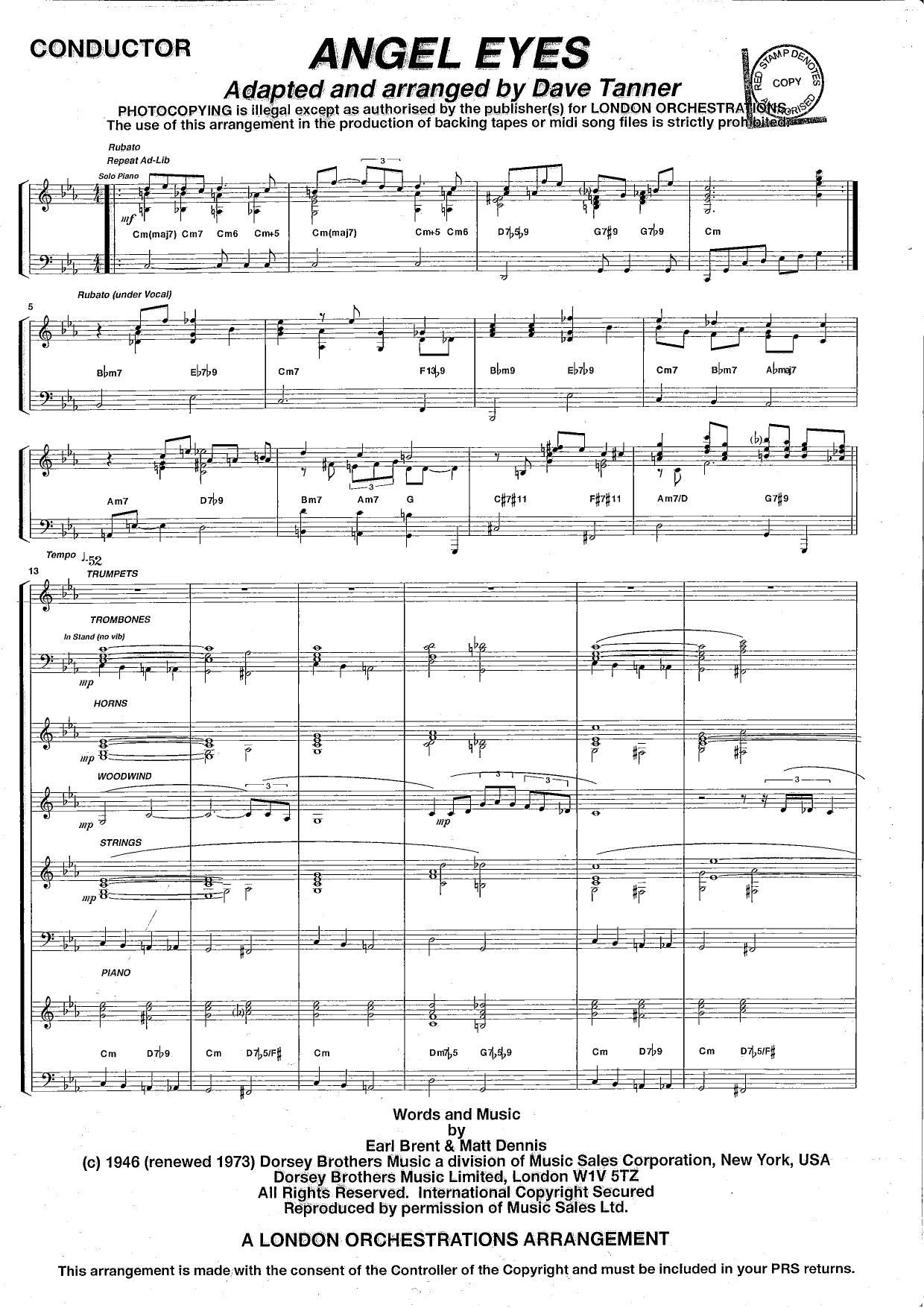
angel eyes(eric richards) sheet music preview

angel eyes(eric richards)

Composed by Matt Dennis

Arranged by eric richards

  • Ensemble: Big Band Vocal
  • Style: Jazz Standard
  • Pages: 29
  • Instruments (19): Vocal, Flute 1, Flute 2, Clarinet 1, Clarinet 2, Bass Clarinet, Trumpet 1 (on Flugel), Trumpet 2 (on Flugel), Trumpet 3 (on Flugel), Trumpet 4 (on Flugel), Trombone 1, Trombone 2, Trombone 3, Trombone 4, Keyboards 1 (Piano), Keyboards 2 (Strings), Guitar, Bass, Drums
  • Difficulty: medium
  • Content: Individual Parts
  • Format: PDF Download (Instant)
  • Price: $24.99

Composed by Matt Dennis with lyrics by Earl Brent, "Angel Eyes" emerged in 1946, quickly establishing itself as a quintessential jazz ballad. Its melancholic yet sophisticated harmonic progression and poignant lyrical narrative about lost love resonated deeply, making it a favorite among vocalists and instrumentalists alike. The song gained significant traction through iconic recordings by artists such as Frank Sinatra, whose 1958 Capitol version with Nelson Riddle's arrangement is particularly famous for its dramatic intensity and lush orchestration. Other notable interpretations by Chet Baker, Dave Brubeck, and Shirley Horn further cemented its status as a timeless standard, embodying the emotional depth and harmonic richness characteristic of the post-war jazz era. Its enduring appeal lies in its capacity for profound emotional expression, often explored through slow, reflective tempos and intricate melodic improvisation. Eric Richards' big band vocal arrangement of "Angel Eyes" masterfully reinterprets this classic, setting it in a medium-slow swing feel at approximately 80 BPM, primarily in the key of C minor. The arrangement immediately establishes a mood of introspective longing, beginning with a rubato piano introduction that sets a somber tone before the rhythm section ushers in a gentle, brushed swing. Richards' signature is evident in the sophisticated voicings, particularly in the brass and saxophones, which provide a rich, supportive bed for the vocalist without ever overwhelming. The arrangement maintains a delicate balance between ensemble power and intimate vocal delivery, allowing the emotional arc of the lyrics to unfold naturally. The vocal melody is carried by the soloist throughout the initial AABA form, supported by subtle, harmonically rich ensemble pads and counter-melodies. A standout feature is the instrumental interlude following the first vocal chorus, where Richards crafts a beautifully voiced saxophone soli that echoes the vocal melody, providing a moment of instrumental reflection before returning to the vocalist. This section showcases Richards' command of ensemble writing, with smooth lines and carefully placed dynamics. The arrangement includes a dedicated section for an improvised tenor saxophone solo, offering a chance for a band member to shine and contribute their interpretation to the narrative. Technical challenges include maintaining a consistent, relaxed swing feel at a slower tempo, precise articulation in the saxophone soli, and dynamic control, especially in balancing the ensemble with the vocalist. This arrangement is ideally suited for college, community, and professional big bands looking to feature a strong vocalist with a piece that offers both musical depth and emotional resonance. The nuanced scoring demands attention to detail from all sections, rewarding bands that can execute subtle dynamics and blend. The interplay between the vocalist and the meticulously crafted ensemble parts makes this a highly rewarding piece to perform, offering audiences a fresh yet respectful take on a beloved jazz standard. Approach this arrangement with a focus on lyrical phrasing and dynamic nuance. The medium-slow swing tempo (quarter note around 80 BPM) requires a relaxed yet propulsive feel from the rhythm section, emphasizing a light, brushed drum part and a walking bass line that breathes. Conductors should guide the ensemble to support the vocalist without overpowering, paying close attention to the carefully marked dynamics. The saxophone soli demands precise articulation and blend, ensuring a unified sound that maintains the melodic integrity. The improvised tenor saxophone solo should be encouraged to be expressive and harmonically informed. Brass players should use straight mutes for specific sections to achieve clarity and a focused tone, as indicated. Rehearsal time should be dedicated to balancing the vocal microphone with the ensemble, and to finessing the rubato introduction and the transition into the swing feel, ensuring a seamless and emotionally impactful opening. Q: What instruments and parts are included in this arrangement? A: This big band vocal arrangement includes parts for a vocalist, 5 saxophones (AATTB), 4 trumpets, 4 trombones, piano, bass, drums, and guitar. All standard big band instrumentation is covered. Q: What is the difficulty level of "angel eyes(eric richards)"? A: This arrangement is rated as medium-advanced. It requires proficient instrumentalists capable of executing sophisticated voicings, maintaining precise dynamics, and a vocalist with strong interpretive skills. Q: What is the musical style and historical context of "Angel Eyes"? A: "Angel Eyes" is a classic jazz standard composed in 1946 by Matt Dennis. It's a melancholic ballad typically performed in a medium-slow swing feel, embodying the harmonic and emotional depth of post-WWII jazz. Q: What makes Eric Richards' arrangement of "Angel Eyes" unique? A: Eric Richards' treatment is distinctive for its sophisticated voicings, a beautifully crafted saxophone soli interlude, and a balanced approach that supports the vocalist with rich harmonies while allowing for an improvised tenor saxophone solo. Q: What is the approximate performance duration and tempo for this arrangement? A: The approximate performance duration for this arrangement is 4-5 minutes, depending on the length of the improvised solo. It is set at a medium-slow swing tempo, around 80 beats per minute.

Questions and answers

What is included in the angel eyes(eric richards) PDF?
The verified current file contains a conductor score and individual parts across 29 pages.
How many instruments or parts are listed for angel eyes(eric richards)?
The verified instrumentation list contains 19 entries for this Big Band Vocal arrangement.
Who is credited for angel eyes(eric richards)?
Composer: Matt Dennis. Arranger: eric richards.
What difficulty is listed for angel eyes(eric richards)?
The verified difficulty level is medium.
What style is listed for angel eyes(eric richards)?
The catalog lists the style as Jazz Standard.
Can I preview angel eyes(eric richards) before buying?
Yes. The product page provides a preview generated from the current PDF file.
How is angel eyes(eric richards) delivered?
After successful payment, the digital PDF is made available for download. The displayed price is $24.99.

Musicians Also Search For

angel eyes eric richards PDFangel eyes eric richards sheet musicangel eyes arranged by eric richardseric richards big band vocal chartseric richards jazz arrangements PDFangel eyes Matt Dennis sheet musicangel eyes Matt Dennis big band vocal arrangementsMatt Dennis big band vocal chartsangel eyes big band vocal arrangementsangel eyes big band vocal PDF downloadangel eyes jazz sheet musicbig band vocal sheet music downloadangel eyes conductor score PDFangel eyes individual parts downloadangel eyes sheet music PDFangel eyes Jazz Standard chartsJazz Standard big band vocal arrangementsbuy angel eyes sheet musicdownload angel eyes PDFangel eyes jazz chartsbest eric richards big band vocal arrangementsMatt Dennis arranged by eric richardsangel eyes printable sheet musicbig band vocal repertoire PDF

All arrangements by eric richards All Matt Dennis sheet music