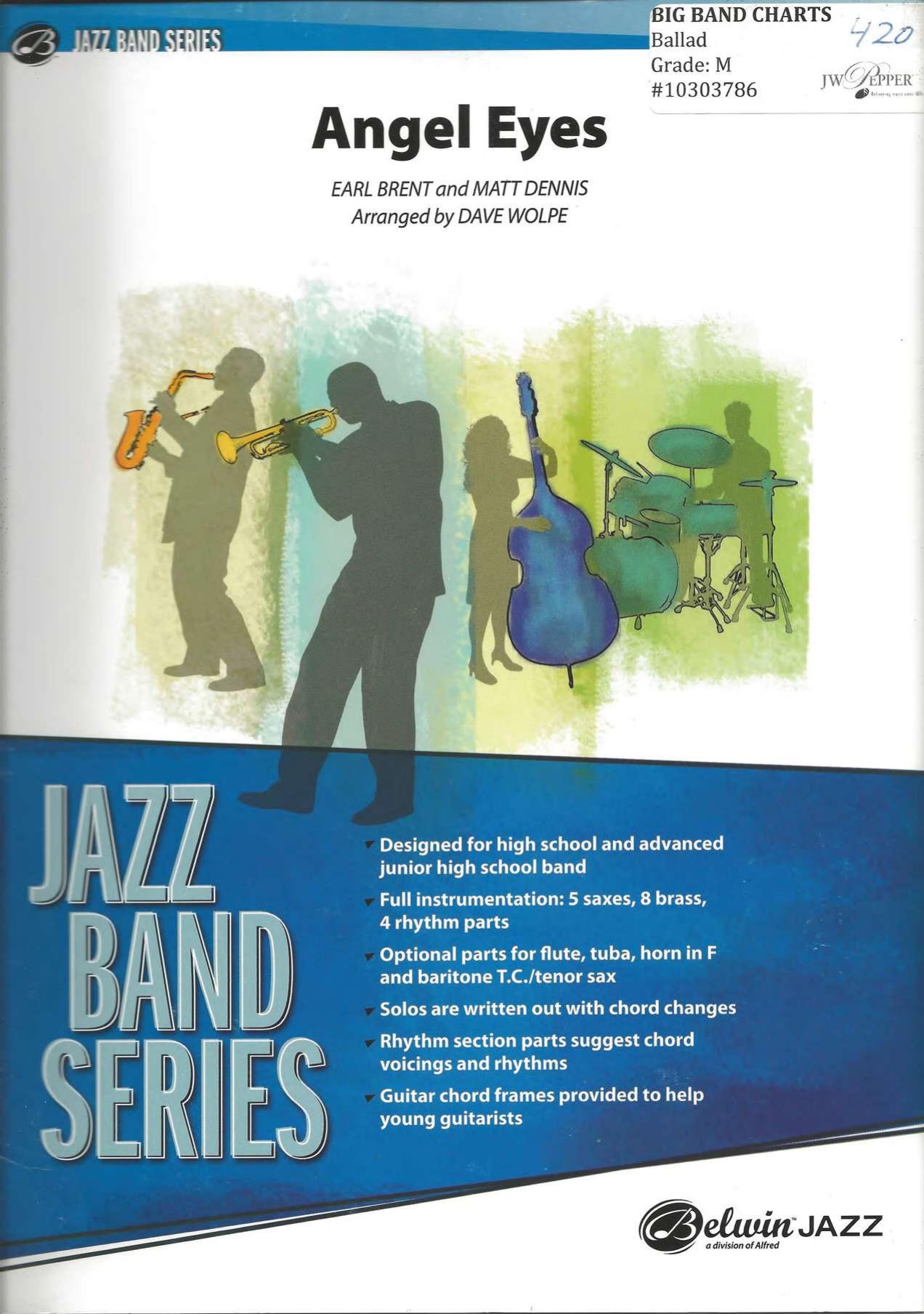
Angel Eyes (D.Wolpe)
Composed by Matt Dennis
Arranged by Dave Wolpe
- Ensemble: Big Band
- Pages: 60
- Instruments (24): Conductor, 1st Eb Alto Saxophone, 2nd Eb Alto Saxophone, 1st Bb Tenor Saxophone, 2nd Bb Tenor Saxophone, Eb Baritone Saxophone, 1st Bb Trumpet, 2nd Bb Trumpet, 3rd Bb Trumpet, 4th Bb Trumpet, 1st Trombone, 2nd Trombone, 3rd Trombone, Bass Trombone, Guitar, Piano, Bass, Drums, C Flute, Horn in F, 1st Baritone T.C./Bb Tenor Saxophone, 2nd Baritone T.C./Bb Tenor Saxophone, 3rd Baritone T.C./Bb Tenor Saxophone, Tuba
- Difficulty: advanced
- Content: Individual Parts
- Format: PDF Download (Instant)
- Price: $24.99
Composed in 1946 by Matt Dennis with lyrics by Earl Brent, "Angel Eyes" stands as one of the most haunting and enduring torch ballads in the Great American Songbook. Immortalized by legendary recordings from Frank Sinatra, Ella Fitzgerald, and the Dave Brubeck Quartet, this quintessential standard defines the smoky, nocturnal atmosphere of post-war jazz. Its sophisticated harmonic structure—featuring deceptive cadences and a melancholy minor-mode aesthetic—has made it a vehicle of choice for vocalists and instrumentalists seeking to convey deep emotional resonance and late-night introspection. Dave Wolpe’s magnificent big band arrangement captures the quintessential mood of the genre, treating the ensemble to a lush, slow-swing ballad feel set in a warm, expressive key. The emotional landscape is heavy with yearning and sophisticated melancholy, driven by rich, rolling harmonic textures in the brass and cascading woodwind lines. Wolpe avoids rushing the sentiment, instead allowing the tempo to breathe with a relaxed, pulsing 4/4 meter that relies on subtle rubato-esque phrasing within a strict rhythmic framework to maximize tension and release. Renowned for his idiomatic, hard-swinging yet accessible writing style, Dave Wolpe crafts an arrangement that highlights the full dynamic palette of a standard 20-piece jazz orchestra. The saxophones carry much of the early thematic material in lush, tightly voiced solis that showcase Wolpe’s mastery of Johnny Mandel-esque coloring, while the muted trumpets and warm trombones provide a velvety harmonic cushion. A standout feature of the chart is its deft redistribution of the melody between sections, culminating in a restrained, highly emotive shout chorus that builds intensity through harmonic expansion rather than sheer volume, avoiding over-orchestration to preserve the intimacy of the original composition. Advanced high school, collegiate, and professional community big bands will find this chart an exceptional vehicle for developing stylistic maturity, section blending, and expressive control. While the technical demands regarding rapid execution are low, the intellectual and artistic demands are high, requiring exceptional intonation, breath support, and dynamic restraint from every player. The arrangement includes featured solo space for an expressive instrumentalist—typically tenor saxophone or piano—allowing a featured soloist to shine against a rich background of shimmering ensemble harmonies, making it a powerful centerpiece for any sophisticated jazz concert program. Conductors should approach Dave Wolpe’s arrangement of "Angel Eyes" with a primary focus on time feel, intonation, and dynamic subtlety. The tempo must remain steady yet flexible, embodying a relaxed, laid-back slow swing where eighth notes are characteristically weighted rather than overly rushed. Achieving a professional sound requires the saxophone section to focus intensely on balance and blend during the dense, harmonically rich soli passages. Brass players must utilize cup or harmon mutes where indicated, ensuring that muted sections blend smoothly without sounding shrill or piercing. Rehearsal should prioritize listening across sections; because the arrangement relies heavily on chordal suspensions and slow resolutions, minor pitch discrepancies will immediately cloud the lush harmonic colors Wolpe has constructed. Encourage the featured soloist to lean into the blues-inflected minor tonalities of the changes, utilizing space and lyrical phrasing rather than dense, fast-running lines to match the nocturnal, reflective character of the chart. Q: What instrumentation and parts are included in this publication? A: This 60-page publication includes a complete 20-instrument big band instrumentation featuring Alto Saxophone 1, Alto Saxophone 2, Tenor Saxophone 1, Tenor Saxophone 2, Baritone Saxophone, 4 Trumpets, 4 Trombones, Guitar, Piano, Bass, Drums, and a comprehensive conductor score. Q: What is the difficulty level of this Dave Wolpe arrangement? A: This arrangement is graded as medium (suitable for advanced high school, collegiate, and professional community big bands), requiring mature ensemble balance, blend, and expressive ballad control rather than extreme technical velocity. Q: What is the musical style and historical background of "Angel Eyes"? A: Originally composed by Matt Dennis in 1946 with lyrics by Earl Brent, this piece is a classic jazz and pop standard epitomizing the melancholic, late-night torch ballad tradition famously interpreted by icons like Frank Sinatra and Ella Fitzgerald. Q: What makes this specific arrangement by Dave Wolpe unique? A: Wolpe's chart stands out for its rich, sophisticated harmonic voicings, lush woodwind solis, and a carefully controlled, emotive shout chorus that builds dramatic intensity through harmonic expansion while preserving the intimate mood of the original song. Q: What is the performance duration and tempo feel of the arrangement? A: The arrangement is written as a slow, expressive swing ballad in 4/4 time, with a typical performance duration of approximately 4 to 5 minutes depending on the length of the improvised solo choruses.
Questions and answers
- What is included in the Angel Eyes (D.Wolpe) PDF?
- The verified current file contains a conductor score and individual parts across 60 pages.
- How many instruments or parts are listed for Angel Eyes (D.Wolpe)?
- The verified instrumentation list contains 24 entries for this Big Band arrangement.
- Who is credited for Angel Eyes (D.Wolpe)?
- Composer: Matt Dennis. Arranger: Dave Wolpe.
- What difficulty is listed for Angel Eyes (D.Wolpe)?
- The verified difficulty level is advanced.
- Can I preview Angel Eyes (D.Wolpe) before buying?
- Yes. The product page provides a preview generated from the current PDF file.
- How is Angel Eyes (D.Wolpe) delivered?
- After successful payment, the digital PDF is made available for download. The displayed price is $24.99.
Musicians Also Search For
Angel Eyes Dave Wolpe PDF • Angel Eyes Dave Wolpe sheet music • Angel Eyes arranged by Dave Wolpe • Dave Wolpe big band charts • Dave Wolpe jazz arrangements PDF • Angel Eyes Matt Dennis sheet music • Angel Eyes Matt Dennis big band arrangements • Matt Dennis big band charts • Angel Eyes big band arrangements • Angel Eyes big band PDF download • Angel Eyes jazz sheet music • big band sheet music download • Angel Eyes conductor score PDF • Angel Eyes individual parts download • Angel Eyes sheet music PDF • buy Angel Eyes sheet music • download Angel Eyes PDF • Angel Eyes jazz charts • best Dave Wolpe big band arrangements • Matt Dennis arranged by Dave Wolpe • Angel Eyes printable sheet music • big band repertoire PDF