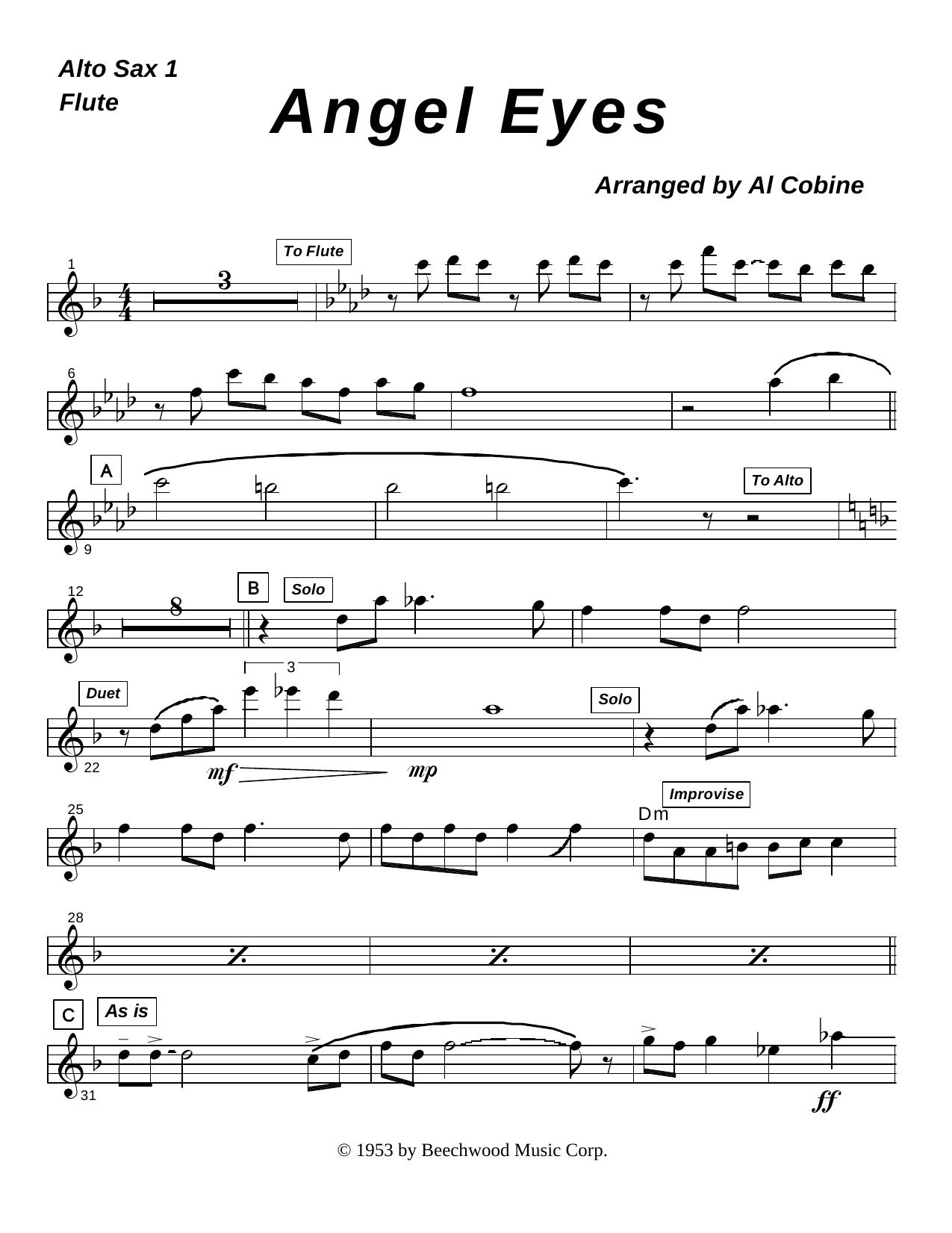
Angel Eyes (A.Cobine)
Composed by Matt Dennis
Arranged by Al Cobine
- Ensemble: Big Band
- Style: Jazz Standard
- Pages: 44
- Instruments (20): Alto Sax 1, Flute, Alto Sax 2, Bb Clarinet, Tenor Sax 1, Tenor Sax 2, Baritone Sax, Trumpet 1, Fluegel Horn, Trumpet 2, Trumpet 3, Trumpet 4, Trombone 1, Trombone 2, Trombone 3, Trombone 4, Guitar, Piano, Bass, Drums
- Difficulty: medium
- Content: Individual Parts
- Format: PDF Download (Instant)
- Price: $24.99
"Angel Eyes," penned by Matt Dennis in 1946, emerged from the golden age of American popular song, quickly establishing itself as a poignant jazz standard. Its melancholic melody and sophisticated harmonic progression perfectly encapsulate the bittersweet romance and late-night introspection often associated with the film noir era. While initially introduced by Dennis himself, it was Frank Sinatra's iconic 1958 recording for his album "Only the Lonely" that cemented its status, transforming it into an anthem for the lovelorn and the lonely. The song's enduring appeal lies in its evocative lyrics and the way its minor key tonality and descending bass lines create a sense of yearning and introspection, making it a staple for countless vocalists and instrumentalists seeking to convey deep emotional resonance. Al Cobine's masterful big band arrangement of "Angel Eyes" reimagines this classic ballad with a distinctly lush and sophisticated sound. Set at a **slow, reflective ballad tempo** in 4/4, the arrangement maintains the original's melancholic mood while elevating it with rich, contemporary big band voicings. Cobine's signature is evident in his meticulous attention to harmonic detail, employing extended chords and subtle inner voice movement that add depth and color without obscuring the melody. The piece opens with a beautifully voiced saxophone choir, setting the somber tone before the melody is introduced, typically carried by a lead alto or trumpet, often doubled for warmth. Performance of this arrangement offers numerous rewarding moments and specific challenges. The melody is initially presented with understated elegance, allowing the band to establish the emotional landscape. Cobine frequently utilizes **layered voicings** across the brass and saxophone sections, creating a tapestry of sound that swells and recedes dynamically. There are opportunities for featured solos, typically for a tenor saxophone or trumpet, providing a platform for expressive improvisation over the rich harmonic changes. The technical demands primarily revolve around achieving a cohesive ensemble sound, particularly in the sustained chords and delicate dynamic shifts required for a convincing ballad performance. The brass sections will need precise intonation and controlled vibrato, while the saxophones must blend seamlessly. The rhythm section is crucial in maintaining the slow, steady pulse and providing subtle harmonic support, allowing the melody and ensemble passages to breathe. This arrangement is ideally suited for **college, community, and professional big bands** that possess a strong command of ensemble blend, intonation, and dynamic control. While not overtly technically challenging in terms of rapid passages, its difficulty lies in its musicality and the need for mature interpretation. Bands capable of conveying deep emotion through sound and executing sophisticated voicings with precision will find this a highly rewarding and impactful addition to their repertoire, perfect for showcasing the band's expressive capabilities and offering a sophisticated take on a beloved jazz standard. To truly capture the essence of Al Cobine's "Angel Eyes," prioritize a **slow, deliberate ballad tempo** around quarter note = 60-66, emphasizing a relaxed, flowing feel rather than a rigid pulse. The primary technical challenge lies in achieving seamless blend and impeccable intonation, especially within the sustained, often dense, voicings. Encourage brass players to use controlled vibrato and saxophones to match tone colors meticulously. Dynamics are paramount; practice the subtle crescendos and decrescendos, particularly in the ensemble swells, to build and release tension effectively. There are no special techniques like plunger mutes or falls indicated, focusing instead on pure tone and expressive phrasing. For rehearsal, isolate challenging harmonic passages and practice them slowly, ensuring each voice is heard and contributes to the overall chord. Emphasize listening across sections to achieve maximum blend and emotional impact. Q: What instruments are included in this arrangement of "Angel Eyes"? A: This is a standard big band arrangement for 17 instruments, including Alto Saxophone 1 & 2, Tenor Saxophone 1 & 2, Baritone Saxophone, Trumpet 1-4, Trombone 1-4, Piano, Bass, and Drums. Q: What is the difficulty level of this arrangement? A: This arrangement is rated as **Medium-Advanced**. While not featuring extremely fast tempos or complex rhythmic figures, it demands mature musicality, excellent ensemble blend, precise intonation, and dynamic control, making it suitable for college, community, and professional big bands. Q: What is the musical style and historical context of "Angel Eyes"? A: "Angel Eyes" is a classic jazz standard from 1946, embodying the melancholic and sophisticated ballad style of the post-WWII era. It's renowned for its poignant melody and rich harmonic progression. Q: What makes Al Cobine's arrangement of "Angel Eyes" unique? A: Cobine's arrangement is distinguished by its lush, contemporary big band voicings, sophisticated harmonic extensions, and meticulous attention to dynamic shaping, which elevate the original ballad with a rich, expressive sound perfect for a modern ensemble. Q: What is the typical performance duration and tempo for this piece? A: Performed at a slow ballad tempo (around quarter note = 60-66), this arrangement typically has a performance duration of approximately 4 to 5 minutes, depending on the length of any improvised solos.
Questions and answers
- What is included in the Angel Eyes (A.Cobine) PDF?
- The verified current file contains individual parts across 44 pages.
- How many instruments or parts are listed for Angel Eyes (A.Cobine)?
- The verified instrumentation list contains 20 entries for this Big Band arrangement.
- Who is credited for Angel Eyes (A.Cobine)?
- Composer: Matt Dennis. Arranger: Al Cobine.
- What difficulty is listed for Angel Eyes (A.Cobine)?
- The verified difficulty level is medium.
- What style is listed for Angel Eyes (A.Cobine)?
- The catalog lists the style as Jazz Standard.
- Can I preview Angel Eyes (A.Cobine) before buying?
- Yes. The product page provides a preview generated from the current PDF file.
- How is Angel Eyes (A.Cobine) delivered?
- After successful payment, the digital PDF is made available for download. The displayed price is $24.99.
Musicians Also Search For
Angel Eyes Al Cobine PDF • Angel Eyes Al Cobine sheet music • Angel Eyes arranged by Al Cobine • Al Cobine big band charts • Al Cobine jazz arrangements PDF • Angel Eyes Matt Dennis sheet music • Angel Eyes Matt Dennis big band arrangements • Matt Dennis big band charts • Angel Eyes big band arrangements • Angel Eyes big band PDF download • Angel Eyes jazz sheet music • big band sheet music download • Angel Eyes individual parts download • Angel Eyes sheet music PDF • Angel Eyes Jazz Standard charts • Jazz Standard big band arrangements • buy Angel Eyes sheet music • download Angel Eyes PDF • Angel Eyes jazz charts • best Al Cobine big band arrangements • Matt Dennis arranged by Al Cobine • Angel Eyes printable sheet music • big band repertoire PDF