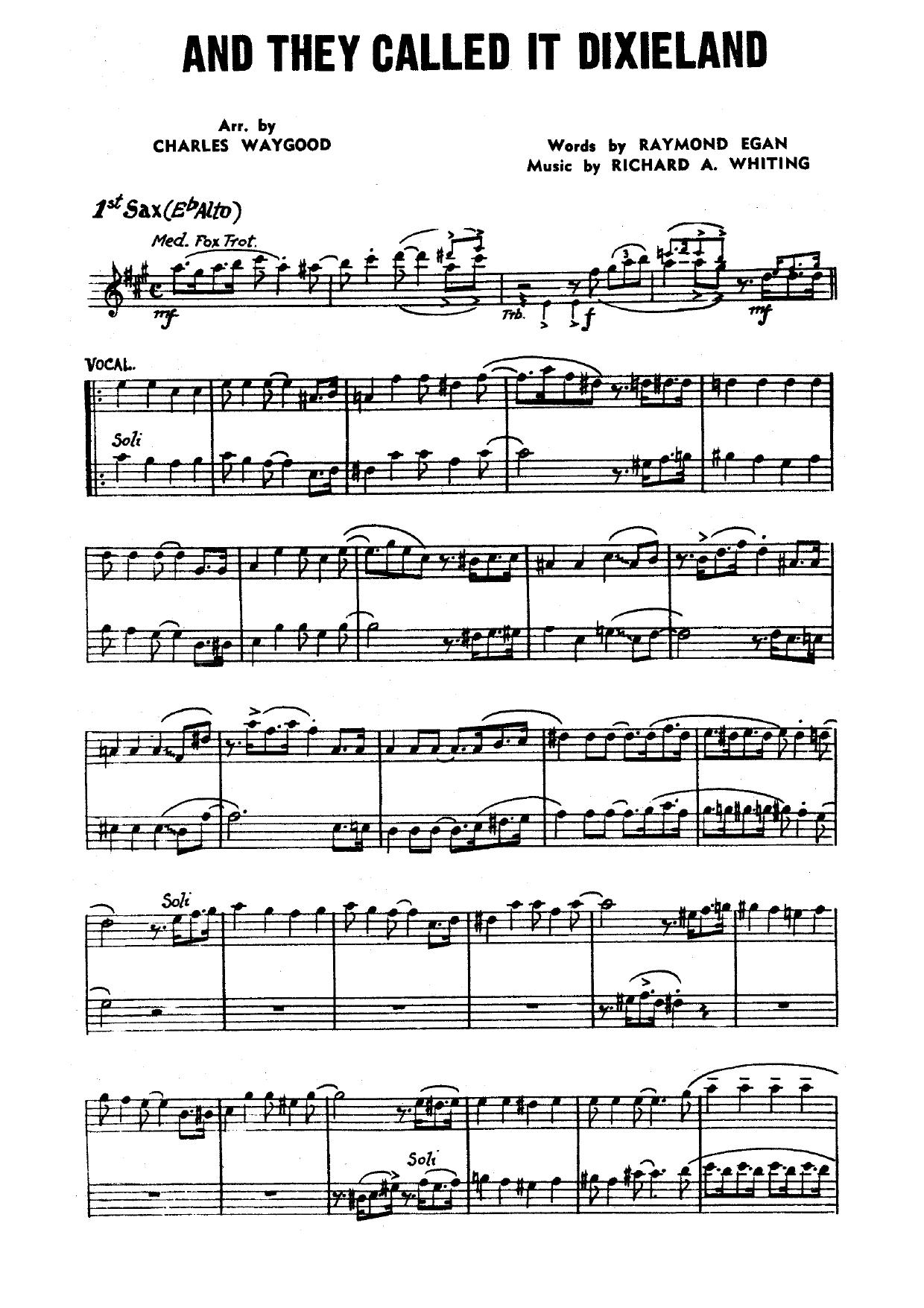
And They Called It Dixieland (R.Whiting)
Composed by Richard Whiting
Arranged by R.Whiting
- Ensemble: Big Band
- Pages: 26
- Instruments (18): 1st Eb Alto Sax, 3rd Eb Alto Sax, 2nd Bb Tenor Sax, Clarinet, 4th Bb Tenor Sax, 1st Bb Trumpet, 2nd Bb Trumpet, 3rd Bb Trumpet, 1st Trombone, 2nd Trombone, Piano, Piano Accordion Guide, Bass, Drums, Guitar, 1st Violin, C Melody Sax, Flute
- Difficulty: medium
- Content: Individual Parts
- Format: PDF Download (Instant)
- Price: $24.99
Richard Whiting’s timeless composition "And They Called It Dixieland" captures the infectious vitality and melodic charm of the 1920s Tin Pan Alley era, bridging traditional early jazz idioms with the sophisticated arranging techniques of the emerging big band age. Originally conceived during a golden age of American popular song when Whiting was churning out indelible standards, this tune celebrates the roots of southern-born syncopated music with a sophisticated harmonic palette. While traditional Dixieland numbers often relied on collective polyphonic improvisation, this expansive big band adaptation honors that spirited heritage through tightly knit, section-driven counterpoint and driving rhythmic propulsion that reimagines front-line polyphony for a full reed and brass section. Driving forward with a bright, buoyant medium-up swing feel in 4/4 time, the arrangement radiates an irresistible, foot-tapping energy. The emotional landscape is unapologetically joyful and nostalgic, evoking smoky speakeasies, roaring twenties dance halls, and the celebratory spirit of early jazz revues. The chart opens with a sparkling introductory fanfare that immediately establishes the buoyant tempo before yielding to a dynamic vocal feature. Throughout the chart, the harmonic language balances diatonic sweetness with clever secondary dominants and chromatic passing chords, giving the classic melody a richer, more polished texture without sacrificing its populist appeal. The arranger utilizes a classic big band framework to keep the narrative engaging from the downbeat to the final tag. Following the vocal presentation of the primary theme, the arrangement features tightly woven saxophone solis that showcase crisp articulation and nimble fingerwork, demanding absolute precision from the reed section. Brass sections trade punchy, staccato punctuations with warm, sustained pads, building tension organically toward a rousing, high-energy shout chorus. This climactic section integrates dynamic peaks and rhythmic cross-accents, providing the entire ensemble with an opportunity to dig into heavy swing grooves and project a room-filling wall of sound before pulling back for a cheeky, quintessential big band ending. Advanced high school ensembles, collegiate jazz orchestras, and professional community big bands will find this chart an ideal balance of crowd-pleasing entertainment and technical refinement. The 18-instrument orchestration requires a capable vocalist comfortable with vintage phrasing, alongside a rhythm section that can maintain an unwavering, buoyant pocket. While the individual wind parts are accessible for developing players with solid reading skills, the true test—and reward—lies in achieving uniform articulation, authentic swing phrasing, and dynamic balance across the entire ensemble. Success with "And They Called It Dixieland" hinges on maintaining an energetic, forward-moving medium-up swing tempo without rushing. Conductors should emphasize the distinct difference between dotted-eighth-and-sixteenth figures and triplet-based swing feels; the articulation must remain crisp, light, and buoyant rather than heavy or dragged. The rhythm section is the engine here: the bassist should walk a steady, acoustic-style quarter-note line with emphasis on beats two and four, while the drummer keeps a crisp ride cymbal pattern alive with appropriate hi-hat chokes on two and four. Brass players should utilize subtle plunger mutes or cup mutes where indicated to capture that authentic early-jazz color, ensuring falls and doits are executed with stylistic taste rather than raw volume. Rehearsal time should be heavily invested in the saxophone soli, ensuring the inner voices blend seamlessly under the lead alto, and balancing the vocal soloist dynamically against a full ensemble blasting through the shout chorus. Q: What instruments and specific parts are included in this arrangement? A: The 18-instrument orchestration includes a dedicated Vocal part, Alto Saxophone 1, Alto Saxophone 2, Tenor Saxophone 1, plus standard big band instrumentation spanning the full reed, brass, and rhythm sections across a comprehensive 26-page score and part set. Q: What is the overall difficulty level of this chart? A: This arrangement is well-suited for advanced high school, collegiate, and professional community big bands, presenting moderate technical demands in the wind sections while prioritizing stylistic cohesion, articulation, and ensemble blend. Q: What is the musical style and historical context of "And They Called It Dixieland"? A: Composed by Richard Whiting, the piece represents the vibrant intersection of 1920s Tin Pan Alley songwriting and classic big band swing, channeling early jazz enthusiasm through a polished, arranged orchestral framework. Q: What makes this specific arrangement unique? A: It brilliantly translates the polyphonic spirit of early Dixieland combo playing into a modern big band language, featuring clever section writing, a prominent vocal feature, dynamic contrast, and a roaring shout chorus. Q: What is the recommended performance tempo and duration? A: The chart is designed for a bright, energetic medium-up swing tempo (approximately quarter note = 160–168 BPM), resulting in a performance duration of roughly 3 to 4 minutes depending on solo extensions and vamp choices.
Questions and answers
- What is included in the And They Called It Dixieland (R.Whiting) PDF?
- The verified current file contains individual parts across 26 pages.
- How many instruments or parts are listed for And They Called It Dixieland (R.Whiting)?
- The verified instrumentation list contains 18 entries for this Big Band arrangement.
- Who is credited for And They Called It Dixieland (R.Whiting)?
- Composer: Richard Whiting. Arranger: R.Whiting.
- What difficulty is listed for And They Called It Dixieland (R.Whiting)?
- The verified difficulty level is medium.
- Can I preview And They Called It Dixieland (R.Whiting) before buying?
- Yes. The product page provides a preview generated from the current PDF file.
- How is And They Called It Dixieland (R.Whiting) delivered?
- After successful payment, the digital PDF is made available for download. The displayed price is $24.99.
Musicians Also Search For
And They Called It Dixieland R.Whiting PDF • And They Called It Dixieland R.Whiting sheet music • And They Called It Dixieland arranged by R.Whiting • R.Whiting big band charts • R.Whiting jazz arrangements PDF • And They Called It Dixieland Richard Whiting sheet music • And They Called It Dixieland Richard Whiting big band arrangements • Richard Whiting big band charts • And They Called It Dixieland big band arrangements • And They Called It Dixieland big band PDF download • And They Called It Dixieland jazz sheet music • big band sheet music download • And They Called It Dixieland individual parts download • And They Called It Dixieland sheet music PDF • buy And They Called It Dixieland sheet music • download And They Called It Dixieland PDF • And They Called It Dixieland jazz charts • best R.Whiting big band arrangements • Richard Whiting arranged by R.Whiting • And They Called It Dixieland printable sheet music • big band repertoire PDF