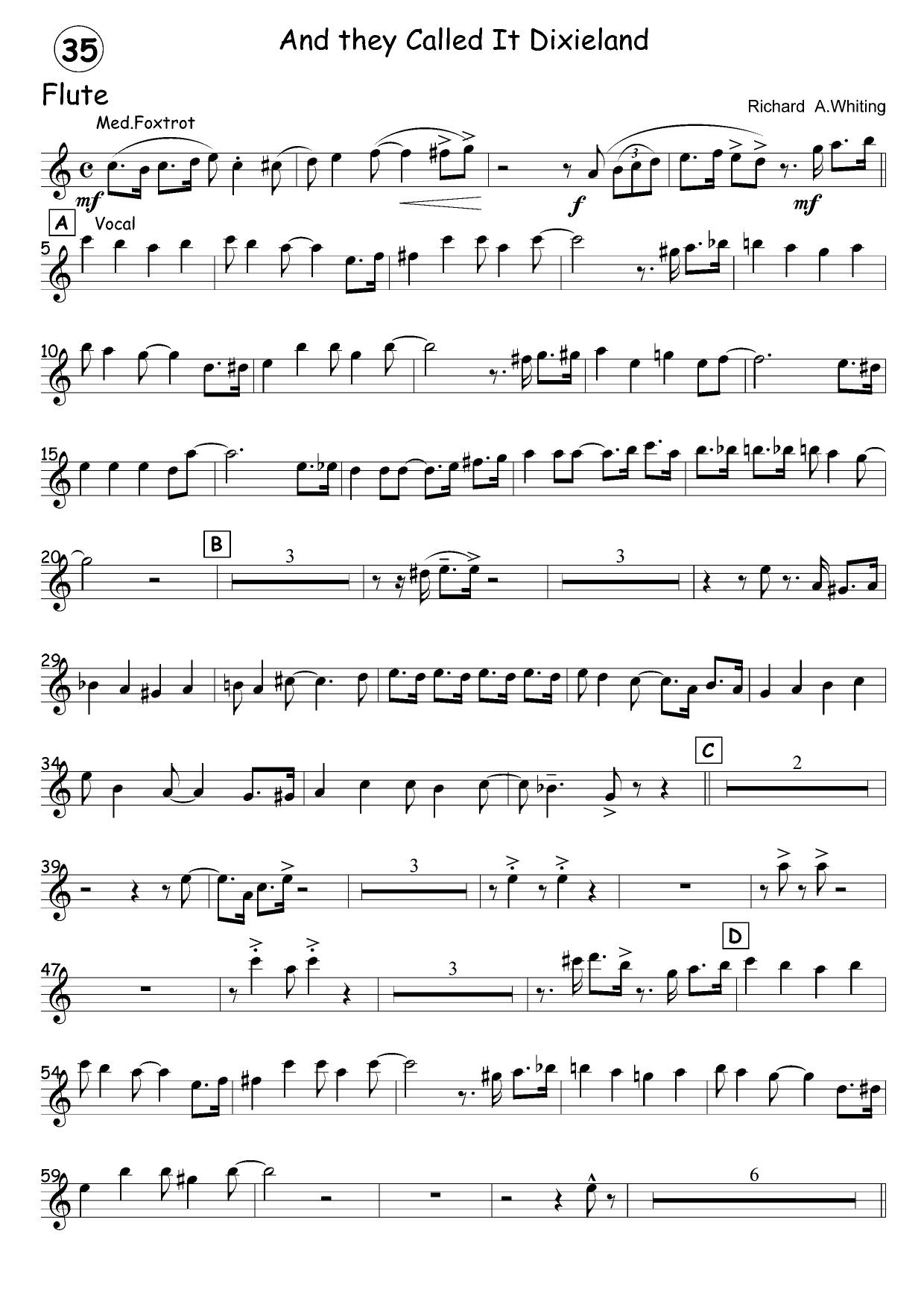
And They Called It Dixieland - Richard Whiting (R.Whiting)
Composed by Richard A. Whiting
Arranged by Richard Whiting
- Ensemble: Concert Band
- Style: Dixieland
- Pages: 65
- Instruments (28): Flute, Oboe, Clarinet-1, Bb Clarinet-2, Clarinet-3, Bass Clarinet, Alto Saxophone-1, Alto Saxophone-2, Tenor Saxophone, Baritone Saxophone, Soprano Cornet, Trumpet-1, Trumpet-2, Trumpet-3, Eb Horn-1, Eb Horn-2, F Horn-1, F Horn-2, Trombone-1, Trombone-2, Trombone-2 T.C., Euphonium, Euphonium (T.C.), Bb Bass, Eb Bass, Electric Bass, Tuba, Drums
- Difficulty: advanced
- Content: Individual Parts
- Format: PDF Download (Instant)
- Price: $22.99
"And They Called It Dixieland," originally penned by the prolific Richard A. Whiting, stands as a vibrant tribute to the foundational era of jazz. Composed in the early 20th century, this piece encapsulates the joyous, freewheeling spirit of Dixieland jazz, a style that emerged from New Orleans in the 1910s and 20s, laying the groundwork for much of what we recognize as jazz today. While the original composition itself might not be a household name in the same vein as some later standards, its composer, Richard A. Whiting, was a significant figure, responsible for numerous popular songs of the era, many of which became Tin Pan Alley hits and were recorded by major artists. This particular piece, with its evocative title, serves as a quintessential example of the genre's characteristic exuberance, collective improvisation feel, and infectious melodicism, making it a valuable historical and musical touchstone. Richard Whiting's concert band arrangement of "And They Called It Dixieland" masterfully captures the authentic essence of this early jazz style. The musical character is decidedly upbeat and celebratory, typically performed at a bright, medium-up tempo with a driving 2-beat feel that propels the piece forward. While the original Dixieland ensembles were smaller and more improvisational, Whiting's arrangement translates this energy effectively to the larger concert band format. Expect a bright, major key tonality, likely C or G major, contributing to its inherently cheerful mood. The arrangement prioritizes clarity and stylistic authenticity, ensuring that the characteristic Dixieland polyphony—where multiple melodic lines intertwine—is both present and accessible for a larger ensemble. Whiting's distinctive approach to this arrangement is evident in his thoughtful voicings and the strategic deployment of the concert band's diverse timbres to mimic the original small-group feel. He skillfully assigns melodic fragments and counter-melodies to various sections, creating a rich tapestry of sound that evokes the collective improvisation of traditional Dixieland. While true improvisation is often left to individual soloists in smaller groups, Whiting's arrangement provides written-out soli sections for woodwinds and brass that emulate this spontaneous interplay, offering a rewarding challenge for section leaders. The melody is often carried by the clarinets and trumpets, with robust trombone lines providing harmonic and rhythmic support. There are specific moments, such as a well-crafted shout chorus, where the full ensemble unites in a powerful, joyful statement, culminating in a spirited finale. Technically, the piece demands crisp articulation, precise rhythmic execution, and a strong sense of ensemble blend, particularly in the interwoven melodic lines. This arrangement is ideally suited for high school, college, and community concert bands looking to explore the roots of jazz in a structured, yet spirited, setting. It offers an engaging performance experience that is both historically informative and immensely fun to play. Conductors should aim for a bright, consistent tempo around quarter note = 120-132, emphasizing a crisp 2-beat feel in the bass and tuba parts to establish the Dixieland groove. Articulation is paramount; encourage short, detached notes in the brass and woodwinds, especially in the rhythmic accompaniment figures, to maintain buoyancy. Pay close attention to the balance in the polyphonic sections, ensuring that no single voice overpowers the others, allowing the intertwining melodies to shine through. The written soli passages require careful rehearsal to achieve a unified, yet stylistically authentic, "collective improvisation" sound. Encourage brass players to use plunger or cup mutes in designated sections to achieve the characteristic "wa-wa" effects, adding to the period authenticity. Rehearsal time should be dedicated to rhythmic precision, particularly in the syncopated figures, and to developing a unified approach to stylistic interpretation, focusing on the joyous and energetic mood inherent in Dixieland. Q: What instruments/parts are included in this arrangement? A: This arrangement for concert band typically includes a full complement of standard concert band instrumentation, such as flutes, oboes, clarinets (Bb, bass), saxophones (alto, tenor, baritone), trumpets, French horns, trombones, euphonium, tuba, and percussion. The 65 pages include a comprehensive conductor score. Q: What is the difficulty level of this arrangement? A: This arrangement is generally considered suitable for intermediate to advanced high school, college, and community concert bands. It presents challenges in articulation, rhythmic precision, and ensemble balance, making it rewarding for groups with solid fundamental skills. Q: What style of jazz does "And They Called It Dixieland" represent, and what is its historical context? A: This piece is a quintessential example of Dixieland jazz, an early form of jazz that originated in New Orleans in the early 20th century. It is characterized by its upbeat tempo, collective improvisation feel, and a strong melodic focus, reflecting the celebratory music of that era. Q: What makes Richard Whiting's arrangement of "And They Called It Dixieland" unique? A: Richard Whiting's arrangement is unique for its ability to translate the intimate, improvisational nature of Dixieland jazz to the larger concert band format. It features thoughtful voicings, written-out soli sections that emulate collective improvisation, and a vibrant shout chorus, all while maintaining stylistic authenticity. Q: What is the typical performance duration or tempo for this piece? A: The typical performance duration for "And They Called It Dixieland" is approximately 3-4 minutes. It is generally performed at a bright, medium-up tempo, around quarter note = 120-132, with a driving 2-beat feel.
Questions and answers
- What is included in the And They Called It Dixieland - Richard Whiting (R.Whiting) PDF?
- The verified current file contains a conductor score and individual parts across 65 pages.
- How many instruments or parts are listed for And They Called It Dixieland - Richard Whiting (R.Whiting)?
- The verified instrumentation list contains 28 entries for this Concert Band arrangement.
- Who is credited for And They Called It Dixieland - Richard Whiting (R.Whiting)?
- Composer: Richard A. Whiting. Arranger: Richard Whiting.
- What difficulty is listed for And They Called It Dixieland - Richard Whiting (R.Whiting)?
- The verified difficulty level is advanced.
- What style is listed for And They Called It Dixieland - Richard Whiting (R.Whiting)?
- The catalog lists the style as Dixieland.
- Can I preview And They Called It Dixieland - Richard Whiting (R.Whiting) before buying?
- Yes. The product page provides a preview generated from the current PDF file.
- How is And They Called It Dixieland - Richard Whiting (R.Whiting) delivered?
- After successful payment, the digital PDF is made available for download. The displayed price is $22.99.
Musicians Also Search For
And They Called It Dixieland - Richard Whiting Richard Whiting PDF • And They Called It Dixieland - Richard Whiting Richard Whiting sheet music • And They Called It Dixieland - Richard Whiting arranged by Richard Whiting • Richard Whiting concert band charts • Richard Whiting jazz arrangements PDF • And They Called It Dixieland - Richard Whiting Richard A. Whiting sheet music • And They Called It Dixieland - Richard Whiting Richard A. Whiting concert band arrangements • Richard A. Whiting concert band charts • And They Called It Dixieland - Richard Whiting concert band arrangements • And They Called It Dixieland - Richard Whiting concert band PDF download • And They Called It Dixieland - Richard Whiting jazz sheet music • concert band sheet music download • And They Called It Dixieland - Richard Whiting conductor score PDF • And They Called It Dixieland - Richard Whiting individual parts download • And They Called It Dixieland - Richard Whiting sheet music PDF • And They Called It Dixieland - Richard Whiting Dixieland charts • Dixieland concert band arrangements • buy And They Called It Dixieland - Richard Whiting sheet music • download And They Called It Dixieland - Richard Whiting PDF • And They Called It Dixieland - Richard Whiting jazz charts • best Richard Whiting concert band arrangements • Richard A. Whiting arranged by Richard Whiting • And They Called It Dixieland - Richard Whiting printable sheet music • concert band repertoire PDF