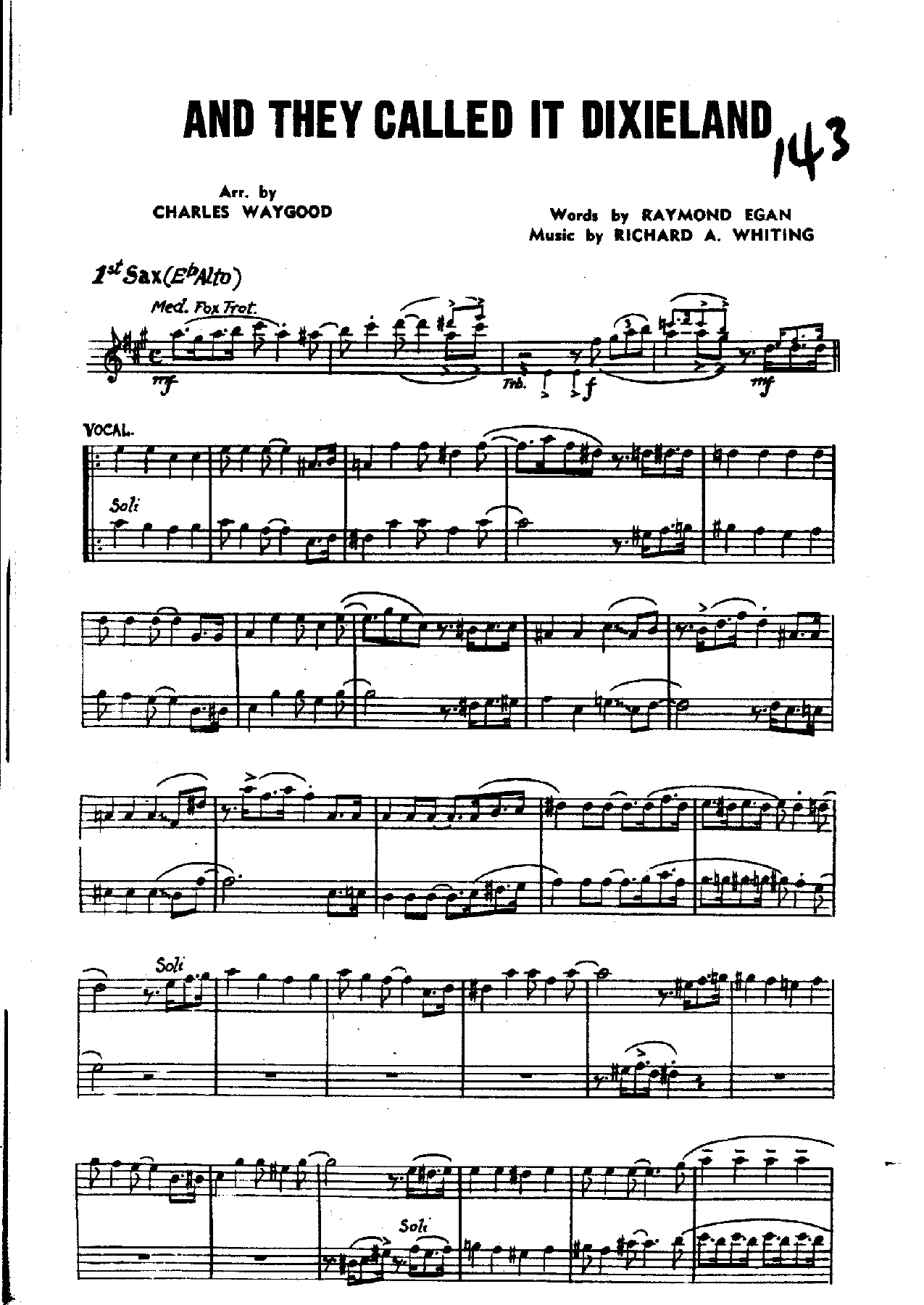
And They Call It Dixieland (C.Waygood)
Composed by C. Waygood
Arranged by C.Waygood
- Ensemble: Dixieland Band
- Style: Jazz Standard
- Pages: 15
- Instruments (8): 1st Eb Alto Saxophone, 1st Bb Trumpet, 2nd Bb Tenor Saxophone or Clarinet, 1st Trombone, Piano and Piano Accordion Guide, Guitar, Drums, Bass
- Difficulty: easy
- Content: Individual Parts
- Format: PDF Download (Instant)
- Price: $18.99
"And They Call It Dixieland," originally composed by Richard A. Whiting and Raymond B. Egan in 1916, stands as a quintessential early 20th-century popular song that quickly became emblematic of the burgeoning Dixieland jazz style. Born from the vibrant musical melting pot of New Orleans, Dixieland jazz itself emerged around the turn of the 20th century, drawing influences from ragtime, blues, gospel, and military brass bands. This era, often referred to as the "Jazz Age," saw the rise of collective improvisation and a lively, syncopated sound that captivated audiences. While the Original Dixieland Jass Band's 1917 recordings are often credited with popularizing the genre, the song "And They Call It Dixieland" itself, with its evocative title, perfectly encapsulates the romanticized view of the American South that was prevalent in popular culture at the time. It’s a piece that evokes a sense of nostalgia and buoyant celebration, a hallmark of the Dixieland repertoire. C.Waygood's arrangement of this classic embraces the joyous, medium-up tempo two-beat feel characteristic of traditional Dixieland, typically around 160-180 beats per minute. The primary key of F Major provides a bright and accessible harmonic landscape, allowing the melodic lines to shine with clarity. The mood is unequivocally upbeat and festive, designed to elicit smiles and foot-tapping from both performers and listeners. This arrangement features the classic Dixieland "front line" interplay, where the trumpet carries the lead melody, the clarinet weaves an intricate obligato above it, and the trombone provides a robust counter-melody with characteristic smears and glissandi. The rhythm section, comprising piano, bass (or tuba), and drums, lays down a solid, driving foundation, emphasizing the strong 2 and 4 beats. C.Waygood's distinctive approach to this arrangement lies in his masterful balance of authentic stylistic elements with thoughtful pedagogical considerations. While maintaining the spirit of collective improvisation that defines Dixieland, Waygood provides meticulously notated parts that guide musicians through the polyphonic textures, ensuring a cohesive and polished performance without sacrificing spontaneity. Expect clearly articulated soli sections that highlight the unique timbres of the brass and woodwinds, punctuated by a well-crafted shout chorus that builds excitement towards the final statement. His voicings are historically informed, utilizing simple triads and seventh chords, yet he injects subtle harmonic extensions that add a touch of sophistication without straying from the genre's roots. The arrangement includes a featured improvised solo section, typically for clarinet or trumpet, providing an opportunity for individual expression within the ensemble context. Performing "And They Call It Dixieland" is a rewarding experience, offering musicians a direct connection to jazz's earliest forms. The technical challenges primarily involve maintaining precise articulation and rhythmic accuracy within the lively tempo, as well as navigating the intricate counterpoint between the front-line instruments. The call-and-response passages and the energetic ensemble sections are particularly satisfying to execute. This arrangement is ideally suited for high school, college, and community Dixieland bands or traditional jazz ensembles. Its accessible key, clear melodic lines, and well-structured ensemble writing make it an excellent choice for developing musicians to explore the nuances of early jazz, while still providing enough depth and excitement for more experienced players to truly make it swing. Conductors should emphasize a vibrant, driving two-beat feel, ensuring the rhythm section maintains a steady, buoyant pulse at a medium-up tempo (quarter note = 160-180 bpm). Articulation is paramount; encourage crisp staccatos and well-defined slurs, particularly in the front-line melodies. For the trombone, authentic Dixieland performance calls for expressive smears and glissandi; these should be executed with enthusiasm but without overdoing them. Clarinetists should focus on a bright, clear tone to cut through the ensemble, especially during obligato lines. The improvised solo section, typically over the form of the tune, offers a chance for individual expression; encourage soloists to draw from the melodic motifs of the piece and utilize blues-infused phrasing. Rehearsal time should be dedicated to balancing the collective improvisation sections, ensuring each voice is heard without overwhelming the others, and practicing the transitions into and out of soli and shout choruses for seamless flow. Q: What instruments are included in this arrangement? A: This arrangement is scored for a standard Dixieland band, typically including trumpet, clarinet, trombone, piano, bass (or tuba), and drums. Additional parts for banjo or guitar may be included to reinforce the rhythm section. Q: What is the difficulty level of "And They Call It Dixieland (C.Waygood)"? A: This arrangement is rated as an intermediate level. It presents engaging challenges in articulation, rhythmic precision, and ensemble balance, making it suitable for high school, college, and community jazz bands. Q: What musical style and historical context does this arrangement represent? A: This arrangement is a classic Dixieland jazz standard, originally composed in 1916. It embodies the lively, polyphonic, and often celebratory style of early jazz that emerged from New Orleans at the turn of the 20th century. Q: What makes C.Waygood's arrangement of "And They Call It Dixieland" unique? A: C.Waygood's arrangement uniquely blends authentic Dixieland stylistic elements, such as collective improvisation and characteristic voicings, with clear, pedagogically sound notation. It provides a structured yet spirited framework for performing this jazz standard, including well-defined soli sections and a vibrant shout chorus. Q: What is the typical performance duration and tempo for this piece? A: The typical performance duration for "And They Call It Dixieland" is approximately 3-4 minutes, depending on the number and length of improvised solos. It is designed to be performed at a medium-up tempo, generally between 160-180 beats per minute, with a strong two-beat feel.
Questions and answers
- What is included in the And They Call It Dixieland (C.Waygood) PDF?
- The verified current file contains a conductor score and individual parts across 15 pages.
- How many instruments or parts are listed for And They Call It Dixieland (C.Waygood)?
- The verified instrumentation list contains 8 entries for this Dixieland Band arrangement.
- Who is credited for And They Call It Dixieland (C.Waygood)?
- Composer: C. Waygood. Arranger: C.Waygood.
- What difficulty is listed for And They Call It Dixieland (C.Waygood)?
- The verified difficulty level is easy.
- What style is listed for And They Call It Dixieland (C.Waygood)?
- The catalog lists the style as Jazz Standard.
- Can I preview And They Call It Dixieland (C.Waygood) before buying?
- Yes. The product page provides a preview generated from the current PDF file.
- How is And They Call It Dixieland (C.Waygood) delivered?
- After successful payment, the digital PDF is made available for download. The displayed price is $18.99.
Musicians Also Search For
And They Call It Dixieland C.Waygood PDF • And They Call It Dixieland C.Waygood sheet music • And They Call It Dixieland arranged by C.Waygood • C.Waygood dixieland band charts • C.Waygood jazz arrangements PDF • And They Call It Dixieland C. Waygood sheet music • And They Call It Dixieland C. Waygood dixieland band arrangements • C. Waygood dixieland band charts • And They Call It Dixieland dixieland band arrangements • And They Call It Dixieland dixieland band PDF download • And They Call It Dixieland jazz sheet music • dixieland band sheet music download • And They Call It Dixieland conductor score PDF • And They Call It Dixieland individual parts download • And They Call It Dixieland sheet music PDF • And They Call It Dixieland Jazz Standard charts • Jazz Standard dixieland band arrangements • buy And They Call It Dixieland sheet music • download And They Call It Dixieland PDF • And They Call It Dixieland jazz charts • best C.Waygood dixieland band arrangements • C. Waygood arranged by C.Waygood • And They Call It Dixieland printable sheet music • dixieland band repertoire PDF