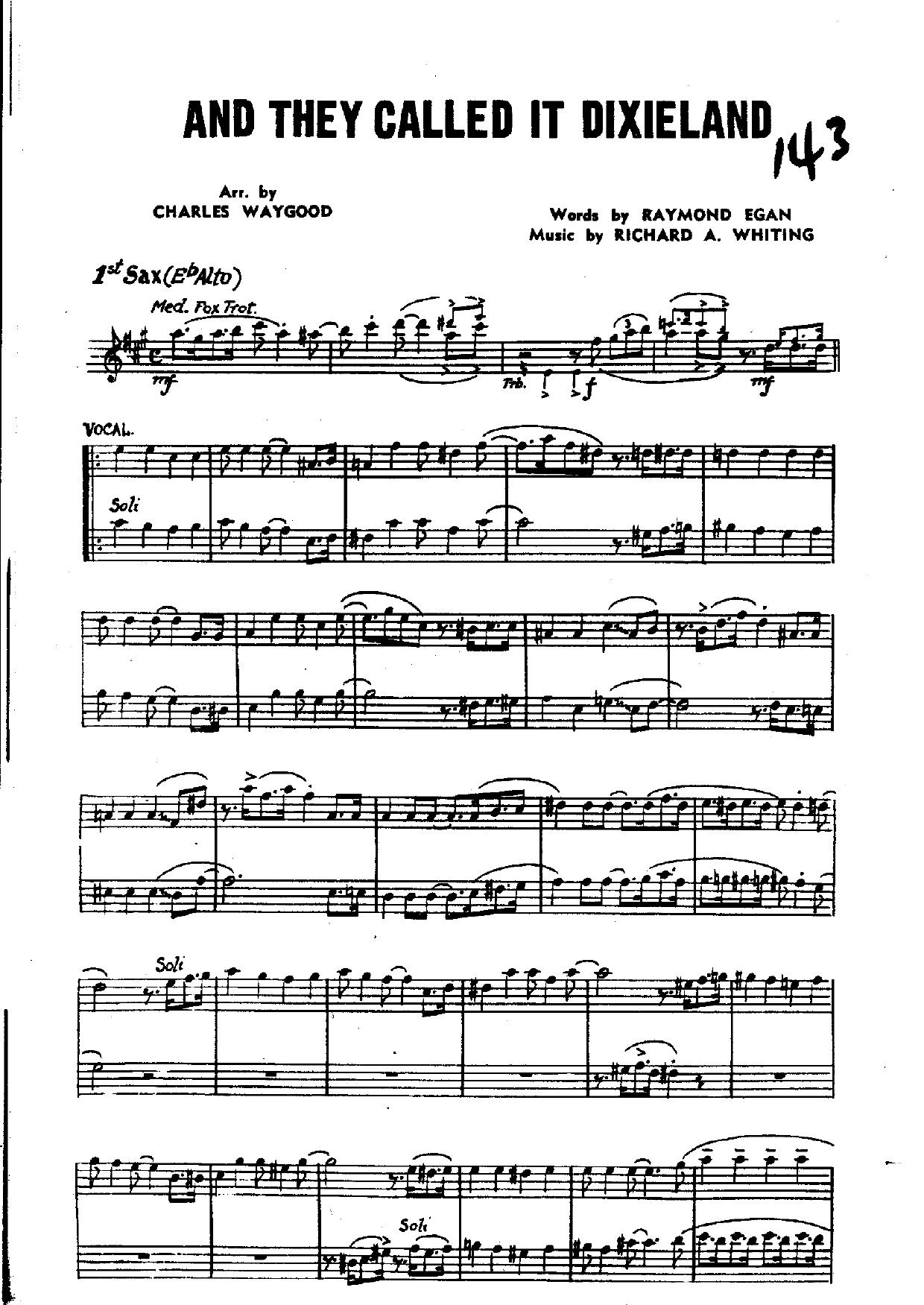
And They Call It Dixieland (C.Waygood)
Composed by RICHARD A. WHITING
Arranged by CHARLES WAYGOOD
- Ensemble: Dixieland Band
- Style: Dixieland
- Pages: 15
- Instruments (10): 1st Eb Alto Saxophone, 1st Bb Trumpet, 2nd Bb Tenor Saxophone, Clarinet, 1st Trombone, Piano, Piano Accordion, Guitar, Drums, Bass
- Difficulty: easy
- Content: Individual Parts
- Format: PDF Download (Instant)
- Price: $18.99
Richard A. Whiting's enduring classic, "And They Call It Dixieland," first captivated audiences in the early 20th century, emerging from the vibrant crucible of American popular music and the nascent jazz scene. While not a traditional "jazz standard" in the improvisational sense, its catchy melody and celebratory spirit quickly made it a staple of vaudeville, dance halls, and, crucially, the burgeoning Dixieland revival movements. It epitomizes the joyous, often boisterous energy of early jazz, characterized by collective improvisation, syncopated rhythms, and a strong melodic focus. This piece harks back to an era when jazz was primarily dance music, designed to uplift and entertain with its straightforward yet infectious charm. Charles Waygood's arrangement masterfully captures this quintessential Dixieland spirit, presenting a lively and authentic rendition in a bright, medium-up tempo 4/4 feel. The arrangement is firmly rooted in the traditional Dixieland instrumentation, featuring prominent roles for clarinet, trumpet, and trombone, supported by a robust rhythm section. Waygood's distinctive approach often emphasizes clear melodic statements, followed by engaging counterpoint and collective improvisation sections that are carefully notated to guide players while allowing for stylistic freedom. The key is set comfortably for the brass and reeds, likely in a bright major key such as B-flat or F, enhancing its inherent cheerfulness. The overall mood is one of unbridled exuberance and classic Americana, evoking images of riverboats and bustling speakeasies. The arrangement opens with a classic ensemble statement of the melody, often led by the trumpet, before transitioning into a series of featured solo sections. Waygood skillfully crafts these moments, providing written-out solos that are stylistically appropriate, yet flexible enough for experienced players to embellish. Expect a lively clarinet break, a powerful trombone tailgate, and a soaring trumpet lead. A notable feature of Waygood's writing is his ability to create dynamic contrasts; he might introduce a softer, more lyrical section before building to a full-ensemble shout chorus that truly encapsulates the Dixieland "hot" sound. Technical challenges include maintaining a consistent, driving swing feel, executing precise articulations characteristic of the style, and navigating the often intricate counterlines between the front-line instruments. The rewarding aspect lies in the sheer joy of collective music-making and the immediate audience appeal of this timeless genre. This arrangement is ideally suited for high school and college Dixieland ensembles, community bands, and semi-professional groups seeking an authentic and engaging piece for their repertoire. Its clear notation and well-structured form make it accessible for developing musicians to grasp the stylistic nuances of Dixieland, while offering enough depth and opportunity for improvisation to satisfy more advanced players. The 15 pages of score and parts ensure comprehensive coverage for a standard Dixieland band lineup, providing a complete and ready-to-perform package that is both educational and entertaining. Conductors should aim for a bright, medium-up tempo, around quarter note = 180-200 BPM, ensuring a consistent, driving 4/4 swing feel with a clear emphasis on the "two" and "four." Articulation is paramount: encourage crisp, short notes for rhythmic clarity, especially in the brass, and smooth, flowing lines for the clarinet. Technical challenges include maintaining precise ensemble balance during collective improvisation sections and ensuring the rhythm section lays down a solid, unwavering foundation. The trombone should embrace a "tailgate" style where appropriate, utilizing glissandi and smears. Rehearsal time should focus on the interplay between the front-line instruments, practicing the written solos for stylistic accuracy, and building the dynamic arc towards the exhilarating shout choruses. Encourage a sense of joyful abandon within the structured framework. Q: What instruments are included in this arrangement? A: This arrangement for Dixieland Band typically includes parts for Trumpet, Clarinet, Trombone, Piano, Bass, and Drums, providing a complete score and individual parts for each instrument. Q: What is the difficulty level of "And They Call It Dixieland (C.Waygood)"? A: This arrangement is rated as Medium, making it suitable for high school, college, community, and semi-professional Dixieland ensembles. It presents stylistic challenges but is accessible for musicians with a solid grasp of their instruments. Q: What musical style and historical context does this arrangement represent? A: This arrangement is firmly in the Dixieland style, capturing the celebratory and collective improvisation spirit of early 20th-century American jazz, based on Richard A. Whiting's original composition. Q: What makes Charles Waygood's arrangement of this piece unique? A: Waygood's treatment is distinguished by its authentic Dixieland voicings, well-crafted written solos that are stylistically true to the genre, and dynamic ensemble sections that build to exciting shout choruses, all while maintaining a clear and engaging melodic focus. Q: What is the typical performance duration and tempo for this arrangement? A: A typical performance of this arrangement runs approximately 3-4 minutes, played at a bright, medium-up tempo in a 4/4 swing feel, generally around 180-200 beats per minute.
Questions and answers
- What is included in the And They Call It Dixieland (C.Waygood) PDF?
- The verified current file contains a conductor score and individual parts across 15 pages.
- How many instruments or parts are listed for And They Call It Dixieland (C.Waygood)?
- The verified instrumentation list contains 10 entries for this Dixieland Band arrangement.
- Who is credited for And They Call It Dixieland (C.Waygood)?
- Composer: RICHARD A. WHITING. Arranger: CHARLES WAYGOOD.
- What difficulty is listed for And They Call It Dixieland (C.Waygood)?
- The verified difficulty level is easy.
- What style is listed for And They Call It Dixieland (C.Waygood)?
- The catalog lists the style as Dixieland.
- Can I preview And They Call It Dixieland (C.Waygood) before buying?
- Yes. The product page provides a preview generated from the current PDF file.
- How is And They Call It Dixieland (C.Waygood) delivered?
- After successful payment, the digital PDF is made available for download. The displayed price is $18.99.
Musicians Also Search For
And They Call It Dixieland CHARLES WAYGOOD PDF • And They Call It Dixieland CHARLES WAYGOOD sheet music • And They Call It Dixieland arranged by CHARLES WAYGOOD • CHARLES WAYGOOD dixieland band charts • CHARLES WAYGOOD jazz arrangements PDF • And They Call It Dixieland RICHARD A. WHITING sheet music • And They Call It Dixieland RICHARD A. WHITING dixieland band arrangements • RICHARD A. WHITING dixieland band charts • And They Call It Dixieland dixieland band arrangements • And They Call It Dixieland dixieland band PDF download • And They Call It Dixieland jazz sheet music • dixieland band sheet music download • And They Call It Dixieland conductor score PDF • And They Call It Dixieland individual parts download • And They Call It Dixieland sheet music PDF • And They Call It Dixieland Dixieland charts • Dixieland dixieland band arrangements • buy And They Call It Dixieland sheet music • download And They Call It Dixieland PDF • And They Call It Dixieland jazz charts • best CHARLES WAYGOOD dixieland band arrangements • RICHARD A. WHITING arranged by CHARLES WAYGOOD • And They Call It Dixieland printable sheet music • dixieland band repertoire PDF