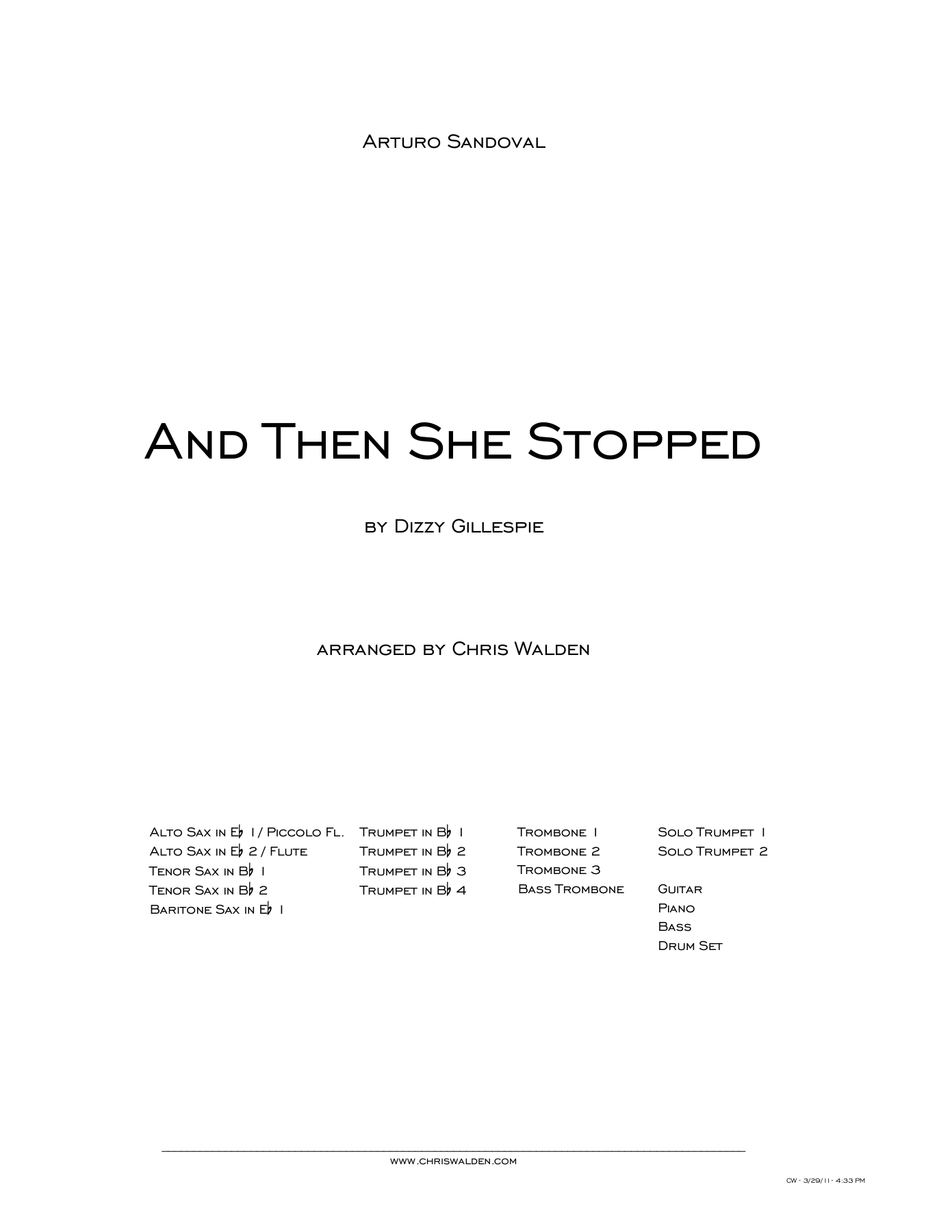
And Then She Stopped (C.Walden)
Composed by Dizzy Gillespie
Arranged by Arturo Sandoval-Ed Calle
- Ensemble: Big Band
- Style: Jazz Standard
- Pages: 36
- Instruments (21): Alto Saxophone 1, Piccolo Flute, Alto Saxophone 2, Flute, Tenor Saxophone 1, Tenor Saxophone 2, Baritone Saxophone, Trumpet 1, Trumpet 2, Trumpet 3, Trumpet 4, Trombone 1, Trombone 2, Trombone 3, Bass Trombone, Solo Trumpet 1, Solo Trumpet 2, Guitar, Piano, Bass, Drum Set
- Difficulty: medium
- Content: Individual Parts
- Format: PDF Download (Instant)
- Price: $24.99
Dizzy Gillespie's iconic "And Then She Stopped" emerges from the fertile ground of bebop, a revolutionary jazz style that took shape in the 1940s. While not as universally recognized as some of Gillespie's other compositions, it embodies the virtuosic complexity, lightning-fast harmonic changes, and rhythmic ingenuity that defined the era and established Gillespie as one of its undisputed architects. The original piece, often characterized by its intricate melodic lines and challenging chord progressions, served as a vehicle for Gillespie's trumpet prowess and the improvisational brilliance of his sidemen, solidifying its place as a deep-cut standard for serious jazz enthusiasts. This arrangement pays homage to that legacy while infusing it with contemporary big band sensibilities. Arturo Sandoval and Ed Calle, both titans in the world of Latin jazz and contemporary big band, bring their formidable expertise to this arrangement. Their distinctive approach is immediately evident in the vibrant orchestration and sophisticated harmonic palette. While maintaining the original's up-tempo bebop feel in 4/4, the arrangement introduces a robust, driving energy, often leaning into a bright, almost Latin-tinged swing that is a hallmark of both arrangers' styles. The key remains true to the original's bright, energetic character, likely in a sharp key to facilitate brass brilliance. Expect meticulously crafted soli sections for the saxophones, showcasing intricate contrapuntal lines and tight ensemble work. The brass sections are given ample opportunity to shine with powerful, soaring melodies and punchy, often syncopated figures, building to a climactic shout chorus that is both harmonically rich and dynamically thrilling. The arrangement features the melody initially carried by the trumpet section, often doubled or harmonized with saxophones for a full, impactful sound. There are prominent solo opportunities, typically for Trumpet and Tenor Saxophone, allowing advanced improvisers to navigate Gillespie's challenging changes within a dynamic big band framework. The technical demands are considerable, requiring strong individual instrumentalists with excellent sight-reading skills, precise articulation, and a solid understanding of bebop phrasing. Ensemble precision, particularly in the rapid soli passages and tight brass figures, is paramount. The rewarding aspect lies in the sheer exhilaration of performing such a high-energy, harmonically sophisticated piece, culminating in a powerful, unified statement that captures the essence of both Gillespie's genius and Sandoval/Calle's arranging prowess. This arrangement is ideally suited for advanced college and university jazz ensembles, as well as professional big bands. Its complexity and demands on individual musicianship and ensemble cohesion make it an excellent choice for groups seeking to challenge themselves with a sophisticated, high-energy chart that will impress audiences and provide a deeply satisfying performance experience. Community bands with a strong core of experienced musicians may also find it a rewarding, albeit ambitious, project. Conductors should emphasize a bright, driving up-tempo swing feel from the outset, maintaining rhythmic precision in the often-syncopated figures. Articulation must be crisp and unified, particularly in the saxophone soli sections and brass punches. Rehearsal time should be dedicated to isolating these intricate soli passages, ensuring every voice is heard clearly while maintaining blend. Dynamics are crucial; the arrangement features significant dynamic contrasts, from subtle melodic statements to powerful, full-ensemble shout choruses. Encourage brass players to employ a brilliant, open sound in forte sections, while woodwinds should focus on a light, agile articulation in faster passages. Specific techniques like controlled falls and doits on brass should be executed with precision and stylistic awareness to enhance the bebop character. Pay close attention to the harmonic voicings, ensuring balance so that the sophisticated chord extensions resonate clearly without muddiness. Q: What instruments are included in this arrangement? A: This is a standard 17-piece big band arrangement, including Alto Saxophone 1, Alto Saxophone 2, Tenor Saxophone 1, Tenor Saxophone 2, Baritone Saxophone, Trumpet 1, Trumpet 2, Trumpet 3, Trumpet 4, Trombone 1, Trombone 2, Trombone 3, Bass Trombone, Piano, Bass, Drums, and Guitar. A full conductor score is also included. Q: What is the difficulty level of "And Then She Stopped (C.Walden)"? A: This arrangement is rated as advanced (Grade 5-6), suitable for advanced college/university jazz ensembles and professional big bands. It demands strong individual musicianship, excellent sight-reading, and precise ensemble execution due to its complex harmonies, fast tempos, and intricate soli sections. Q: What is the musical style and historical context of this piece? A: "And Then She Stopped" is a jazz standard rooted in the bebop era of the 1940s, originally composed by Dizzy Gillespie. This arrangement by Arturo Sandoval and Ed Calle maintains the up-tempo bebop feel while infusing it with contemporary big band orchestration and a vibrant, driving energy. Q: What makes this arrangement unique compared to other versions of Gillespie's work? A: Sandoval and Calle's arrangement is distinguished by its sophisticated harmonic voicings, powerful brass writing, and intricate saxophone soli sections. It blends Gillespie's original bebop complexity with the arrangers' signature contemporary big band sound, offering a fresh, high-energy interpretation. Q: What is the approximate performance duration and recommended tempo for this arrangement? A: The performance duration typically ranges from 4 to 6 minutes, depending on the length of improvised solos. The recommended tempo is a bright, driving up-tempo swing, generally in the range of 220-260 beats per minute, to capture the piece's energetic bebop character.
Musicians Also Search For
And Then She Stopped Arturo Sandoval-Ed Calle PDF • And Then She Stopped Arturo Sandoval-Ed Calle sheet music • And Then She Stopped arranged by Arturo Sandoval-Ed Calle • Arturo Sandoval-Ed Calle big band charts • Arturo Sandoval-Ed Calle jazz arrangements PDF • And Then She Stopped Dizzy Gillespie sheet music • And Then She Stopped Dizzy Gillespie big band arrangement • Dizzy Gillespie big band charts • And Then She Stopped big band arrangement • And Then She Stopped big band PDF download • And Then She Stopped jazz ensemble sheet music • big band sheet music instant download • And Then She Stopped conductor score PDF • And Then She Stopped individual parts download • And Then She Stopped sheet music with parts • And Then She Stopped Jazz Standard chart • Jazz Standard big band arrangements • buy And Then She Stopped sheet music online • download And Then She Stopped PDF • And Then She Stopped jazz chart • best Arturo Sandoval-Ed Calle big band arrangements • Dizzy Gillespie songs arranged by Arturo Sandoval-Ed Calle • And Then She Stopped printable sheet music • big band repertoire PDF