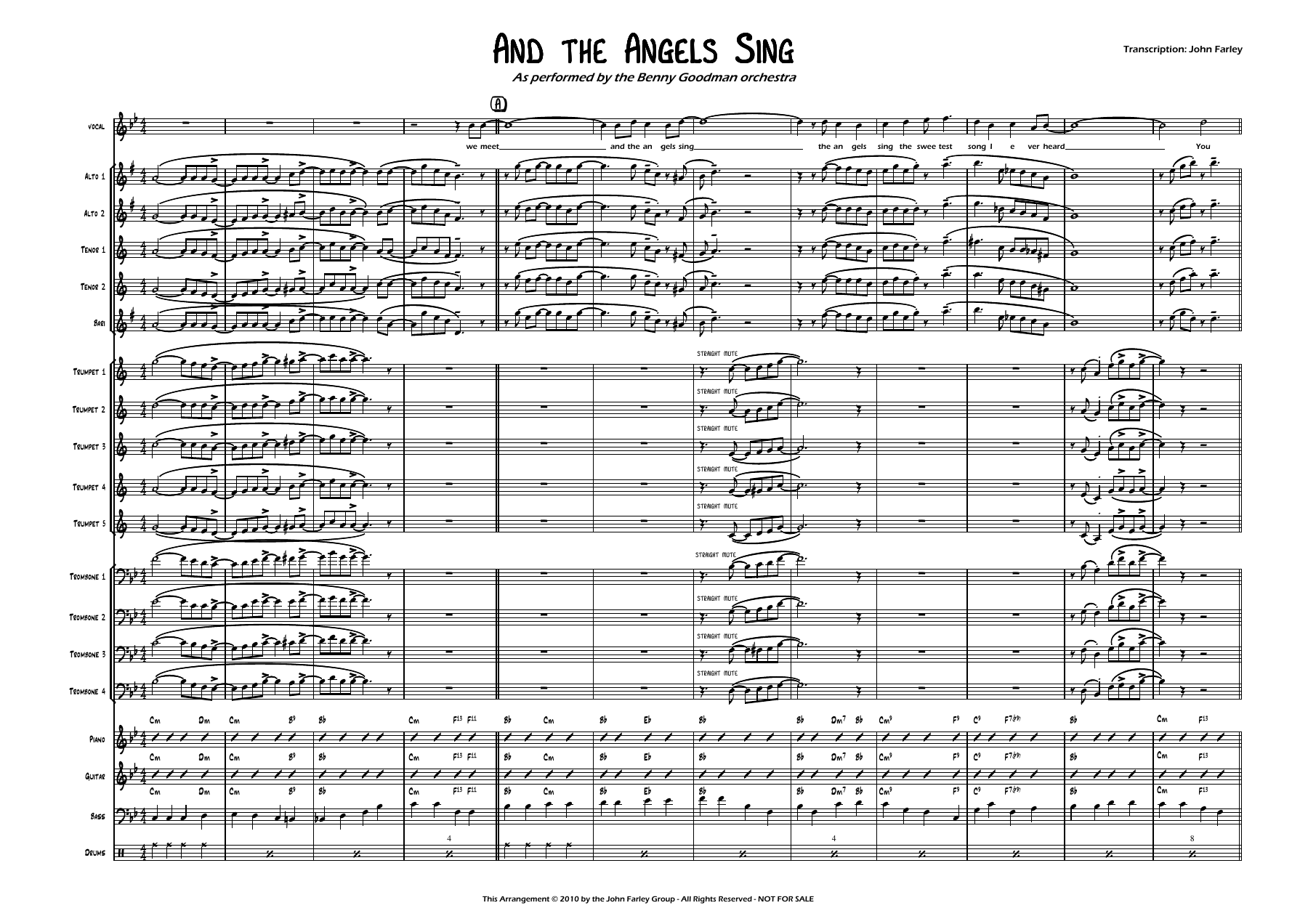
And The Angels Sing (Arr. Noni Bernardi (J.Farley) B.Goodman) voc sheet music preview

And The Angels Sing (Arr. Noni Bernardi (J.Farley) B.Goodman) voc

Composed by Ziggy Elman

Arranged by Benny Goodman

  • Ensemble: Big Band
  • Style: Jazz Standard
  • Pages: 51
  • Instruments (17): Alto Saxophone 1, Alto Saxophone 2, Tenor Saxophone 1, Tenor Saxophone 2, Baritone Saxophone, Trumpet 1, Trumpet 2, Trumpet 3, Trumpet 4, Trombone 1, Trombone 2, Trombone 3, Bass Trombone, Guitar, Piano, Bass, Drums
  • Difficulty: advanced
  • Content: Individual Parts
  • Format: PDF Download (Instant)
  • Price: $24.99

"And The Angels Sing," a timeless jazz standard penned by Ziggy Elman, stands as an enduring emblem of the Swing Era, forever etched into the annals of popular music by the iconic Benny Goodman Orchestra. First recorded in 1939, this piece captured the optimistic spirit and infectious energy of a pre-war America, quickly becoming one of Goodman's signature tunes. Its distinctive opening trumpet fanfare, a direct quote from Elman's earlier Yiddish-inspired "Fralich in Swing," immediately grabs attention, setting the stage for a composition that masterfully blends Jewish folk melodies with sophisticated big band swing. The original recording, featuring Martha Tilton's memorable vocal, propelled it to the top of the charts, solidifying its status as a quintessential jazz standard that continues to resonate with audiences and musicians alike. This particular arrangement, attributed to Benny Goodman himself and adapted by Noni Bernardi (J. Farley), captures the vibrant, medium-up swing feel that defined Goodman's sound. The arrangement is firmly rooted in the 4/4 time signature, maintaining a bright, driving tempo that encourages toe-tapping and spontaneous movement. While the original key is typically E-flat major, this arrangement likely navigates through common big band keys, offering a rich harmonic landscape. The mood is undeniably jubilant and celebratory, evoking the golden age of swing with its effervescent energy and polished ensemble work. Expect a full, rich sound, characterized by the classic clarinet-led ensemble sections and the powerful brass and saxophone voicings that were hallmarks of the Goodman band. Goodman's arranging approach, even when adapted, emphasizes clarity, precision, and an irresistible swing pulse. This arrangement features the melody predominantly carried by the lead alto saxophone or trumpet, often with lush, harmonized voicings from the full saxophone section, creating that signature Goodman blend. Expect meticulously crafted soli sections for the saxophones and brass, showcasing the band's tightness and articulation. A prominent feature will undoubtedly be the iconic trumpet solo, often a direct transcription or interpretation of Ziggy Elman's original, which is both technically demanding and melodically captivating. The arrangement builds dynamically, likely culminating in a powerful shout chorus that brings the entire ensemble together in a thrilling climax, punctuated by crisp brass figures and driving rhythm section work. Technical challenges include maintaining precise ensemble articulation, navigating fast melodic lines, and achieving a cohesive, swinging rhythm section feel. The rewarding aspect lies in recreating the authentic sound of one of jazz's most beloved orchestras, delivering a performance that is both historically informed and exhilaratingly live. This arrangement is ideally suited for college-level big bands, advanced community ensembles, and professional jazz orchestras. Its demands for tight ensemble playing, strong lead trumpet and alto saxophone players, and a rhythm section capable of sustaining a consistent, energetic swing feel make it an excellent vehicle for showcasing a band's precision and stylistic authenticity. While high school bands with exceptionally strong sections could tackle it, the nuances of the swing feel and the technical requirements of the solo features might prove challenging for less experienced groups. Conductors should aim for a consistent medium-up swing tempo, around 180-200 BPM, ensuring a light yet driving feel in the rhythm section. Emphasize crisp articulation, particularly in the brass, and encourage a unified, soaring sound from the saxophone section during soli passages. The iconic trumpet solo, often a transcription of Ziggy Elman's original, requires both technical dexterity and expressive phrasing; encourage the soloist to study Elman's recordings for stylistic authenticity. Pay close attention to dynamics, building tension gradually towards the shout chorus, and ensuring the final ensemble hits are powerful and precise. Rehearsal time should be dedicated to balancing the intricate voicings, especially between the clarinet/lead alto and the rest of the saxophones, and perfecting the ensemble's cut-offs and releases to achieve a polished, professional sound. Q: What instruments are included in this arrangement? A: This big band arrangement includes parts for 17 instruments: Alto Saxophone 1, Alto Saxophone 2, Tenor Saxophone 1, Tenor Saxophone 2, Baritone Saxophone, Trumpet 1, Trumpet 2, Trumpet 3, Trumpet 4, Trombone 1, Trombone 2, Trombone 3, Trombone 4, Piano, Bass, Drums, and an optional Vocal part. Q: What is the difficulty level of this arrangement? A: This arrangement is considered advanced, suitable for college-level big bands, advanced community ensembles, and professional jazz orchestras due to its demands for precise ensemble playing, strong lead players, and authentic swing interpretation. Q: What musical style and historical context does "And The Angels Sing" represent? A: "And The Angels Sing" is a quintessential jazz standard from the Swing Era (late 1930s), popularized by Benny Goodman. It blends traditional Jewish melodies with sophisticated big band swing, embodying the vibrant and optimistic spirit of the period. Q: What makes this specific arrangement by Benny Goodman unique? A: This arrangement by Benny Goodman (adapted by Noni Bernardi) is unique for its authentic recreation of Goodman's signature sound, featuring meticulously crafted soli sections, prominent clarinet/lead alto lines, and a powerful, driving swing feel, culminating in an iconic trumpet solo and a thrilling shout chorus. Q: What is the typical performance duration and tempo for this piece? A: The typical performance duration for "And The Angels Sing" is around 3-4 minutes, played at a medium-up swing tempo, generally between 180 and 200 beats per minute.

Musicians Also Search For

And The Angels Sing Benny Goodman PDFAnd The Angels Sing Benny Goodman sheet musicAnd The Angels Sing arranged by Benny GoodmanBenny Goodman big band chartsBenny Goodman jazz arrangements PDFAnd The Angels Sing Ziggy Elman sheet musicAnd The Angels Sing Ziggy Elman big band arrangementZiggy Elman big band chartsAnd The Angels Sing big band arrangementAnd The Angels Sing big band PDF downloadAnd The Angels Sing jazz ensemble sheet musicbig band sheet music instant downloadAnd The Angels Sing individual parts downloadAnd The Angels Sing sheet music with partsAnd The Angels Sing Jazz Standard chartJazz Standard big band arrangementsbuy And The Angels Sing sheet music onlinedownload And The Angels Sing PDFAnd The Angels Sing jazz chartbest Benny Goodman big band arrangementsZiggy Elman songs arranged by Benny GoodmanAnd The Angels Sing printable sheet musicbig band repertoire PDF

All arrangements by Benny Goodman All Ziggy Elman sheet music