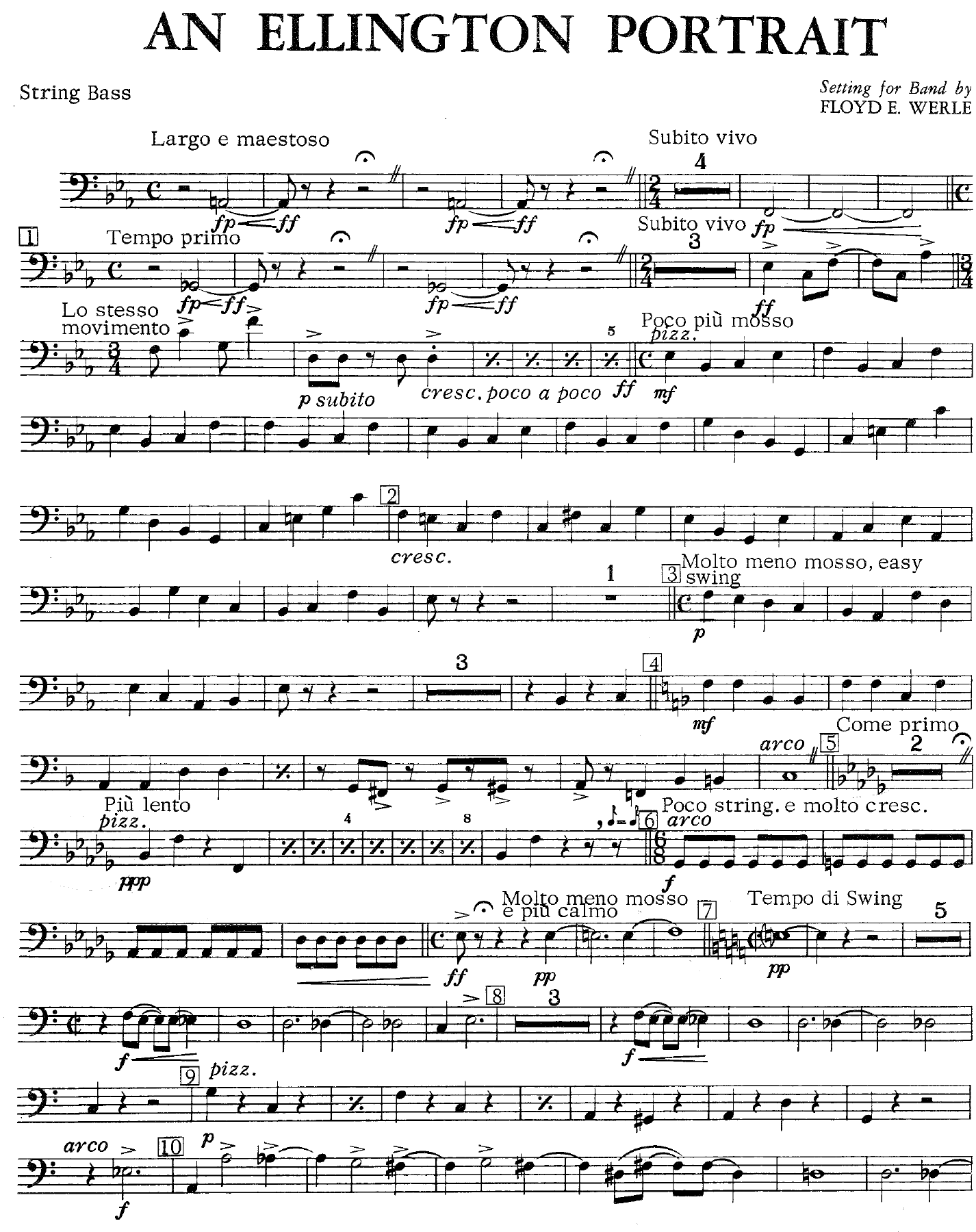
An Ellington Portrait string bass (F.Werle)
Composed by Duke Ellington
Arranged by Floyd E. Werle
- Ensemble: Concert Band
- Style: Jazz Standard
- Pages: 81
- Difficulty: easy
- Content: Sheet Music
- Format: PDF Download (Instant)
- Price: $10.99
Duke Ellington's legacy as one of America's most prolific and influential composers is undeniable, and his vast catalog forms the bedrock of the jazz standard repertoire. "An Ellington Portrait string bass (F.Werle)" by Floyd E. Werle masterfully encapsulates the essence of this jazz giant's work, presenting a symphonic concert band interpretation that pays homage to the original compositions while reimagining them for a grander ensemble. The original pieces, largely composed and recorded during Ellington's most fertile periods from the late 1920s through the 1960s, defined the sound of the swing era and beyond, making him a pivotal figure in 20th-century music. This arrangement, though titled for string bass, is a comprehensive concert band setting, implying a significant role for the bass within the larger orchestral texture, likely anchoring the harmonic and rhythmic foundation as Ellington's own bassists like Jimmy Blanton and Oscar Pettiford did. Werle's arrangement typically features a sophisticated blend of Ellington's signature elements: lush, often dissonant harmonies, distinctive voicings that highlight specific instrumental colors, and a dynamic range that moves from intimate solos to powerful full-ensemble statements. While the specific Ellington tunes included in this "Portrait" are not listed, Werle's style suggests a medley approach, weaving together iconic melodies and harmonic progressions. Expect a varied musical character, likely transitioning between a medium swing feel for a classic standard, perhaps a slow, expressive ballad section, and possibly an up-tempo, driving swing for a more energetic segment. The overall mood would be one of sophisticated elegance, punctuated by moments of vibrant energy and soulful introspection, characteristic of Ellington's diverse output. Floyd E. Werle, known for his prolific contributions to the concert band repertoire, approaches this "Ellington Portrait" with his characteristic flair for dramatic orchestration and technical demands. His arrangements often feature intricate counterpoint, extended harmonic language, and powerful brass writing, which would translate Ellington's big band sound into a symphonic context without losing its jazz soul. Expect rich soli sections for various instrument families (e.g., woodwind soli, brass soli), carefully crafted shout choruses that build intensity, and potentially subtle modulations that add harmonic interest. The arrangement would likely feature prominent melodic statements passed between different sections of the band, ensuring that all instrumental groups have engaging material. There would undoubtedly be featured solo opportunities, often written out but allowing for stylistic interpretation, particularly for saxophone, trumpet, or trombone, echoing the soloists of Ellington's orchestras. Performing "An Ellington Portrait" is a rewarding challenge for a high school, college, or advanced community concert band. The 81 pages of score and parts suggest a substantial work, requiring a strong command of jazz idioms within a classical ensemble setting. Technical challenges would include precise articulation, dynamic control across a wide range, and the ability to maintain a consistent swing feel in various tempos. The piece demands excellent ensemble blend and balance, especially in the denser harmonic passages and powerful climaxes. The string bass part, as indicated in the title, would be crucial, providing a foundational pulse and harmonic clarity, often requiring both arco and pizzicato techniques. The reward lies in bringing to life the timeless music of Duke Ellington through a grand, symphonic lens, offering both musicians and audiences a rich, immersive musical experience. Conductors should emphasize a nuanced understanding of jazz articulation and phrasing, even within the concert band context. Encourage musicians to listen to original Duke Ellington recordings to internalize the stylistic nuances of swing, blues, and ballad playing. The tempo markings, while precise, should be interpreted with a natural, unhurried swing feel, avoiding a rigid metronomic approach. Key technical challenges include maintaining rhythmic precision in syncopated passages, achieving a balanced blend in complex voicings, and executing dynamic contrasts effectively. Pay close attention to the string bass part, ensuring its foundational role is clear and well-articulated, often requiring a strong pizzicato for rhythmic drive and a warm arco for melodic or sustained harmonic lines. Rehearsal time should be dedicated to shaping the melodic lines, particularly in soli sections, and building the intensity of the shout choruses through careful dynamic layering and precise attacks. Q: What instruments and parts are included in "An Ellington Portrait string bass (F.Werle)"? A: This arrangement is for a full concert band, meaning it includes standard woodwind, brass, percussion, and string bass parts. The title specifically highlights the string bass, indicating a significant and well-developed part for that instrument. Q: What is the difficulty level of this arrangement for a concert band? A: Given Floyd E. Werle's typical writing style and the substantial 81-page score, this arrangement is best suited for advanced high school, college, or skilled community concert bands. It requires strong technical proficiency and an understanding of jazz idioms. Q: What is the musical style and historical context of this arrangement? A: This is a concert band arrangement of Duke Ellington's jazz standards, capturing the essence of the swing era and beyond. It reimagines Ellington's iconic big band sound for a symphonic ensemble, representing a fusion of jazz and classical orchestration. Q: What makes Floyd E. Werle's arrangement of "An Ellington Portrait" unique? A: Werle's arrangements are known for their dramatic orchestration, rich harmonies, and intricate counterpoint. He translates Ellington's original jazz genius into a powerful symphonic setting, featuring complex voicings, dynamic contrasts, and potentially prominent solo features. Q: What is the approximate performance duration or tempo characteristics of this piece? A: As a "Portrait," it likely involves a medley of Ellington's works, suggesting a varied performance duration typically ranging from 7-12 minutes. The piece will feature a dynamic range of tempos and feels, from medium swing to expressive ballads and possibly up-tempo sections.
Musicians Also Search For
An Ellington Portrait string bass Floyd E. Werle PDF • An Ellington Portrait string bass Floyd E. Werle sheet music • An Ellington Portrait string bass arranged by Floyd E. Werle • Floyd E. Werle concert band charts • Floyd E. Werle jazz arrangements PDF • An Ellington Portrait string bass Duke Ellington sheet music • An Ellington Portrait string bass Duke Ellington concert band arrangement • Duke Ellington concert band charts • An Ellington Portrait string bass concert band arrangement • An Ellington Portrait string bass concert band PDF download • An Ellington Portrait string bass jazz ensemble sheet music • concert band sheet music instant download • An Ellington Portrait string bass sheet music with parts • An Ellington Portrait string bass Jazz Standard chart • Jazz Standard concert band arrangements • buy An Ellington Portrait string bass sheet music online • download An Ellington Portrait string bass PDF • An Ellington Portrait string bass jazz chart • best Floyd E. Werle concert band arrangements • Duke Ellington songs arranged by Floyd E. Werle • An Ellington Portrait string bass printable sheet music • concert band repertoire PDF