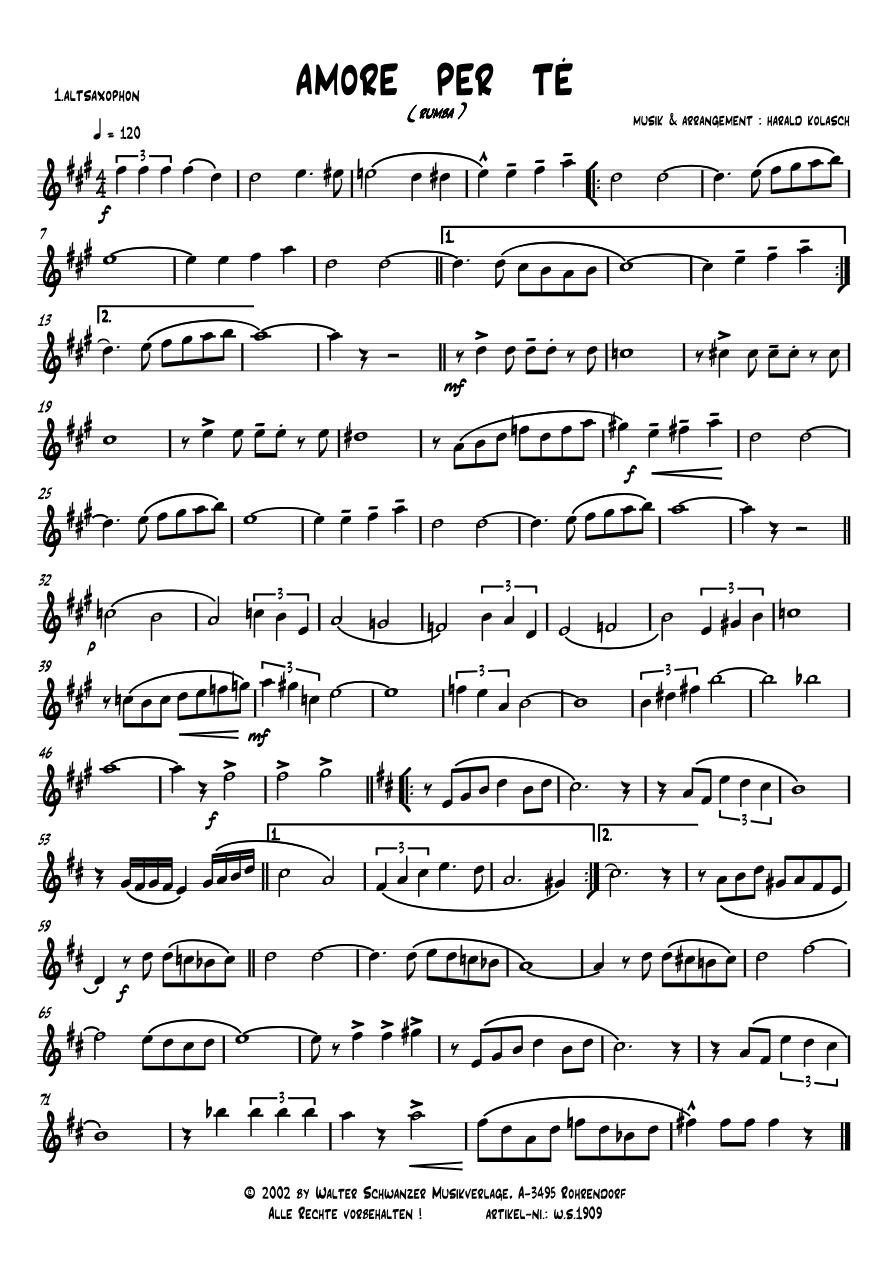
Amore Per Te (H.Kolasch)
Composed by H. Kolasch
- Ensemble: Big Band Dance
- Style: Big Band Dance
- Pages: 17
- Instruments (17): Alto Sax 1, Alto Sax 2, Tenor Sax 1, Tenor Sax 2, Baritone Sax, Trumpet 1, Trumpet 2, Trumpet 3, Trumpet 4, Trombone 1, Trombone 2, Trombone 3, Trombone 4, Piano, Bass, Drums, Guitar
- Difficulty: easy
- Content: Individual Parts
- Format: PDF Download (Instant)
- Price: $24.99
"Amore Per Te," originally penned by H. Kolasch, stands as a quintessential example of the Big Band Dance era, a period roughly spanning the late 1930s through the 1950s when large ensembles dominated popular music and dance halls. While not a jazz standard in the improvisational sense, its enduring melodic charm and rhythmic drive place it firmly within the repertoire of bands seeking to evoke the sophisticated, yet accessible, sound of classic dance orchestras. Kolasch's compositions often featured memorable, singable melodies and straightforward harmonic progressions, making them ideal for the structured arrangements that defined the era. The piece's inherent romanticism and lilting feel are characteristic of the European light music tradition, seamlessly adapted for American big band instrumentation. This particular arrangement of "Amore Per Te" embraces a medium-slow swing tempo, typically around 90-100 BPM, in the key of C major, establishing a warm, inviting mood from the outset. The musical character is one of elegant romance, imbued with a gentle, swaying energy perfect for a ballroom or concert setting. The emotional landscape is one of tender affection and nostalgic reflection, avoiding overt drama in favor of a smooth, flowing narrative. The arrangement's strength lies in its ability to maintain interest through dynamic contrasts and thoughtful orchestration, rather than complex harmonic reharmonizations. It’s a piece designed to make listeners feel good, providing a sophisticated backdrop without demanding intense intellectual engagement, true to its Big Band Dance roots. Though the arranger remains unknown, their approach to "Amore Per Te" is distinctly traditional and highly effective for the style. The melody is predominantly carried by the lead alto saxophone, often doubled by the lead trumpet, providing a bright, clear voice. Rich, block-chord voicings are prevalent in the saxophone section, creating a lush harmonic carpet, while the brass sections contribute punctuating figures and soaring counter-melodies. There are no extended improvised solo sections, reflecting the dance band tradition where the focus was on the ensemble and the melody. Instead, short, melodic fills and call-and-response passages between sections provide instrumental color. A notable feature is the carefully constructed soli section for the saxophones, showcasing their blend and precision, followed by a full ensemble shout chorus that builds to a satisfying climax before returning to the main theme. The arrangement emphasizes smooth transitions and a cohesive ensemble sound, prioritizing blend and balance. Performing "Amore Per Te" is a rewarding experience for a well-rehearsed ensemble. The primary challenge lies in achieving a unified, polished sound, particularly in the saxophone soli and the brass fanfare figures. Dynamics must be meticulously observed to convey the piece's romantic ebb and flow. The lead alto saxophonist and lead trumpeter carry significant melodic responsibility, requiring strong tone and accurate phrasing. This arrangement is ideally suited for high school and community college jazz ensembles seeking to explore the Big Band Dance repertoire, as well as community bands and professional groups looking for a charming, well-crafted piece that offers a pleasant contrast to more modern or technically demanding charts. Its accessibility and melodic appeal make it an excellent choice for concerts, dances, or as a sophisticated opener. "Amore Per Te" thrives on a consistent, medium-slow swing feel, ideally around 90-100 BPM. Conductors should emphasize a relaxed, flowing pulse, avoiding any tendency to rush. The primary technical challenge lies in achieving precise ensemble blend and balance, particularly within the saxophone section's block-chord voicings and the brass section's sustained harmonies. Encourage brass players to maintain a warm, controlled tone, especially in the upper register. Dynamics are crucial; ensure clear differentiation between *p*, *mf*, and *f* sections to convey the piece's emotional arc. Rehearsal time should focus on the saxophone soli for intonation and articulation clarity, and on the brass figures for rhythmic precision and unified attacks. No special techniques like plunger mutes or falls are explicitly notated, allowing the ensemble to focus on fundamental big band execution. Q: What instruments are included in this arrangement of "Amore Per Te"? A: This arrangement is scored for a standard 17-piece big band: Alto Sax 1, Alto Sax 2, Tenor Sax 1, Tenor Sax 2, Baritone Sax, Trumpet 1, Trumpet 2, Trumpet 3, Trumpet 4, Trombone 1, Trombone 2, Trombone 3, Trombone 4, Piano, Bass, Guitar, and Drums. Q: What is the difficulty level of this arrangement? A: This arrangement is rated as medium-easy to medium. While it requires a solid understanding of big band ensemble playing, its melodic nature and absence of complex improvisation or extreme technical demands make it accessible for high school, community college, and experienced community bands. Q: What musical style and historical context does "Amore Per Te" represent? A: "Amore Per Te" is a classic example of the Big Band Dance style from the mid-20th century. It embodies the romantic, melodically driven sound popular in ballrooms and concert halls of the 1940s and 50s, focusing on ensemble blend and a smooth, medium-slow swing feel. Q: What makes this specific arrangement of "Amore Per Te" unique? A: This arrangement's distinction lies in its faithful adherence to the Big Band Dance tradition, featuring lush saxophone voicings, clear melodic presentation primarily by lead alto and trumpet, and a well-crafted saxophone soli section that leads into a full ensemble shout chorus, all contributing to its elegant and accessible character. Q: What is the typical performance duration and tempo for this piece? A: The typical performance duration for "Amore Per Te" is approximately 3:00 to 3:30 minutes. It is best performed at a medium-slow swing tempo, ideally in the range of 90-100 beats per minute.
Musicians Also Search For
Amore Per Te H. Kolasch sheet music • Amore Per Te H. Kolasch big band dance arrangement • H. Kolasch big band dance charts • Amore Per Te big band dance arrangement • Amore Per Te big band dance PDF download • Amore Per Te jazz ensemble sheet music • big band dance sheet music instant download • Amore Per Te individual parts download • Amore Per Te sheet music with parts • Amore Per Te Big Band Dance chart • Big Band Dance big band dance arrangements • buy Amore Per Te sheet music online • download Amore Per Te PDF • Amore Per Te jazz chart • Amore Per Te printable sheet music • big band dance repertoire PDF