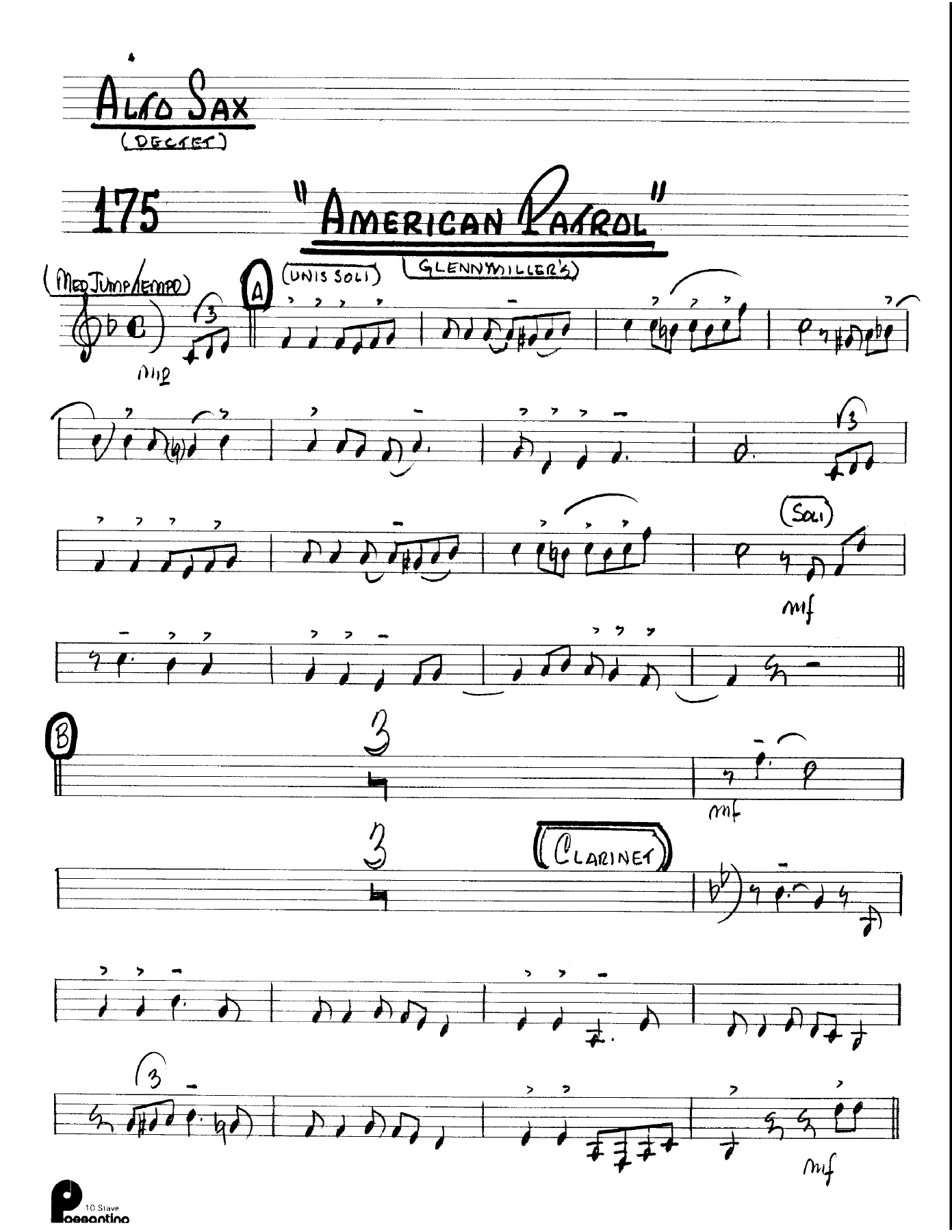
American Patrol (Kenton Dectet #175)
Composed by Frank Meacham
Arranged by Stan Kenton Dected 176
- Ensemble: Small Ensemble
- Style: Jazz Standard
- Pages: 32
- Difficulty: easy
- Content: Sheet Music
- Format: PDF Download (Instant)
- Price: $12.99
Frank Meacham's "American Patrol," originally a martial march composed in 1885, found an enduring place in the jazz lexicon through its spirited adaptation by Glenn Miller during the swing era, cementing its status as a quintessential American tune. Miller's iconic 1942 recording, characterized by its driving swing rhythm and call-and-response brass figures, introduced the piece to a wider audience and established it as a jazz standard, celebrated for its patriotic fervor and infectious energy. This transformation from a military march to a swing-era staple highlights its adaptability and universal appeal, making it a recognizable and beloved melody across generations. Stan Kenton Dected 176's arrangement of "American Patrol" reimagines this classic with the sophisticated harmonic and rhythmic sensibilities characteristic of the Kenton sound, tailored for a small ensemble setting. While maintaining the piece's inherent medium-up swing feel, the arrangement infuses it with a modern, angular edge. Kenton Dected 176's distinctive approach is evident in the intricate voicings, which often feature close harmonies and unexpected dissonances, creating a rich, textured sound that belies the ensemble's size. The arrangement likely features a driving 4/4 swing tempo, emphasizing crisp articulation and dynamic contrasts to propel the piece forward. The overall mood is exhilarating and powerful, evoking a sense of forward momentum and sophisticated energy rather than mere jingoism. The arrangement showcases Kenton Dected 176’s mastery of small-group orchestration, transforming the familiar melody into a vehicle for intricate ensemble interplay and individual expression. The melody is typically presented first by a lead instrument, often a trumpet or alto saxophone, before being passed through various instrumental combinations, including tightly voiced soli passages that are a hallmark of the Kenton style. Featured solo sections provide ample opportunity for improvisation, likely over a set of challenging but rewarding chord changes that push the boundaries of traditional harmony. Technical demands include precise ensemble playing, strong individual instrumental command, and the ability to navigate complex rhythmic figures and extended harmonies. The arrangement culminates in a powerful shout chorus, building to an exciting climax that leaves a lasting impression. This rendition is particularly rewarding for ensembles seeking to explore the intellectual and emotional depth of jazz, offering both technical challenge and immense musical satisfaction. This arrangement is ideally suited for advanced high school, collegiate, and community jazz ensembles, as well as professional small groups. Its complexity in harmony and rhythm, coupled with the demands for precise articulation and dynamic control, makes it an excellent vehicle for developing sophisticated ensemble skills and individual musicianship. The detailed scoring and opportunities for improvisation provide a rich educational experience, allowing musicians to delve into the nuances of modern jazz arranging while engaging with a historically significant tune. Ensembles looking to expand their repertoire with a challenging yet highly rewarding piece that bridges the gap between traditional swing and more progressive jazz styles will find this arrangement particularly appropriate. This arrangement of "American Patrol" requires a keen attention to rhythmic precision and dynamic shaping to fully realize Stan Kenton Dected 176's vision. The medium-up swing tempo should be maintained with a consistent, driving feel, emphasizing a light but firm articulation, particularly in the brass. Technical challenges include navigating complex soli passages with tight voicings, which demand careful intonation and balance across the ensemble. Rehearsal should focus on isolating these sections, ensuring each part is accurately played before blending. Soloists should be encouraged to explore harmonic extensions over the provided chord changes, embracing the Kenton aesthetic of sophisticated improvisation. Pay close attention to the dynamic swells and sudden contrasts, as these are crucial for building excitement, especially leading into and out of the shout chorus. No special mutes or extended techniques are explicitly required, but a precise, unified attack and release throughout the ensemble are paramount. Q: What instruments are included in the "American Patrol (Kenton Dectet #175)" arrangement? A: As a small ensemble (dectet) arrangement, it typically includes parts for five saxophones (2 altos, 2 tenors, baritone), three trombones, three trumpets, and a rhythm section (piano, bass, drums). Specific instrumentation may vary slightly, but this is the standard Kenton Dectet setup. Q: What is the difficulty level of this arrangement? A: This arrangement is considered advanced. It demands strong technical proficiency from all instrumentalists, requiring precise ensemble playing, advanced harmonic understanding for soloists, and a mature grasp of jazz phrasing and dynamics. Q: What is the musical style and historical context of this arrangement? A: This is a jazz standard arranged in the distinctive style of Stan Kenton Dected 176, blending the traditional swing feel of the original "American Patrol" with Kenton's characteristic modern jazz harmonies and complex voicings. It represents a sophisticated evolution of a classic tune. Q: What makes this particular arrangement unique compared to other versions of "American Patrol"? A: Stan Kenton Dected 176's treatment stands out due to its intricate small-ensemble voicings, sophisticated harmonic reinterpretation, and challenging solo sections. It transforms the familiar melody into a vehicle for advanced jazz expression, moving beyond a simple swing chart. Q: What is the typical performance duration or tempo for this piece? A: The arrangement is designed for a medium-up swing tempo, typically around 160-180 BPM. The exact performance duration will depend on the number and length of improvised solos, but it generally falls within the 4-6 minute range.
Musicians Also Search For
American Patrol Stan Kenton Dected 176 PDF • American Patrol Stan Kenton Dected 176 sheet music • American Patrol arranged by Stan Kenton Dected 176 • Stan Kenton Dected 176 small ensemble charts • Stan Kenton Dected 176 jazz arrangements PDF • American Patrol Frank Meacham sheet music • American Patrol Frank Meacham small ensemble arrangement • Frank Meacham small ensemble charts • American Patrol small ensemble arrangement • American Patrol small ensemble PDF download • American Patrol jazz ensemble sheet music • small ensemble sheet music instant download • American Patrol sheet music with parts • American Patrol Jazz Standard chart • Jazz Standard small ensemble arrangements • buy American Patrol sheet music online • download American Patrol PDF • American Patrol jazz chart • best Stan Kenton Dected 176 small ensemble arrangements • Frank Meacham songs arranged by Stan Kenton Dected 176 • American Patrol printable sheet music • small ensemble repertoire PDF