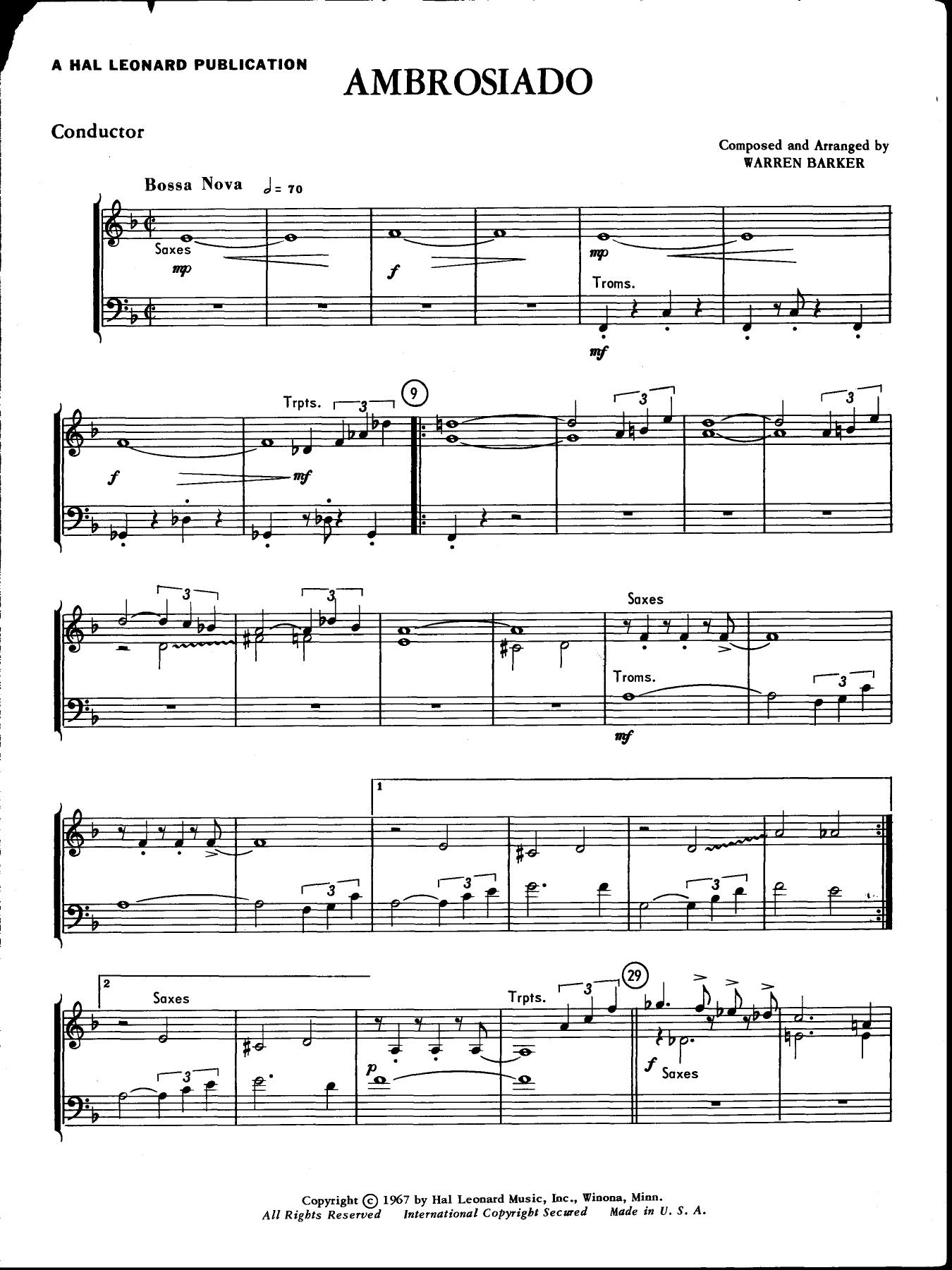
Ambrosiado (W.Barker) sheet music preview

Ambrosiado (W.Barker)

Composed by W. Barker

Arranged by W.Barker

  • Ensemble: Big Band
  • Pages: 40
  • Instruments (17): 1st Eb Alto Saxophone, 2nd Eb Alto Saxophone, 1st Bb Tenor Saxophone, 2nd Bb Tenor Saxophone, Eb Baritone Saxophone, 1st Bb Trumpet, 2nd Bb Trumpet, 3rd Bb Trumpet, 4th Bb Trumpet, 1st Trombone, 2nd Trombone, 3rd Trombone, 4th Trombone, Bass, Drums, Piano, Guitar
  • Difficulty: medium
  • Content: Individual Parts
  • Format: PDF Download (Instant)
  • Price: $24.99

Rooted in the rich tradition of mid-century studio jazz and dance orchestra writing, "Ambrosiado" reflects the sophisticated craftsmanship associated with composer and arranger W. Barker. Emerging from an era where big band scoring balanced accessible melodic hooks with intricate harmonic color, this composition captures the vibrant energy of professional jazz radio and television stages. Barker’s signature style bridges traditional swing era orchestration with modern harmonic extensions, creating a chart that feels both timeless and structurally intriguing. It serves as an engaging example of mid-20th-century jazz composition, prized by directors looking to inject authentic, swinging character into a concert program. Driven by an infectious, medium-tempo swing feel in 4/4 time, the musical character of "Ambrosiado" balances buoyant rhythmic momentum with lush, sophisticated voicings. The piece opens with an inviting groove that immediately establishes a confident, upbeat mood, blending playful syncopation with smooth, interlocking horn lines. Emotional shifts throughout the chart transition smoothly from warm, harmonized ensemble passages to vibrant, foot-tapping shout sections. The interplay between the sections evokes the smoky ambiance of classic metropolitan jazz clubs while maintaining the polished clarity required for modern concert hall acoustics. Barker approaches the 17-instrument big band scoring with a meticulous ear for color, utilizing closed-position sax voicings and bright brass counterlines to create depth without clutter. The arrangement features rich chord extensions—including major sevenths, ninths, and altered dominants—that give the harmony a distinctly contemporary edge. Melodic responsibilities are shared dynamically across the ensemble; the saxophone section frequently carries the primary thematic material in tight, beautiful solis, while the brass interject with snappy, punctuating figures. The writing avoids predictable patterns, building toward a cohesive shout section that challenges the band to balance volume with precise articulation and stylistic unity. Designed with versatility in mind, this medium-difficulty chart is exceptionally well-suited for advanced high school ensembles, collegiate jazz bands, and community big bands. Technical demands include maintaining consistent swing eighth-note subdivision at a moderate tempo, executing clean section blend, and navigating moderately extended chromatic harmonies. Rhythm section players will find ample opportunity to shine, with structured comping prompts and bass lines that anchor the groove. Solos are integrated smoothly into the overall architectural flow, offering featured performers a comfortable yet stimulating canvas to stretch their improvisational wings before the final ensemble chorus brings the chart to a rousing conclusion. To achieve the authentic stylistic flavor of "Ambrosiado," the ensemble must prioritize a locked-in, relaxed medium swing feel. Avoid rushing the tempo; the groove relies on a settled, forward-moving pocket where eighth notes are properly swung and articulated with a natural triplet feel. Conductors should pay close attention to the dynamic balance between the brass and saxophones, particularly during the dense soli passages where inner voices can easily get buried. Saxophone players need to focus on seamless blend and intonation within tight interval drops, while the brass section should emphasize clean, unforced attacks on staccato accents. Special care must be given to dynamic contrasts—bring out the subtle nuances in the softer transitional phrases so that the eventual shout choruses have maximum impact. Standard big band articulation applies: drop-offs and doits should be controlled and stylish rather than exaggerated, ensuring the jazz idiom remains tasteful and cohesive across all 17 parts. Q: What instruments and parts are included in this arrangement? A: This 17-instrument big band arrangement includes parts for 1st Eb Alto Saxophone, 2nd Eb Alto Saxophone, 1st Bb Tenor Saxophone, 2nd Bb Tenor Saxophone, and Eb Baritone Saxophone, alongside a complete brass and rhythm section complement, plus a full conductor score spanning 40 pages. Q: What is the difficulty level of this piece? A: This chart is graded at a medium difficulty level, making it an ideal choice for advanced high school groups, collegiate ensembles, and professional community big bands looking to refine their swing style and section blend. Q: What is the historical context and musical style of "Ambrosiado"? A: Composed and arranged by W. Barker, the piece is written in the jazz big band style, drawing inspiration from the sophisticated studio and dance orchestra traditions of the mid-20th century. Q: What makes W. Barker's arrangement unique? A: Barker’s arrangement stands out through its clever integration of lush extended harmonies, tightly woven saxophone solis, and dynamic conversational interplay between the brass and reed sections. Q: What is the tempo and overall duration feel of the arrangement? A: The piece is set to a buoyant, medium-tempo swing feel in 4/4 time, providing an energetic and engaging performance arc ideal for concert settings or jazz festivals.

Questions and answers

What is included in the Ambrosiado (W.Barker) PDF?
The verified current file contains a conductor score and individual parts across 40 pages.
How many instruments or parts are listed for Ambrosiado (W.Barker)?
The verified instrumentation list contains 17 entries for this Big Band arrangement.
Who is credited for Ambrosiado (W.Barker)?
Composer: W. Barker. Arranger: W.Barker.
What difficulty is listed for Ambrosiado (W.Barker)?
The verified difficulty level is medium.
Can I preview Ambrosiado (W.Barker) before buying?
Yes. The product page provides a preview generated from the current PDF file.
How is Ambrosiado (W.Barker) delivered?
After successful payment, the digital PDF is made available for download. The displayed price is $24.99.

Musicians Also Search For

Ambrosiado W.Barker PDFAmbrosiado W.Barker sheet musicAmbrosiado arranged by W.BarkerW.Barker big band chartsW.Barker jazz arrangements PDFAmbrosiado W. Barker sheet musicAmbrosiado W. Barker big band arrangementsW. Barker big band chartsAmbrosiado big band arrangementsAmbrosiado big band PDF downloadAmbrosiado jazz sheet musicbig band sheet music downloadAmbrosiado conductor score PDFAmbrosiado individual parts downloadAmbrosiado sheet music PDFbuy Ambrosiado sheet musicdownload Ambrosiado PDFAmbrosiado jazz chartsbest W.Barker big band arrangementsW. Barker arranged by W.BarkerAmbrosiado printable sheet musicbig band repertoire PDF

All arrangements by W.Barker All W. Barker sheet music