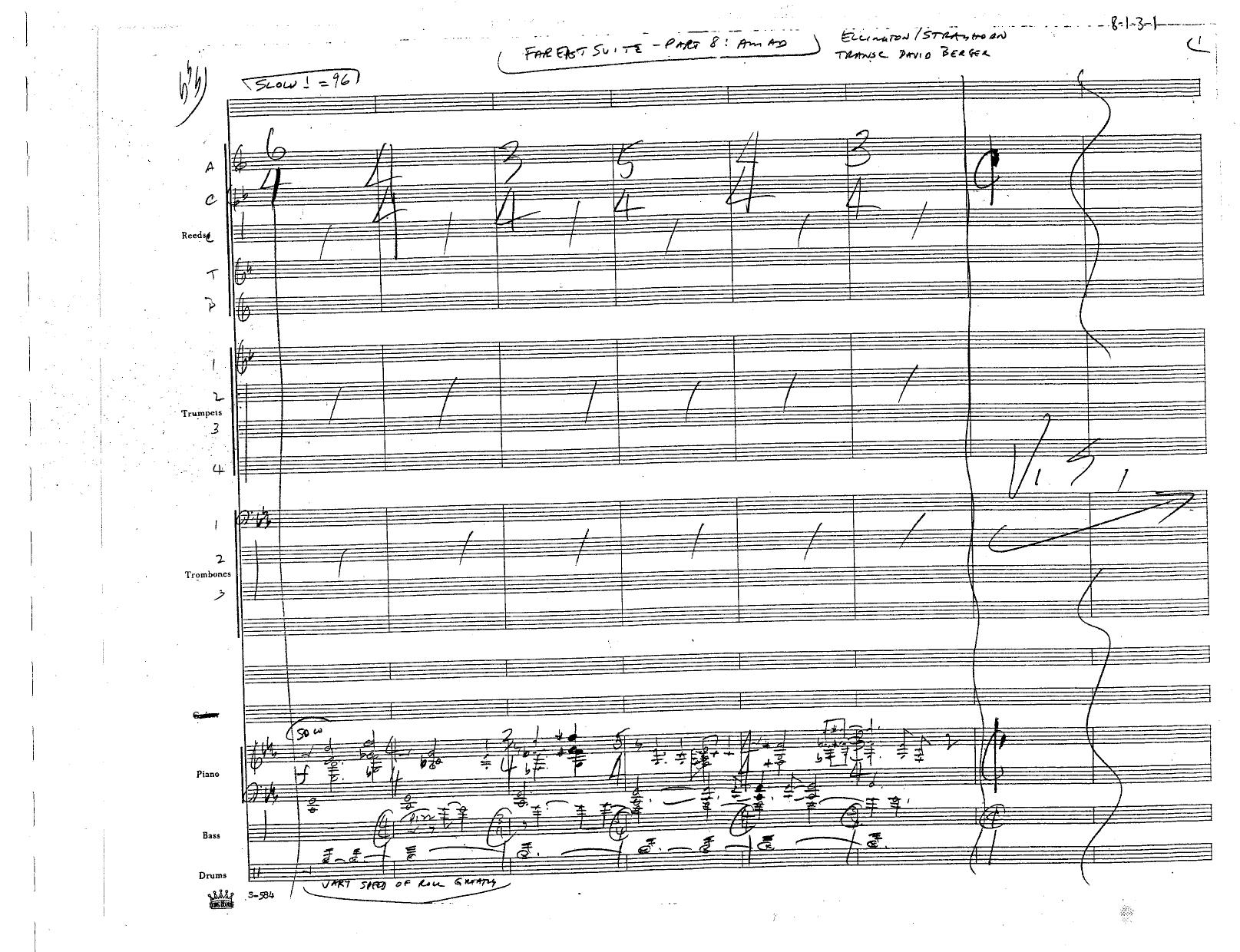
Amad (D.Ellington)
Composed by Duke Ellington
Arranged by Duke Ellington & B.Strayhorn.D.Berger
- Ensemble: Big Band
- Pages: 25
- Instruments (15): Alto Saxophone, Clarinet 1, Clarinet 2, Tenor Saxophone, Baritone Saxophone, Trumpet 1, Trumpet 2, Trumpet 3, Trumpet 4, Trombone 1, Trombone 2, Trombone 3, Piano, Double Bass, Drums
- Difficulty: medium
- Content: Individual Parts
- Format: PDF Download (Instant)
- Price: $24.99
Composed by Duke Ellington as part of his monumental 1942 extended suite *Black, Brown, and Beige*—hailed as a "tone parallel to the history of the American Negro"—"Amad" stands as a striking testament to the visionary intersection of jazz and classical long-form composition. Originally brought to life by the legendary Duke Ellington Orchestra, this movement captures the rich tapestry of early African American history, translating deep cultural narratives into an sophisticated, idiom-shifting big band canvas. The collaborative editing and transcription work by Billy Strayhorn and David Berger preserves the intricate nuances of Ellington's original conception while making the complex score accessible to modern ensembles. Musically, "Amad" operates with a distinctive, evocative temperament that moves fluidly between driving modal textures and evocative, blues-inflected passages. The tempo feel is flexible yet purposeful, driven by an underlying rhythmic pulse that favors atmospheric tension and release over straightforward swing. The key centers shift with cinematic color, evoking a moody, solemn, and deeply introspective emotional landscape. Rather than relying on standard pop-song forms, the composition unfolds episodically, creating a dramatic arc that demands high emotional investment and artistic maturity from every section in the ensemble. The arranging approach relies heavily on Ellington's signature "voice-leading" techniques and cross-section voicings, where instruments are blended in unconventional combinations to create unique orchestral timbres. Strayhorn and Berger's editorial precision highlights the intricate counterpoint and specialized color pairings—such as muted brass contrasting with dark, reedy saxophone solis. The reeds and lower brass frequently carry weighted, vocal-like melodies, while harmonic extensions stretch traditional big band boundaries through cluster voicings and subtle chromatic shifts. Soloists are integrated organically into the texture, functioning less as traditional chord-changes blowers and more as narrative voices within a larger tone poem. Performing "Amad" successfully requires exceptional dynamic control, precise intonation, and a deep appreciation for Ellingtonian phrasing and timbre. The woodwind players must navigate rapid shifts between articulated lines and lush, sustained chordal blending, while the brass section needs refined control over mutes, subtle vibrato, and dynamic shading. Because of its structural complexity, subtle tempo pacing, and historical weight, this 25-page arrangement is best suited for advanced college, conservatory, community jazz orchestras, and professional big bands seeking to explore the upper echelon of America's classical jazz repertoire. Navigating "Amad" successfully requires conductors and performers to prioritize tonal color and rhythmic flexibility over sheer volume. The primary technical challenge lies in maintaining a cohesive ensemble blend across unconventional chord voicings and dense counterpoint. Conductors should establish a steady, hypnotic pulse rather than a rigid metronomic feel, allowing the rubato-esque passages to breathe organically. Pay close attention to dynamic markings; the piece relies heavily on sudden drops to subtones and soaring crescendos to create its dramatic narrative. Saxophone sections should practice balancing their chords internally, ensuring that no single voice sticks out unless carrying a designated melodic line. Brass players must utilize specified mutes (cup and straight variants) with precision to achieve the authentic Ellingtonian tonal palette, avoiding harsh edges in favor of a warm, vocal quality. Rehearsals should initially focus on sectional balance at slower tempos before integrating the full ensemble interplay and featured solo sections. Q: What instruments and parts are included in this arrangement? A: This chart is scored for an 8-instrument core big band instrumentation, featuring Alto Saxophone, Tenor Saxophone, Baritone Saxophone, Trumpet, and Trombone parts, fully supported across a 25-page comprehensive score and set of parts. Q: What is the difficulty level of this arrangement? A: This piece is graded as advanced (Difficult), requiring high-level technical proficiency, refined listening skills, and specialized stylistic awareness tailored to Ellington's sophisticated orchestration. Q: What is the historical context and style of "Amad"? A: "Amad" is a movement from Duke Ellington's landmark 1942 suite *Black, Brown, and Beige*, representing a pivotal moment where jazz expanded into symphonic, long-form storytelling celebrating African American history. Q: What makes this specific collaboration by Ellington, Strayhorn, and Berger unique? A: This arrangement combines Ellington's original compositional genius and Strayhorn's harmonic sensibilities with David Berger's meticulous transcription work, ensuring authentic historic voicings are accurately translated for modern big bands. Q: What is the expected performance duration and tempo approach? A: The performance duration typically spans several minutes depending on the conductor's pacing, featuring a deliberate, narrative-driven tempo that avoids rigid swing clichés in favor of evocative, expressive rubato and groove pacing.
Questions and answers
- What is included in the Amad (D.Ellington) PDF?
- The verified current file contains a conductor score across 25 pages.
- How many instruments or parts are listed for Amad (D.Ellington)?
- The verified instrumentation list contains 15 entries for this Big Band arrangement.
- Who is credited for Amad (D.Ellington)?
- Composer: Duke Ellington. Arranger: Duke Ellington & B.Strayhorn.D.Berger.
- What difficulty is listed for Amad (D.Ellington)?
- The verified difficulty level is medium.
- Can I preview Amad (D.Ellington) before buying?
- Yes. The product page provides a preview generated from the current PDF file.
- How is Amad (D.Ellington) delivered?
- After successful payment, the digital PDF is made available for download. The displayed price is $24.99.
Musicians Also Search For
Amad Duke Ellington & B.Strayhorn.D.Berger PDF • Amad Duke Ellington & B.Strayhorn.D.Berger sheet music • Amad arranged by Duke Ellington & B.Strayhorn.D.Berger • Duke Ellington & B.Strayhorn.D.Berger big band charts • Duke Ellington & B.Strayhorn.D.Berger jazz arrangements PDF • Amad Duke Ellington sheet music • Amad Duke Ellington big band arrangements • Duke Ellington big band charts • Amad big band arrangements • Amad big band PDF download • Amad jazz sheet music • big band sheet music download • Amad conductor score PDF • Amad sheet music PDF • buy Amad sheet music • download Amad PDF • Amad jazz charts • best Duke Ellington & B.Strayhorn.D.Berger big band arrangements • Duke Ellington arranged by Duke Ellington & B.Strayhorn.D.Berger • Amad printable sheet music • big band repertoire PDF