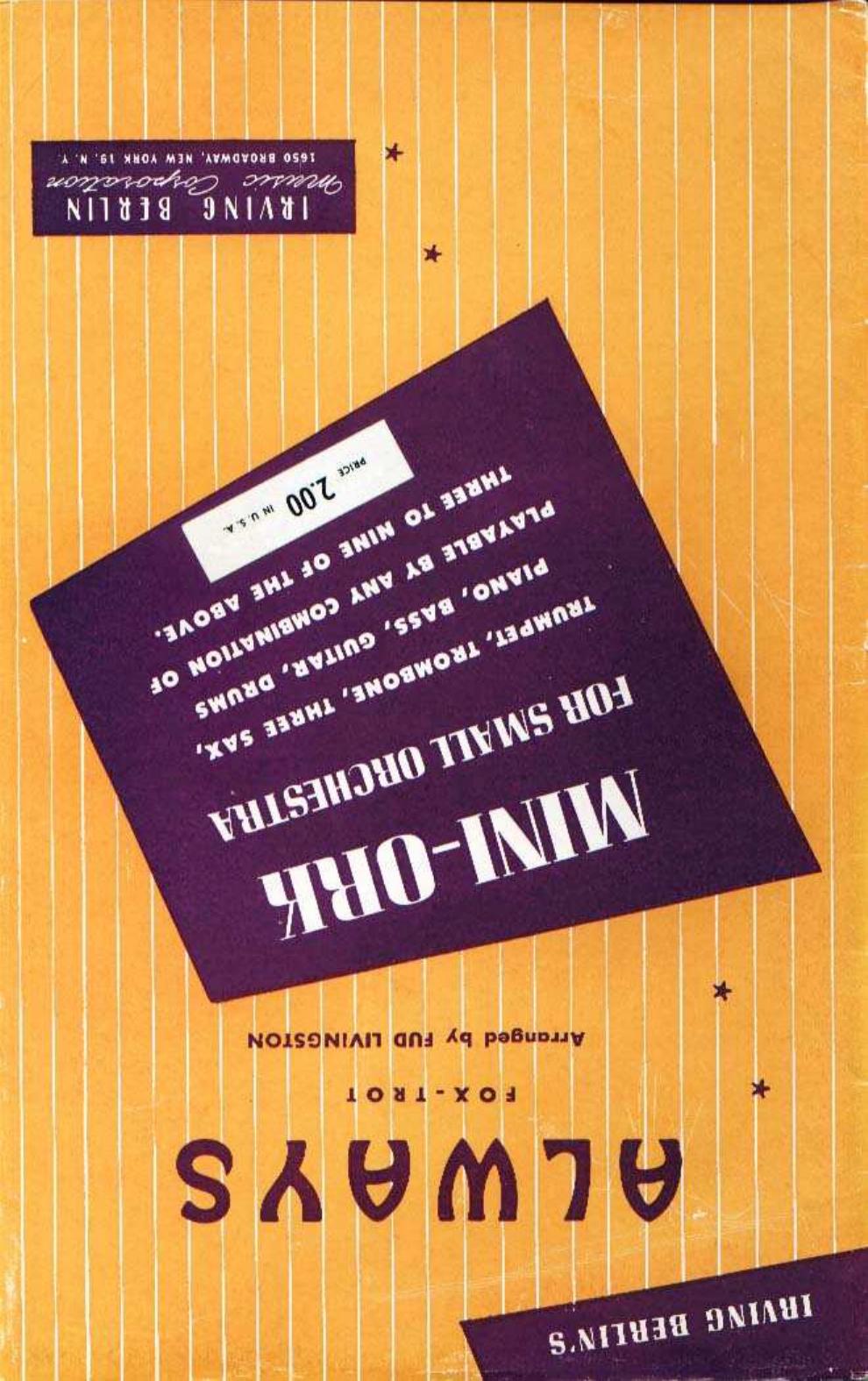
Always (F.Livingston)
Composed by Irving Berlin
Arranged by Fud Livingston
- Ensemble: Big Band
- Pages: 22
- Instruments (9): 1st Saxophone Eb Alto, 2nd Saxophone Bb Tenor, 3rd Saxophone Eb Alto, 1st Trombone, 1st Trumpet in Bb, Piano, Guitar, Bass, Drums
- Difficulty: medium
- Content: Individual Parts
- Format: PDF Download (Instant)
- Price: $24.99
Irving Berlin’s timeless 1925 ballad "Always" occupies a revered space in the Great American Songbook, having transitioned from a sentimental Tin Pan Alley waltz into an enduring vehicle for jazz improvisation. Long before it became a staple for vocal icons like Ella Fitzgerald and instrumentalists such as Lester Young, early jazz arrangers recognized its sublime harmonic architecture. Joseph "Fud" Livingston—a legendary arranger, clarinetist, and saxophonist whose work defined the transitional era between 1920s sweet bands and early swing—reimagined Berlin's masterpiece through a distinctly sophisticated jazz lens. Livingston’s vintage big band scoring captures the bittersweet, romantic yearning of the original composition while infusing it with the ingenious counterpoint, driving pulse, and clever harmonic twists that characterized the late 1920s New York jazz scene. At a comfortable medium-swing tempo, this arrangement trades the original waltz meter for a supple, bouncing 4/4 groove that lets the melody breathe with organic syncopation. The emotional landscape shifts gracefully from intimate, conversational introspective phrasing to warm, texturally rich ensemble passages. Livingston constructs a lush harmonic palette that avoids excessive modernity, instead favoring rich triad extensions, chromatic voice-leading, and clever counter-melodies woven expertly between the reeds and brass. The mood evokes a smoky, late-night speakeasy atmosphere—sophisticated, deeply swinging, and dripping with 1920s elegance, making it an exquisite emotional anchor for any traditional or vintage-leaning jazz concert. Livingston’s signature writing style shines through the meticulous interplay between the front line and the rhythm section. Rather than relying on static block-chord voicing, the arrangement utilizes fluid polyphonic textures where the clarinet and alto saxophone often weave agile obbligatos around a muted trumpet statement of the core melody. The tenor saxophone enjoys prominent feature moments, delivering warm, Lester Young-esque lyrical interpretations of Berlin’s immortal changes. The dynamic arc builds organically toward a tightly knit ensemble shout chorus that showcases classic period voicing techniques—distinctive cup and plunger effects, subtle brass falls, and harmonically clever transitions that propel the band forward without ever sacrificing the underlying sweetness of the tune. Designed specifically for a classic 9-instrument core ensemble (featuring trumpet, trombone, clarinet, alto saxophone, tenor saxophone, and a full rhythm section footprint spanning 22 comprehensive pages), this chart is exceptionally well-suited for advanced high school, collegiate, and professional repertory bands specializing in early swing, hot jazz, or traditional big band idioms. Because the orchestration relies heavily on balance, transparent textures, and stylistic authenticity rather than brute force endurance, it provides an invaluable educational tool for teaching students how to swing with historical accuracy, master early jazz articulation, and balance delicate, interwoven horn lines. Achieving the authentic 1920s jazz aesthetic in this Fud Livingston chart requires careful attention to balance, articulation, and stylistic nuance. The conductor should establish a relaxed medium-swing tempo—avoiding any tendency to rush the quarter-note pulse. Horn players must master a detached, buoyant eighth-note style where downbeats are gently emphasized and upbeats receive a light, vocalized tongue. Reeds, particularly the clarinet and alto saxophone, need to project their counter-melodies without overpowering the primary melodic voice in the trumpet. Pay close attention to dynamic markings in the inner-voice harmonies; the beauty of Livingston's writing lies in the subtle chromatic movement of the middle parts. Brass players should utilize mild cup mutes or bucket mutes where indicated to achieve that velvety, vintage timbre characteristic of late-1920s commercial broadcasting bands. In rehearsal, isolate the rhythm section first to ensure a crisp, unburdened four-to-the-bar guitar and bass foundation that supports, rather than dictates, the horns' expressive phrasing. Q: What instruments and parts are included in this arrangement? A: This arrangement is scored for a 9-instrument ensemble across 22 pages, featuring dedicated parts for trumpet, trombone, clarinet, alto saxophone, tenor saxophone, and a complete rhythm section. Q: What is the difficulty level of this Fud Livingston chart? A: The chart is well-suited for advanced high school, collegiate, and professional ensembles, requiring strong ensemble listening skills, stylistic versatility in early swing, and precise balance rather than extreme technical endurance. Q: What is the historical style and musical context of this piece? A: Written by Fud Livingston, this arrangement adapts Irving Berlin's 1925 standard into the sophisticated, polyphonic hot-jazz and early swing idiom characteristic of late-1920s New York jazz orchestras. Q: What makes this specific arrangement unique? A: Unlike modern big band charts that rely on heavy brass shout choruses, Livingston's treatment stands out for its intricate reed-and-brass counterpoint, warm harmonic voice-leading, and authentic period voicings. Q: What is the recommended performance duration and tempo feel? A: The arrangement is designed for a relaxed medium-swing tempo in 4/4 time, typically clocking in around 3 to 4 minutes depending on solo expansion and stylistic breathing room.
Questions and answers
- What is included in the Always (F.Livingston) PDF?
- The verified current file contains individual parts across 22 pages.
- How many instruments or parts are listed for Always (F.Livingston)?
- The verified instrumentation list contains 9 entries for this Big Band arrangement.
- Who is credited for Always (F.Livingston)?
- Composer: Irving Berlin. Arranger: Fud Livingston.
- What difficulty is listed for Always (F.Livingston)?
- The verified difficulty level is medium.
- Can I preview Always (F.Livingston) before buying?
- Yes. The product page provides a preview generated from the current PDF file.
- How is Always (F.Livingston) delivered?
- After successful payment, the digital PDF is made available for download. The displayed price is $24.99.
Musicians Also Search For
Always Fud Livingston PDF • Always Fud Livingston sheet music • Always arranged by Fud Livingston • Fud Livingston big band charts • Fud Livingston jazz arrangements PDF • Always Irving Berlin sheet music • Always Irving Berlin big band arrangements • Irving Berlin big band charts • Always big band arrangements • Always big band PDF download • Always jazz sheet music • big band sheet music download • Always individual parts download • Always sheet music PDF • buy Always sheet music • download Always PDF • Always jazz charts • best Fud Livingston big band arrangements • Irving Berlin arranged by Fud Livingston • Always printable sheet music • big band repertoire PDF