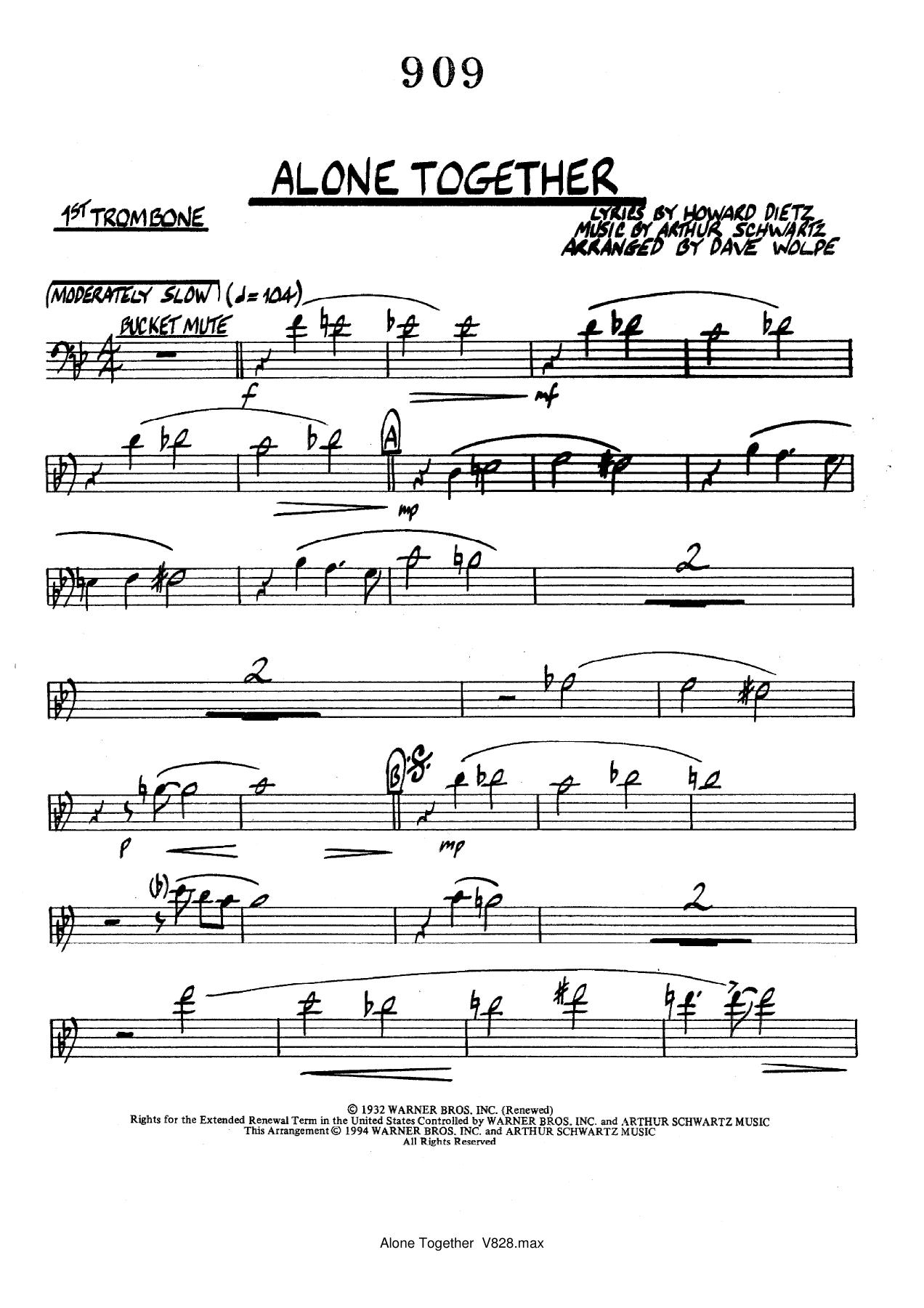
Alone Together (D.Wolpe) vocal sheet music preview

Alone Together (D.Wolpe) vocal

Composed by Arthur Schwartz

Arranged by Dave Wolpe

  • Ensemble: Big Band Vocal
  • Style: Jazz Standard
  • Pages: 38
  • Instruments (19): 1st Trombone, 2nd Trombone, 3rd Trombone, Bass Trombone, Piano, Bass, Drums, Vocal Solo, 1st Alto Saxophone, 2nd Alto Saxophone, 1st Tenor Saxophone, 2nd Tenor Saxophone, Eb Baritone Saxophone, Solo Bb Tenor Saxophone (Optional), 1st Bb Trumpet, 2nd Bb Trumpet, 3rd Bb Trumpet, 4th Bb Trumpet, Guitar
  • Difficulty: medium
  • Content: Individual Parts
  • Format: PDF Download (Instant)
  • Price: $24.99

Arthur Schwartz and Howard Dietz’s timeless ballad, "Alone Together," first graced the stage in the 1932 Broadway revue *Flying Colors*, quickly establishing itself as a poignant standard of the Great American Songbook. Penned during the twilight of the Jazz Age and the dawn of the Swing Era, its melancholic yet tender melody and introspective lyrics resonated deeply, capturing the essence of shared solitude. While numerous vocalists and instrumentalists have embraced its beauty, from Artie Shaw’s iconic instrumental rendition to Blossom Dearie’s intimate vocal interpretation, it remains a cornerstone of the jazz repertoire, celebrated for its sophisticated harmonic progression and enduring emotional depth. Its enduring appeal lies in its ability to evoke a sense of longing and connection, making it a favorite for both performers and audiences across generations. Dave Wolpe’s arrangement of "Alone Together" for big band and vocal soloist reimagines this classic with a medium swing feel, set in the key of G minor. The mood is one of sophisticated yearning, building from a tender, almost contemplative opening to a rich, full-bodied expression of the song’s emotional core. Wolpe, renowned for his ability to craft arrangements that are both accessible and musically substantial, employs his signature blend of lush voicings and dynamic contrasts. Expect meticulously crafted saxophone soli sections that weave intricate counter-melodies around the vocalist, brass figures that provide both harmonic support and rhythmic drive, and a full-ensemble texture that swells and recedes with expert precision. His approach often features a gradual build-up in intensity, culminating in a powerful shout chorus that showcases the full might of the big band without overpowering the vocal line. The arrangement opens with a sensitive introduction, often featuring piano and bass, setting a reflective tone before the vocalist enters with the familiar melody. The vocal line generally carries the primary melodic responsibility, allowing the band to provide a rich harmonic tapestry and rhythmic propulsion. A featured instrumental solo, typically for tenor saxophone or trumpet, offers an opportunity for improvisation and further melodic development, often over a harmonically rich background. Technical challenges include precise ensemble articulation, maintaining a consistent medium swing groove, and achieving balanced dynamics, particularly in sections where the band supports the vocal. The rewarding aspects lie in the arrangement's emotional arc, the interplay between the soloist and the ensemble, and the sheer pleasure of performing a beautifully orchestrated jazz standard. This arrangement is ideally suited for college and community big bands, as well as professional ensembles seeking a polished and engaging vocal feature. Its thoughtful construction provides ample opportunity for musical expression and ensemble cohesion without presenting insurmountable technical hurdles. Conductors should emphasize a relaxed, yet precise medium swing feel from the outset, ensuring the rhythm section lays down a solid foundation without rushing. The opening requires sensitive dynamic control, building gradually as the arrangement progresses. Pay close attention to the balance between the vocal soloist and the ensemble; brass figures, particularly in the shout chorus, should be powerful but never mask the vocalist. Articulation is key: ensure saxophones play with a smooth, legato feel in soli sections, while brass stabs are crisp and unified. Rehearsal time should focus on tuning chords, especially in the lush brass and sax voicings, and on achieving seamless transitions between sections. The featured instrumental solo should allow for expressive improvisation, with the background figures providing supportive, not distracting, texture. Encourage musicians to listen across sections to blend and shape phrases together, bringing out the inherent emotional depth of this classic standard. Q: What instruments and parts are included in this arrangement? A: This arrangement is for a standard big band instrumentation, featuring 5 saxophones (2 altos, 2 tenors, 1 baritone), 4 trumpets, 4 trombones, piano, bass, drums, and a dedicated vocal soloist part. Q: What is the difficulty level of this arrangement? A: This arrangement is rated as medium-difficult. It requires a solid understanding of jazz articulation, good ensemble blend, and dynamic control, making it suitable for advanced high school, college, community, and professional big bands. Q: What is the musical style and historical context of "Alone Together" in this arrangement? A: This is a vocal big band arrangement of the jazz standard "Alone Together," originally composed in 1932. It is presented in a classic medium swing style, typical of the Swing Era but with modern harmonic sensibilities. Q: What makes Dave Wolpe's arrangement of "Alone Together" unique? A: Wolpe's arrangement is distinguished by its lush, sophisticated voicings, dynamic build-ups, and expertly crafted soli sections that support and interact with the vocal soloist, creating a rich and engaging musical narrative. Q: What is the typical performance duration and tempo for this piece? A: The typical performance duration for this arrangement is approximately 3-4 minutes, depending on the length of the instrumental solo. It is designed to be performed at a consistent medium swing tempo, around 120-130 BPM.

Questions and answers

What is included in the Alone Together (D.Wolpe) vocal PDF?
The verified current file contains individual parts across 38 pages.
How many instruments or parts are listed for Alone Together (D.Wolpe) vocal?
The verified instrumentation list contains 19 entries for this Big Band Vocal arrangement.
Who is credited for Alone Together (D.Wolpe) vocal?
Composer: Arthur Schwartz. Arranger: Dave Wolpe.
What difficulty is listed for Alone Together (D.Wolpe) vocal?
The verified difficulty level is medium.
What style is listed for Alone Together (D.Wolpe) vocal?
The catalog lists the style as Jazz Standard.
Can I preview Alone Together (D.Wolpe) vocal before buying?
Yes. The product page provides a preview generated from the current PDF file.
How is Alone Together (D.Wolpe) vocal delivered?
After successful payment, the digital PDF is made available for download. The displayed price is $24.99.

Musicians Also Search For

Alone Together Dave Wolpe PDFAlone Together Dave Wolpe sheet musicAlone Together arranged by Dave WolpeDave Wolpe big band vocal chartsDave Wolpe jazz arrangements PDFAlone Together Arthur Schwartz sheet musicAlone Together Arthur Schwartz big band vocal arrangementsArthur Schwartz big band vocal chartsAlone Together big band vocal arrangementsAlone Together big band vocal PDF downloadAlone Together jazz sheet musicbig band vocal sheet music downloadAlone Together individual parts downloadAlone Together sheet music PDFAlone Together Jazz Standard chartsJazz Standard big band vocal arrangementsbuy Alone Together sheet musicdownload Alone Together PDFAlone Together jazz chartsbest Dave Wolpe big band vocal arrangementsArthur Schwartz arranged by Dave WolpeAlone Together printable sheet musicbig band vocal repertoire PDF

All arrangements by Dave Wolpe All Arthur Schwartz sheet music