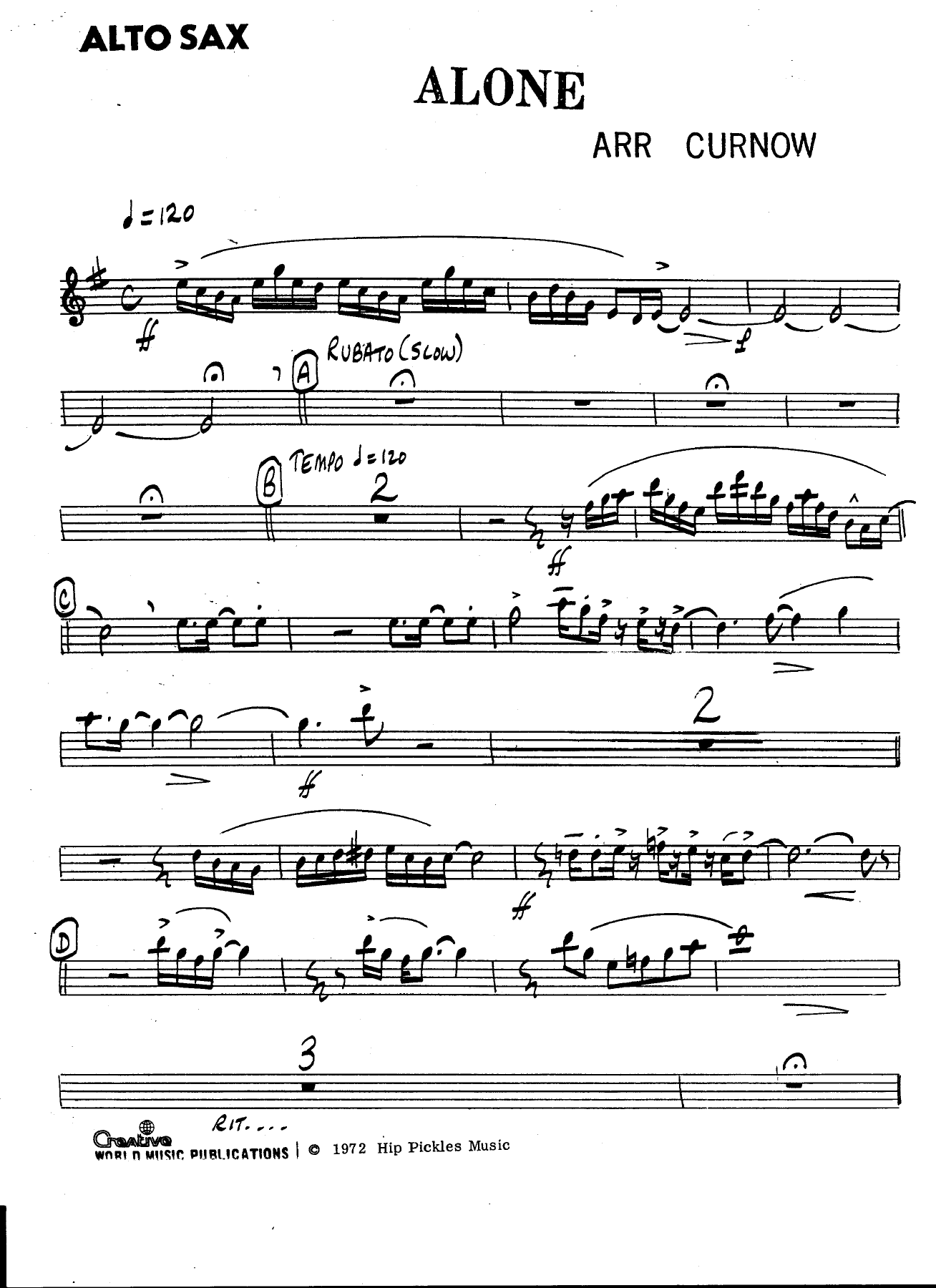
Alone (B.Curnow) sheet music preview

Alone (B.Curnow)

Composed by Bob Curnow

Arranged by B.Curnow

  • Ensemble: Big Band
  • Style: Jazz Standard
  • Pages: 60
  • Instruments (20): Alto Sax, 2nd Alto Sax, 1st Tenor Sax, 2nd Tenor Sax, 4th Tenor Sax, 1st Baritone Sax, 2nd Baritone Sax, 1st Trumpet, 2nd Trumpet, 3rd Trumpet, 4th Trumpet, 5th Trumpet, Solo Trombone, 1st Trombone, 2nd Trombone, 3rd Trombone, Tuba, Piano, Fender Bass, Drums
  • Difficulty: advanced
  • Content: Individual Parts
  • Format: PDF Download (Instant)
  • Price: $24.99

"Alone," originally penned by the esteemed Bob Curnow, stands as a quintessential jazz standard, embodying the rich harmonic and melodic sophistication that characterized the post-bop era. While the original composition's precise debut date is often debated, its essence firmly roots it in the late 20th-century jazz canon, a period marked by intricate arrangements and a deepening exploration of jazz's expressive potential. Curnow, celebrated for his contributions as a trombonist, composer, and arranger, crafted a piece that, though perhaps not as widely known as some standards, is deeply respected within the big band community for its inherent musicality and structural integrity. Its enduring appeal lies in its evocative melody and harmonic depth, making it a compelling vehicle for improvisation and ensemble expression. This specific big band arrangement by B.Curnow transforms the contemplative nature of "Alone" into a vibrant, medium-swing exploration. Set primarily in a reflective minor key, the piece maintains a steady, yet flexible, 4/4 groove, allowing for both rhythmic precision and expressive fluidity. The mood oscillates between introspective melancholy and soaring optimism, creating a dynamic emotional arc. Curnow's signature arranging style is immediately apparent in the sophisticated voicings, which often feature dense, rich harmonies that leverage the full spectrum of the big band's timbre. Expect meticulously crafted soli sections that highlight the saxophone and brass sections, demonstrating Curnow's mastery of orchestral jazz writing. The arrangement builds towards a powerful shout chorus, characteristic of his ability to generate immense energy and excitement through expertly layered brass and sax figures. The melodic responsibilities are thoughtfully distributed, with the initial statement often carried by the lead alto saxophone, establishing the piece's lyrical foundation. Throughout the arrangement, the melody is passed between various sections, offering each voice an opportunity to shine. Featured solo opportunities are typically provided for alto saxophone and trumpet, allowing skilled improvisers to navigate Curnow's rich harmonic landscape. Technical challenges include precise articulation in the fast-moving soli passages, maintaining blend and balance in the dense chordal sections, and achieving a cohesive, driving swing feel across the entire ensemble. The rewarding aspect of performing this arrangement lies in its profound musicality; successfully navigating its intricacies yields a deeply satisfying and impactful performance, showcasing both individual musicianship and collective ensemble prowess. Given its harmonic complexity, intricate voicings, and the demands of maintaining a consistent, authentic swing feel, this arrangement of "Alone" is ideally suited for advanced high school, collegiate, and community jazz ensembles, as well as professional big bands. The depth of the writing offers significant educational value, pushing musicians to develop their understanding of jazz harmony, ensemble blend, and rhythmic precision. Its 60-page conductor score and comprehensive 19-instrument parts ensure a full, rich sound, making it a substantial and impressive addition to any big band's repertoire. Conductors should establish a consistent, relaxed medium-swing tempo (around 120-132 BPM) from the outset, emphasizing a light, buoyant quarter-note pulse. The piece demands meticulous attention to dynamics, particularly in the nuanced interplay between sections. Key technical challenges include the intricate saxophone soli passages, which require precise articulation and unified phrasing to achieve clarity and impact. Brass sections must focus on clean attacks and releases, especially in the extended harmonic voicings, ensuring proper balance to avoid overpowering the woodwinds. While no specific mutes are explicitly called for beyond standard cup and straight mutes, judicious use of plunger mutes for expressive brass swells can enhance the emotional depth. Rehearsal time should be dedicated to isolating and balancing the inner voices of the chordal sections, particularly in the shout chorus, to reveal Curnow's rich harmonic tapestry. Encourage soloists to embrace the melodic and harmonic sophistication, fostering expressive improvisation within the established mood. Q: What instruments and parts are included in the "Alone (B.Curnow)" big band arrangement? A: This arrangement includes parts for 19 instruments: Alto Saxophone 1, Alto Saxophone 2, Tenor Saxophone 1, Tenor Saxophone 4, Baritone Saxophone 1, and the standard full big band instrumentation, along with a comprehensive conductor score. Q: What is the difficulty level of this arrangement, and for what type of ensemble is it most suitable? A: This arrangement is considered advanced, requiring experienced musicianship and strong ensemble skills. It is most suitable for advanced high school, collegiate, community, and professional big bands. Q: What is the musical style and historical context of "Alone (B.Curnow)"? A: "Alone" is a jazz standard rooted in the post-bop era, characterized by sophisticated harmonies and melodic depth. Bob Curnow's original composition and subsequent arrangement embody the rich, orchestral jazz writing style of the late 20th century. Q: What makes B.Curnow's arrangement of "Alone" unique? A: B.Curnow's arrangement is distinguished by its sophisticated voicings, intricate soli sections for saxophones and brass, and a powerful shout chorus. It showcases his signature ability to create a dynamic emotional arc through rich harmonic layering and expressive orchestration. Q: What is the typical performance duration and tempo of this arrangement? A: The performance duration typically ranges from 5 to 7 minutes, depending on the length of improvised solos. It is performed at a medium-swing tempo, generally around 120-132 BPM.

Questions and answers

What is included in the Alone (B.Curnow) PDF?
The verified current file contains a conductor score and individual parts across 60 pages.
How many instruments or parts are listed for Alone (B.Curnow)?
The verified instrumentation list contains 20 entries for this Big Band arrangement.
Who is credited for Alone (B.Curnow)?
Composer: Bob Curnow. Arranger: B.Curnow.
What difficulty is listed for Alone (B.Curnow)?
The verified difficulty level is advanced.
What style is listed for Alone (B.Curnow)?
The catalog lists the style as Jazz Standard.
Can I preview Alone (B.Curnow) before buying?
Yes. The product page provides a preview generated from the current PDF file.
How is Alone (B.Curnow) delivered?
After successful payment, the digital PDF is made available for download. The displayed price is $24.99.

Musicians Also Search For

Alone B.Curnow PDFAlone B.Curnow sheet musicAlone arranged by B.CurnowB.Curnow big band chartsB.Curnow jazz arrangements PDFAlone Bob Curnow sheet musicAlone Bob Curnow big band arrangementsBob Curnow big band chartsAlone big band arrangementsAlone big band PDF downloadAlone jazz sheet musicbig band sheet music downloadAlone conductor score PDFAlone individual parts downloadAlone sheet music PDFAlone Jazz Standard chartsJazz Standard big band arrangementsbuy Alone sheet musicdownload Alone PDFAlone jazz chartsbest B.Curnow big band arrangementsBob Curnow arranged by B.CurnowAlone printable sheet musicbig band repertoire PDF

All arrangements by B.Curnow All Bob Curnow sheet music