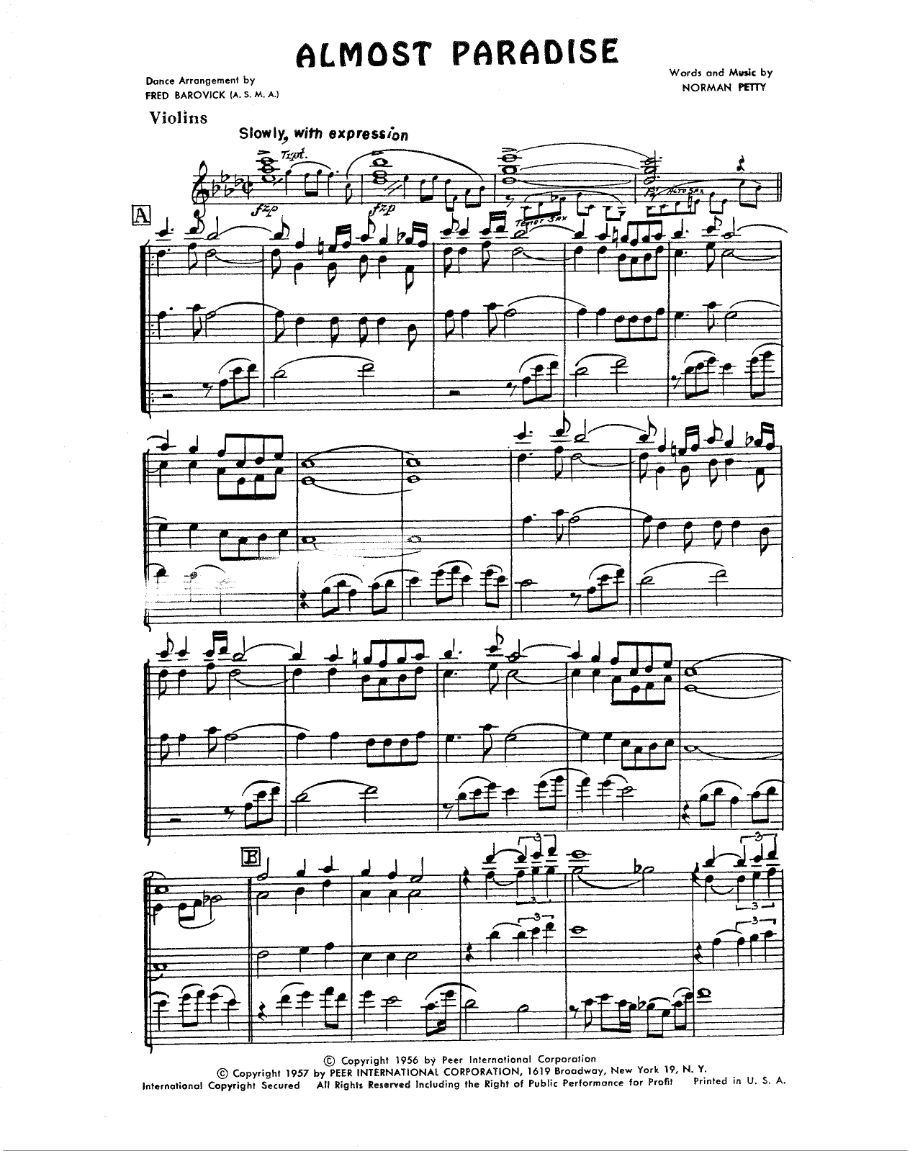
Almost Paradise (F.Barocick)
Composed by Dean Pitchford
Arranged by F.Barocick
- Ensemble: Big Band Vocal
- Style: Jazz Standard
- Pages: 34
- Instruments (18): Violins, 1st Sax. Eb Alto, 3rd Sax. Eb Alto, 2nd Sax. Bb Tenor, 4th Sax. Bb Tenor, 1st Clarinet, 2nd Clarinet, 3rd Clarinet, Bass Clarinet, 1st Trumpet, 2nd Trumpet, 3rd Trumpet, 1st Trombone, 2nd Trombone, Guitar, Piano, Bass, Drums
- Difficulty: medium
- Content: Individual Parts
- Format: PDF Download (Instant)
- Price: $24.99
"Almost Paradise," originally the iconic love theme from the 1984 film *Footloose*, emerged from the vibrant 1980s pop-rock landscape. Composed by Dean Pitchford and Eric Carmen, the song became a smash hit as a duet performed by Mike Reno of Loverboy and Ann Wilson of Heart, peaking at No. 7 on the Billboard Hot 100 and reaching No. 1 on the Adult Contemporary chart. Its enduring popularity is rooted in its powerful melody and heartfelt lyrics, capturing the essence of romantic yearning and making it a staple at proms and weddings. While not traditionally a jazz standard, its strong melodic structure and emotional depth make it ripe for reinterpretation within the jazz idiom, offering a familiar yet fresh canvas for big band exploration. F.Barocick's arrangement transforms this beloved power ballad into a captivating jazz standard for big band with a featured vocalist. Set at a medium-slow ballad tempo in 4/4, the arrangement maintains the original's expressive mood while infusing it with sophisticated jazz harmonies and rhythmic nuances. The primary key of Eb Major provides a rich, warm palette, allowing for lush voicings and a sense of expansive romance. The overall energy is one of tender passion, building gradually from intimate moments to powerful ensemble climaxes. Barocick’s treatment evokes a classic big band ballad feel, reminiscent of arrangements from the Basie or Kenton libraries, but with a contemporary harmonic sensibility. F.Barocick's distinctive arranging style is evident in the artful reharmonization and thoughtful orchestration. Expect rich, often dense voicings in the saxophone section, frequently employing close-position harmonies that create a warm, enveloping sound. Brass sections are utilized for both delicate countermelodies and powerful, sustained chords during climactic moments, often featuring harmon mute work in the trumpets for textural variety. A signature of Barocick's approach is the judicious use of extended harmonies, adding color and tension without obscuring the original melody. The arrangement features the vocalist prominently, with the melody primarily carried by the voice, supported by a meticulously crafted big band accompaniment that weaves intricate lines and sustained pads. There are no extended improvised solos, keeping the focus squarely on the vocal performance and the ensemble's interpretive power. This arrangement is ideally suited for college, community, and professional big bands seeking a challenging yet deeply rewarding piece. The technical demands include precise intonation within complex voicings, dynamic control across a wide range, and a sophisticated understanding of ballad phrasing. The rewarding aspect lies in the opportunity to perform a well-known, emotionally resonant piece with a fresh, jazz-infused perspective, allowing the band to showcase its expressive capabilities and blend. Specific musical moments, such as the gradual build to the shout chorus and the subtle interplay between the vocalist and the ensemble, stand out as highlights. This arrangement of "Almost Paradise" requires meticulous attention to blend and balance, particularly within the saxophone and brass sections during sustained chords and soli passages. Conductors should emphasize a unified approach to phrasing, ensuring that the ballad tempo (approximately quarter note = 60-72) maintains forward motion without dragging. Key technical challenges include navigating the extended harmonies and maintaining precise intonation, especially in the inner voices of the saxophone voicings. Encourage brass players to use plunger mutes for specific dramatic effects as indicated, focusing on a controlled, expressive "wah" sound. Rehearsal time should be dedicated to shaping the dynamic arc of the piece, from the hushed opening to the powerful climaxes, and to ensuring the vocalist's phrasing integrates seamlessly with the ensemble's accompaniment. Pay close attention to the rhythm section's role in providing a supportive yet flexible foundation, allowing the melody to breathe. Q: What instruments and parts are included in this arrangement? A: This big band vocal arrangement includes standard instrumentation: 5 saxophones (2 altos, 2 tenors, 1 baritone), 4 trumpets, 4 trombones, and a full rhythm section (piano, bass, drums, guitar), plus a dedicated vocal chart. Q: What is the difficulty level of this arrangement? A: This arrangement is rated as advanced intermediate to advanced, suitable for college, community, and professional big bands. It requires strong ensemble playing, advanced sight-reading, and a sophisticated understanding of jazz harmony and ballad interpretation. Q: What is the musical style and historical context of "Almost Paradise (F.Barocick)"? A: This is a jazz standard arrangement of "Almost Paradise," originally a popular 1980s power ballad from the movie *Footloose*. F.Barocick's treatment reinterprets the piece with rich jazz harmonies and big band orchestration, giving it a timeless, expressive quality. Q: What makes F.Barocick's arrangement of "Almost Paradise" unique? A: F.Barocick's arrangement is unique for its sophisticated reharmonization, lush saxophone voicings, and dynamic orchestration that transforms the original pop hit into a compelling jazz ballad, focusing on the expressive interplay between the vocalist and the big band. Q: What is the approximate performance duration and tempo of this arrangement? A: The approximate performance duration for this arrangement is 4-5 minutes, performed at a medium-slow ballad tempo, typically around 60-72 beats per minute.
Questions and answers
- What is included in the Almost Paradise (F.Barocick) PDF?
- The verified current file contains individual parts across 34 pages.
- How many instruments or parts are listed for Almost Paradise (F.Barocick)?
- The verified instrumentation list contains 18 entries for this Big Band Vocal arrangement.
- Who is credited for Almost Paradise (F.Barocick)?
- Composer: Dean Pitchford. Arranger: F.Barocick.
- What difficulty is listed for Almost Paradise (F.Barocick)?
- The verified difficulty level is medium.
- What style is listed for Almost Paradise (F.Barocick)?
- The catalog lists the style as Jazz Standard.
- Can I preview Almost Paradise (F.Barocick) before buying?
- Yes. The product page provides a preview generated from the current PDF file.
- How is Almost Paradise (F.Barocick) delivered?
- After successful payment, the digital PDF is made available for download. The displayed price is $24.99.
Musicians Also Search For
Almost Paradise F.Barocick PDF • Almost Paradise F.Barocick sheet music • Almost Paradise arranged by F.Barocick • F.Barocick big band vocal charts • F.Barocick jazz arrangements PDF • Almost Paradise Dean Pitchford sheet music • Almost Paradise Dean Pitchford big band vocal arrangements • Dean Pitchford big band vocal charts • Almost Paradise big band vocal arrangements • Almost Paradise big band vocal PDF download • Almost Paradise jazz sheet music • big band vocal sheet music download • Almost Paradise individual parts download • Almost Paradise sheet music PDF • Almost Paradise Jazz Standard charts • Jazz Standard big band vocal arrangements • buy Almost Paradise sheet music • download Almost Paradise PDF • Almost Paradise jazz charts • best F.Barocick big band vocal arrangements • Dean Pitchford arranged by F.Barocick • Almost Paradise printable sheet music • big band vocal repertoire PDF