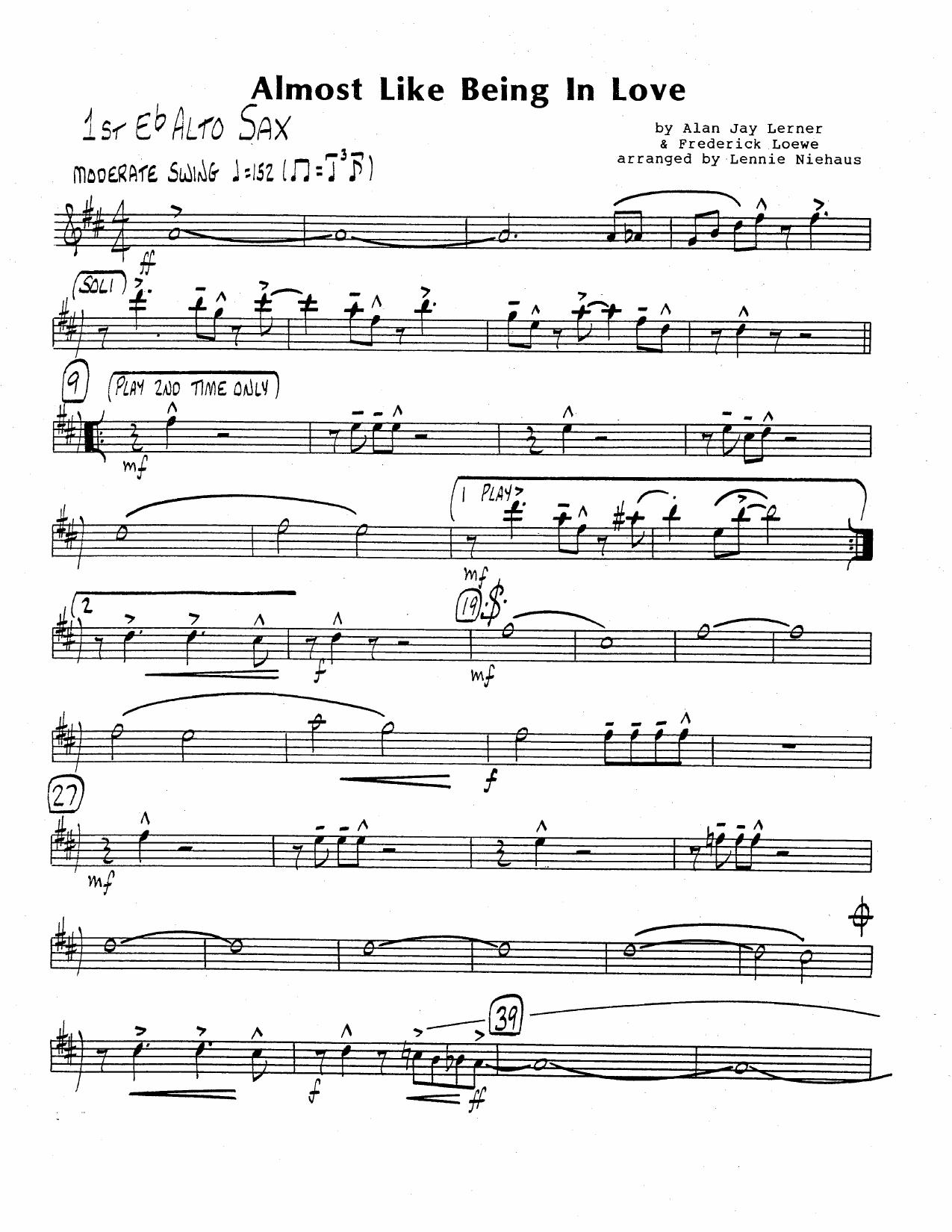
Almost Like Being In Love (L.Niehaus)
Composed by Frederick Loewe
Arranged by Lennie Niehaus
- Ensemble: Big Band
- Pages: 29
- Instruments (19): 1st Eb Alto Sax, 2nd Eb Alto Sax, 1st Bb Tenor Sax, 2nd Bb Tenor Sax, Eb Baritone Sax, 1st Bb Trumpet, 2nd Bb Trumpet, 3rd Bb Trumpet, 4th Bb Trumpet, 1st Trombone, 2nd Trombone, 3rd Trombone, 4th Trombone, Piano, Bass, Drums, Guitar, Solo Vocal, Solo Bb Tenor Sax (Sub. for Solo Vocal)
- Difficulty: medium
- Content: Individual Parts
- Format: PDF Download (Instant)
- Price: $24.99
Frederick Loewe and Alan Jay Lerner originally penned "Almost Like Being in Love" for the 1947 Broadway hit *Brigadoon*, where its irrepressible optimism and luminous melody quickly captured the public imagination. It transitioned seamlessly into the Great American Songbook, becoming a mandatory rite of passage for jazz artists eager to test their improvisational mettle across vibrant harmonic terrain. From Nat King Cole and Frank Sinatra to legendary instrumentalists like Sonny Rollins and Chet Baker, the tune has thrived in jazz history as a vehicle for joyous, life-affirming swing. Lennie Niehaus—a towering figure in West Coast jazz renowned for his sophisticated writing with the historic Stan Kenton Orchestra—approaches this standard with his signature West Coast cool clarity, counterpoint, and crisp, modern harmonic vocabulary. Built around an infectious, driving medium-up swing groove in 4/4 time, the chart crackles with buoyant energy and sophisticated linear development. Niehaus eschews dense, over-padded textures in favor of immaculate, transparent voicing for the five-saxophone section, balancing traditional big band power with the intricate, harmonically rich interplay characteristic of the modern jazz idiom. Throughout the arrangement, melodic duties are shared dynamically between crisp brass punches and lush saxophone solis that showcase Niehaus’s mastery of linear writing. The chart features designated solo space for key chairs, allowing featured improvisers to stretch out over standard changes while the ensemble provides dynamic, tasteful background figures. Technical demands center primarily on clean articulation, agile fingerwork in the woodwinds to navigate rapid scalar passages, and precise ensemble synchronization during tight rhythmic unisons. The shout chorus serves as a structural climax, building tension through clever developmental motifs before resolving into a high-energy restatement of the primary theme. Advanced high school, collegiate, and professional big bands will find this arrangement an ideal centerpiece for festival performances or formal concerts. The work rewards groups that possess strong section discipline, immaculate intonation, and a refined sense of swing phrasing. Conductors will appreciate how the inherent transparency of Niehaus’s scoring exposes any flaws in balance, making it as much an invaluable pedagogical tool for ensemble development as it is an exhilarating crowd-pleaser for audiences attuned to sophisticated jazz orchestration. Navigating this Lennie Niehaus chart successfully requires absolute precision in swing phrasing and articulation consistency across all sections. The tempo should sit comfortably in a bright medium-up swing zone (approx. quarter note = 180–192 BPM), ensuring the underlying groove feels buoyant rather than rushed. The primary technical challenge lies in the tight, interlocking woodwind lines and rapid chromatic passing tones characteristic of Niehaus’s West Coast style. Saxophones must execute fast linear passages with light, detached tonguing, avoiding heavy accents where a delicate, flowing bebop articulation is required. Brass players should focus on controlled dynamics during background figures, ensuring that muted or open lines never obscure the soloist or the primary melody carriers. The rhythm section is the anchor of this chart: the drummer should maintain a crisp, driving ride-cymbal pattern with a feathered bass drum touch, while the bassist walks a steady, quarter-note line that emphasizes the forward motion of the harmonic rhythm. Rehearsals should initially isolate the intricate saxophone soli at a reduced tempo to lock in intonation and unified articulation before bringing the full ensemble up to speed. Q: What instrumentation and parts are included in this big band arrangement? A: The arrangement is scored for a standard 18-instrument big band lineup, comprising 2 alto saxophones, 2 tenor saxophones, 1 baritone saxophone, plus standard trumpet, trombone, and full rhythm section parts. Q: What is the difficulty level of this specific arrangement? A: This chart is graded as advanced, making it exceptionally well-suited for collegiate ensembles, top-tier high school jazz bands, and professional community big bands with strong section players. Q: What is the musical style and historical context of this chart? A: Written in a bright medium-up swing style, the arrangement reflects Lennie Niehaus’s signature West Coast jazz aesthetic, transforming Frederick Loewe’s classic Broadway melody into a sophisticated modern jazz vehicle. Q: What makes Lennie Niehaus’s treatment of "Almost Like Being In Love" unique? A: Niehaus stands out through his use of transparent, linear saxophone voicings, intricate counterpoint, and clever harmonic reharmonizations that replace dense walls of sound with crisp, West Coast cool elegance. Q: What is the recommended performance duration and tempo for this arrangement? A: The chart is designed to run approximately 3 to 4 minutes when performed at the recommended bright medium-up swing tempo of around 180 to 192 beats per minute.
Questions and answers
- What is included in the Almost Like Being In Love (L.Niehaus) PDF?
- The verified current file contains individual parts across 29 pages.
- How many instruments or parts are listed for Almost Like Being In Love (L.Niehaus)?
- The verified instrumentation list contains 19 entries for this Big Band arrangement.
- Who is credited for Almost Like Being In Love (L.Niehaus)?
- Composer: Frederick Loewe. Arranger: Lennie Niehaus.
- What difficulty is listed for Almost Like Being In Love (L.Niehaus)?
- The verified difficulty level is medium.
- Can I preview Almost Like Being In Love (L.Niehaus) before buying?
- Yes. The product page provides a preview generated from the current PDF file.
- How is Almost Like Being In Love (L.Niehaus) delivered?
- After successful payment, the digital PDF is made available for download. The displayed price is $24.99.
Musicians Also Search For
Almost Like Being In Love Lennie Niehaus PDF • Almost Like Being In Love Lennie Niehaus sheet music • Almost Like Being In Love arranged by Lennie Niehaus • Lennie Niehaus big band charts • Lennie Niehaus jazz arrangements PDF • Almost Like Being In Love Frederick Loewe sheet music • Almost Like Being In Love Frederick Loewe big band arrangements • Frederick Loewe big band charts • Almost Like Being In Love big band arrangements • Almost Like Being In Love big band PDF download • Almost Like Being In Love jazz sheet music • big band sheet music download • Almost Like Being In Love individual parts download • Almost Like Being In Love sheet music PDF • buy Almost Like Being In Love sheet music • download Almost Like Being In Love PDF • Almost Like Being In Love jazz charts • best Lennie Niehaus big band arrangements • Frederick Loewe arranged by Lennie Niehaus • Almost Like Being In Love printable sheet music • big band repertoire PDF