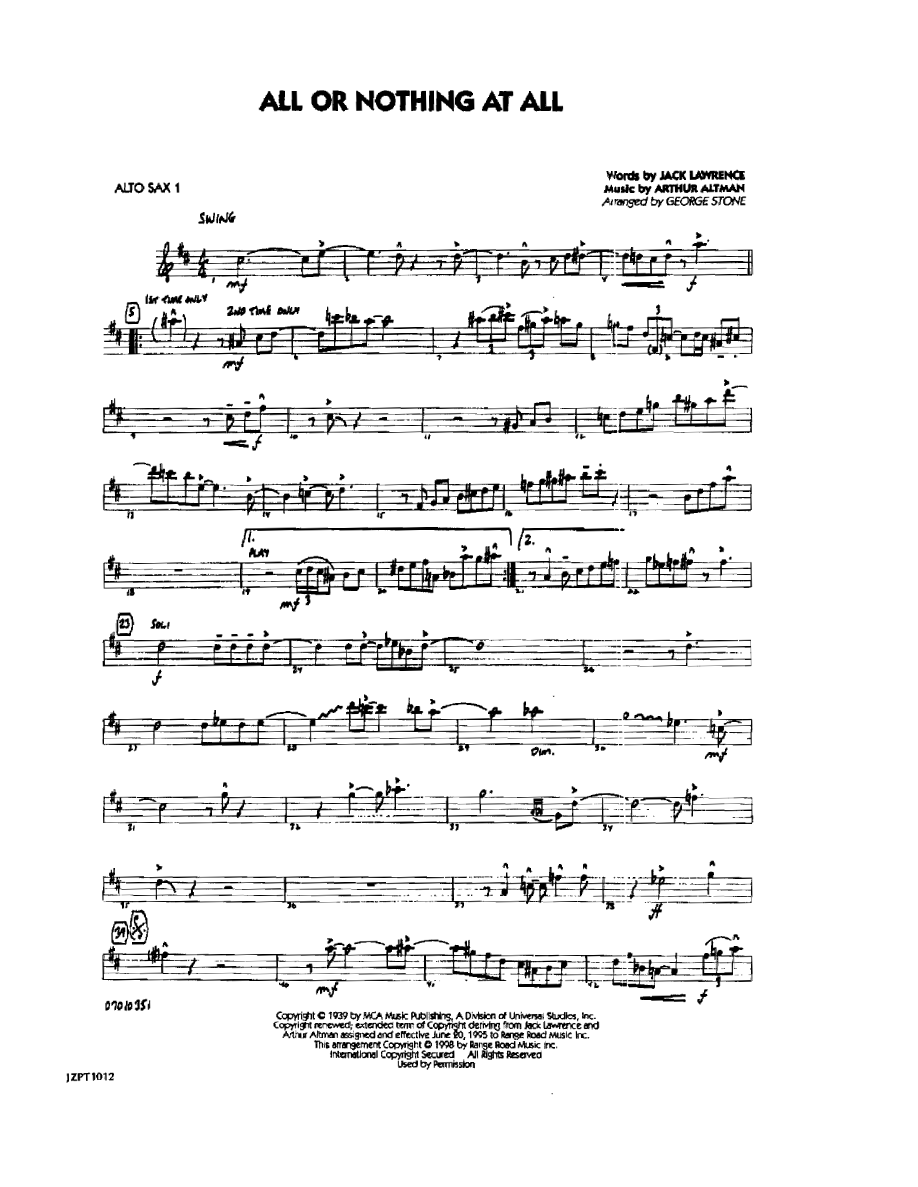
All Or Nothing At All (G.Stone)
Composed by Arthur Altman
Arranged by George Stone
- Ensemble: Big Band
- Pages: 48
- Instruments (17): Alto Sax 1, Alto Sax 2, Tenor Sax 1, Tenor Sax 2, Baritone Sax, Trumpet 1, Trumpet 2, Trumpet 3, Trumpet 4, Trombone 1, Trombone 2, Trombone 3, Trombone 4, Drums, Bass, Guitar, Piano
- Difficulty: medium
- Content: Individual Parts
- Format: PDF Download (Instant)
- Price: $24.99
Arthur Altman and Jack Lawrence penned "All Or Nothing At All" in 1939, but the composition truly ascended into the pantheon of jazz standards when a young Frank Sinatra recorded it with the Harry James Orchestra in 1939, and later re-released it to massive commercial success in 1943. Set originally in a haunting minor mode, the tune epitomizes the dramatic, torch-song aesthetic of the late swing era, offering an inherent tension that has made it a favorite canvas for vocalists and instrumentalists alike. Its unmistakable descending line and soaring release capture a sense of desperate romance and nocturnal melancholy, translating effortlessly into the dynamic palette of a contemporary big band. George Stone’s sophisticated big-band interpretation transforms this classic framework into a masterclass of modern harmonic coloring and textural contrast. Moving away from a straight-ahead swing revival, Stone infuses the chart with a smoldering, driving medium-tempo groove that balances lush, impressionistic brass voicings with biting, syncopated saxophone solis. The arrangement relies heavily on rich extended harmonies, subtle chromatic shifting, and intricate counterpoint, creating an atmosphere that is simultaneously nostalgic and refreshingly avant-garde. The emotional trajectory builds deliberately from moody, restrained introspection in the opening statements to a commanding, high-energy shout chorus that showcases the full power of the ensemble. Throughout the chart, instrumental responsibilities shift dynamically across the sections, with the tenor saxophone and lead trumpet taking prominent roles in carrying the primary thematic material. Improvised solo space is thoughtfully integrated, allowing featured performers to stretch out over sophisticated modal-harmonic shifts that elevate the performance. Technically demanding due to its intricate ensemble phrasing, subtle rubato-to-tempo transitions, and dense chordal structures, the arrangement requires a mature rhythm section capable of maintaining an elastic, driving pulse while leaving ample room for breath and nuance. Advanced collegiate ensembles, premier high school jazz bands, and professional community orchestras will find this chart an exceptionally rewarding centerpiece for festival repertoires or formal concerts. The meticulous 48-page publication—complete with a comprehensive conductor score—provides all the necessary roadmap details for directors aiming to achieve a polished, professional sound. Musicians who tackle this arrangement are rewarded with a sophisticated vehicle that challenges their listening skills, blend, and stylistic versatility while delivering a deeply satisfying emotional payoff for the audience. Success with George Stone’s arrangement hinges on precision in articulation and a unified approach to the underlying groove. The tempo should be anchored by a steady, unhurried medium-swing feel where the eighth notes remain fluid and relaxed rather than overly stiff. Directors should pay close attention to the dynamic markings in the brass section; the lush, harmonized chord clusters require exceptional intonation and a warm, velvety tone to avoid sounding harsh. Saxophones must execute their interlocking lines with light, articulate tongue strokes, ensuring that inner-voice movement remains transparent beneath the lead melodies. The rhythm section acts as the primary architectural support: the drummer should utilize crisp ride-cymbal phrasing and tasteful economic fills, while the bassist walks a robust, driving line that outlines Stone's chromatic alterations. Ensure the ensemble reserves maximum dynamic intensity for the climax of the shout chorus, avoiding premature volume peaks in the early choruses. Q: What instruments and parts are included in this publication? A: This 48-page publication includes a full conductor score and individual parts for a standard 17-instrument big band lineup, featuring two alto saxophones, two tenor saxophones, baritone saxophone, four trumpets, four trombones, guitar, piano, bass, and drums. Q: What is the difficulty level of this arrangement? A: This chart is written at an advanced level, best suited for collegiate ensembles, top-tier high school bands, and professional groups due to its sophisticated extended harmonies, dense voicings, and required rhythmic precision. Q: What is the historical style and context of "All Or Nothing At All"? A: Originally written by Arthur Altman and Jack Lawrence in 1939 and immortalized by Frank Sinatra with the Harry James Orchestra, this piece represents the dramatic peak of the late swing era, adapted here into a modern jazz big band framework. Q: What makes George Stone's arrangement unique? A: Stone departs from standard swing-era clichés by employing lush, impressionistic modern voicings, intricate counterpoint, and a smoldering, dynamic arrangement style that transforms a classic torch song into a contemporary harmonic journey. Q: What is the recommended tempo and performance duration for this piece? A: The arrangement is set to a driving, smoldering medium-swing tempo, providing an ideal framework that typically yields a performance duration of approximately 4 to 5 minutes depending on solo extensions.
Questions and answers
- What is included in the All Or Nothing At All (G.Stone) PDF?
- The verified current file contains a conductor score and individual parts across 48 pages.
- How many instruments or parts are listed for All Or Nothing At All (G.Stone)?
- The verified instrumentation list contains 17 entries for this Big Band arrangement.
- Who is credited for All Or Nothing At All (G.Stone)?
- Composer: Arthur Altman. Arranger: George Stone.
- What difficulty is listed for All Or Nothing At All (G.Stone)?
- The verified difficulty level is medium.
- Can I preview All Or Nothing At All (G.Stone) before buying?
- Yes. The product page provides a preview generated from the current PDF file.
- How is All Or Nothing At All (G.Stone) delivered?
- After successful payment, the digital PDF is made available for download. The displayed price is $24.99.
Musicians Also Search For
All Or Nothing At All George Stone PDF • All Or Nothing At All George Stone sheet music • All Or Nothing At All arranged by George Stone • George Stone big band charts • George Stone jazz arrangements PDF • All Or Nothing At All Arthur Altman sheet music • All Or Nothing At All Arthur Altman big band arrangements • Arthur Altman big band charts • All Or Nothing At All big band arrangements • All Or Nothing At All big band PDF download • All Or Nothing At All jazz sheet music • big band sheet music download • All Or Nothing At All conductor score PDF • All Or Nothing At All individual parts download • All Or Nothing At All sheet music PDF • buy All Or Nothing At All sheet music • download All Or Nothing At All PDF • All Or Nothing At All jazz charts • best George Stone big band arrangements • Arthur Altman arranged by George Stone • All Or Nothing At All printable sheet music • big band repertoire PDF