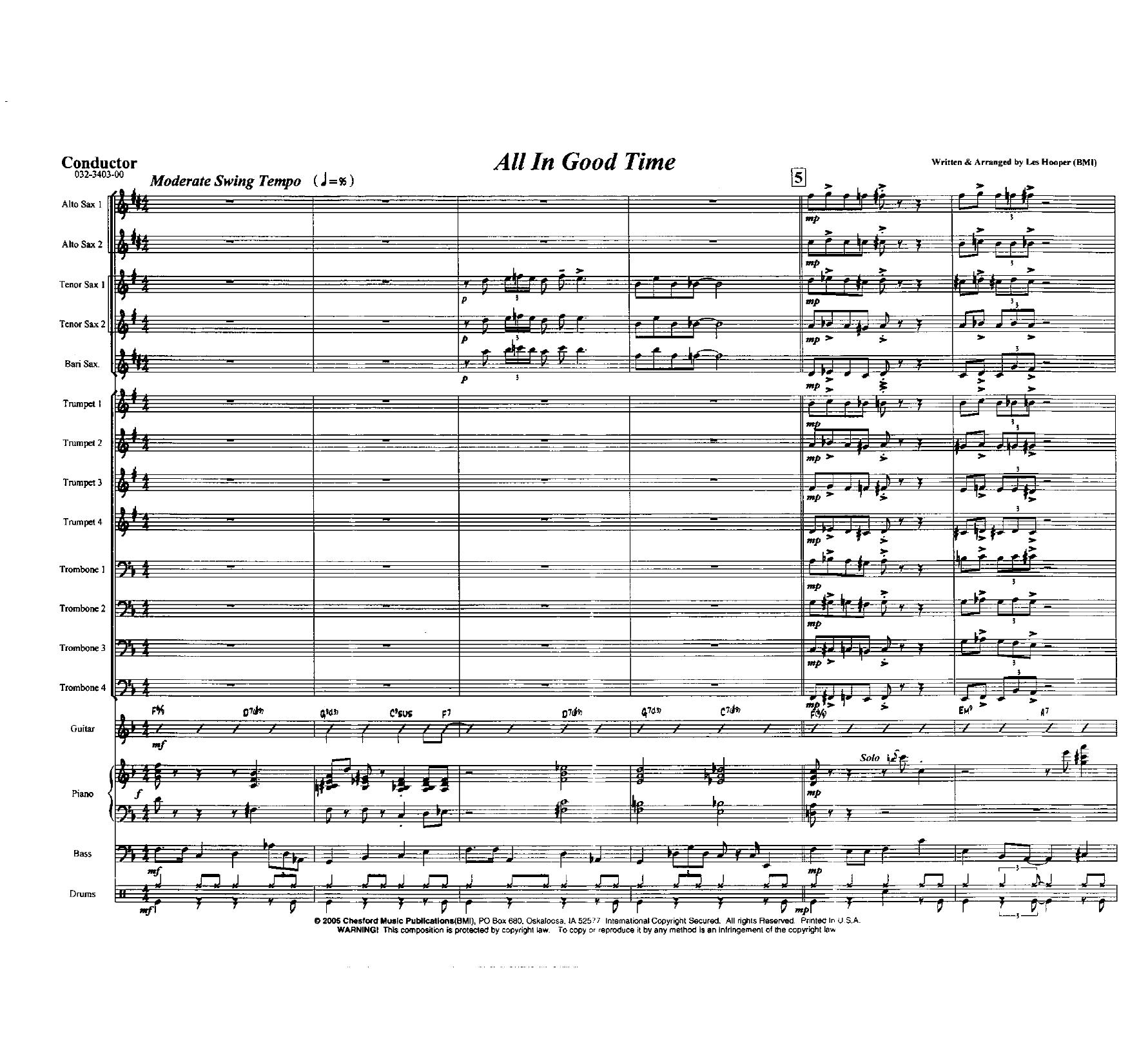
All In Good Time (L.Hooper)
Composed by Les Hooper
Arranged by Les Hooper
- Ensemble: Big Band
- Pages: 44
- Instruments (17): Alto Saxophone 1, Alto Saxophone 2, Tenor Saxophone 1, Tenor Saxophone 2, Baritone Saxophone, Trumpet 1, Trumpet 2, Trumpet 3, Trumpet 4, Trombone 1, Trombone 2, Trombone 3, Trombone 4, Guitar, Piano, Bass, Drums
- Difficulty: medium
- Content: Individual Parts
- Format: PDF Download (Instant)
- Price: $24.99
Les Hooper’s dynamic contribution to the contemporary big band canon represents the pinnacle of modern, high-energy jazz composition, bridging the gap between traditional swing orchestration and progressive fusion sensibilities. Emerging from the vibrant Los Angeles studio scene where Hooper built his formidable reputation as a composer, arranger, and bandleader, "All In Good Time" encapsulates the sophisticated harmonic language and relentless rhythmic drive that defined his critically acclaimed albums. Hooper’s writing style is instantly recognizable by its intricate counterpoint, crisp dynamic shifts, and an unapologetic demand for technical precision, making his charts staples for elite collegiate and professional jazz ensembles seeking to push the boundaries of standard big band repertoire. Driven by an infectious, forward-moving medium-up swing groove in 4/4, the composition radiates an atmosphere of calculated intensity and jubilant sophistication. The piece opens with an attention-commanding motivic statement that immediately establishes a bright, optimistic mood, utilizing lush, extended chord voicings—frequently featuring sharp 11ths and altered dominants—that create a rich, cinematic wall of sound. As the chart unfolds, Hooper balances dense, harmonically complex ensemble passages with moments of transparent, driving rhythm section interplay. The emotional arc transitions seamlessly from playful, syncopated head statements to an explosive, multi-tiered shout chorus that tests the endurance and dynamic control of the entire brass section, ultimately resolving with a clever, high-impact coda. Hooper’s distinctive arranging approach shines through the meticulous distribution of melodic material across the entire 17-piece ensemble, avoiding predictable tutti writing in favor of cascading woodwind solis and tightly knit brass counterlines. The saxophones are treated as a nimble, virtuosic unit capable of executing rapid, intervallic lines that require absolute technical unity, while the brass scoring utilizes aggressive articulation markers—including deliberate staccatos, crisp falls, and well-placed accents—to mimic the crispness of a studio-honed horn section. Solo opportunities are strategically integrated into the arrangement to highlight featured improvisers, providing ample stretching room over contemporary chord changes that flow naturally out of Hooper’s overarching compositional narrative. Advanced college ensembles, top-tier high school jazz bands with exceptional section leaders, and professional community big bands will find this 44-page publication an exhilarating challenge and a deeply rewarding performance vehicle. The primary technical hurdles lie in executing the unforgiving syncopated figures, maintaining pristine intonation across complex chord clusters, and sustaining a locked-in swing feel at a brisk tempo. When executed with the requisite articulation and stylistic awareness, "All In Good Time" serves as an electrifying showcase piece that guarantees an unforgettable climax for any advanced concert program or festival performance. Achieving success with Les Hooper’s "All In Good Time" demands meticulous attention to articulation, time-feel, and dynamic contrast. The rhythm section serves as the anchor; the drummer must maintain a driving, conversational ride cymbal pattern while keeping the backbeat crisp and avoiding over-playing during the dense ensemble hits. Pianists and guitarists should voice chords sparsely, focusing on rootless, upper-structure voicings that complement the modern harmonic palette without muddying the texture. For the horns, precision is paramount. Rehearsals should initially focus on sectional sectional isolation, particularly the intricate saxophone solis, practicing slowly with a metronome to ensure uniform tongue placement and phrasing before bringing the tempo up to performance speed. Brass players must execute accents and short notes with absolute uniformity, treating every staccato marking as a crisp, punchy punctuation point rather than a clipped whisper. Pay close attention to the dynamic markings leading into the shout chorus; pulling back just slightly on the sub-ito dynamics will yield a massive, thrilling impact when the full ensemble unleashes its peak volume. Q: What instruments and parts are included in this arrangement? A: This 44-page publication includes a comprehensive conductor score and standard 17-instrument big band instrumentation, featuring 2 alto saxophones, 2 tenor saxophones, 1 baritone saxophone, 4 trumpets, 4 trombones, guitar, piano, bass, and drums. Q: What is the difficulty level of "All In Good Time"? A: This arrangement is graded as advanced, making it best suited for college jazz ensembles, top-tier high school bands, and professional community big bands due to its complex harmonies and technical demands. Q: What is the musical style and historical context of this piece? A: Written by renowned composer and arranger Les Hooper, the piece represents contemporary modern big band jazz, combining traditional swing drive with progressive, West Coast studio-jazz harmonic sophistication. Q: What makes this Les Hooper arrangement unique? A: It features Hooper’s signature writing style, characterized by intricate woodwind counterpoint, extended chord voicings, sharp dynamic contrasts, and an electrifying shout chorus that pushes the ensemble's technical limits. Q: What is the recommended performance tempo and duration? A: The arrangement is set at a brisk medium-up swing tempo in 4/4 time, typically resulting in a performance duration of approximately 5 to 6 minutes depending on the length of the improvised solos.
Questions and answers
- What is included in the All In Good Time (L.Hooper) PDF?
- The verified current file contains a conductor score and individual parts across 44 pages.
- How many instruments or parts are listed for All In Good Time (L.Hooper)?
- The verified instrumentation list contains 17 entries for this Big Band arrangement.
- Who is credited for All In Good Time (L.Hooper)?
- Composer: Les Hooper. Arranger: Les Hooper.
- What difficulty is listed for All In Good Time (L.Hooper)?
- The verified difficulty level is medium.
- Can I preview All In Good Time (L.Hooper) before buying?
- Yes. The product page provides a preview generated from the current PDF file.
- How is All In Good Time (L.Hooper) delivered?
- After successful payment, the digital PDF is made available for download. The displayed price is $24.99.
Musicians Also Search For
All In Good Time Les Hooper PDF • All In Good Time Les Hooper sheet music • All In Good Time arranged by Les Hooper • Les Hooper big band charts • Les Hooper jazz arrangements PDF • All In Good Time Les Hooper big band arrangements • All In Good Time big band arrangements • All In Good Time big band PDF download • All In Good Time jazz sheet music • big band sheet music download • All In Good Time conductor score PDF • All In Good Time individual parts download • All In Good Time sheet music PDF • buy All In Good Time sheet music • download All In Good Time PDF • All In Good Time jazz charts • best Les Hooper big band arrangements • All In Good Time printable sheet music • big band repertoire PDF