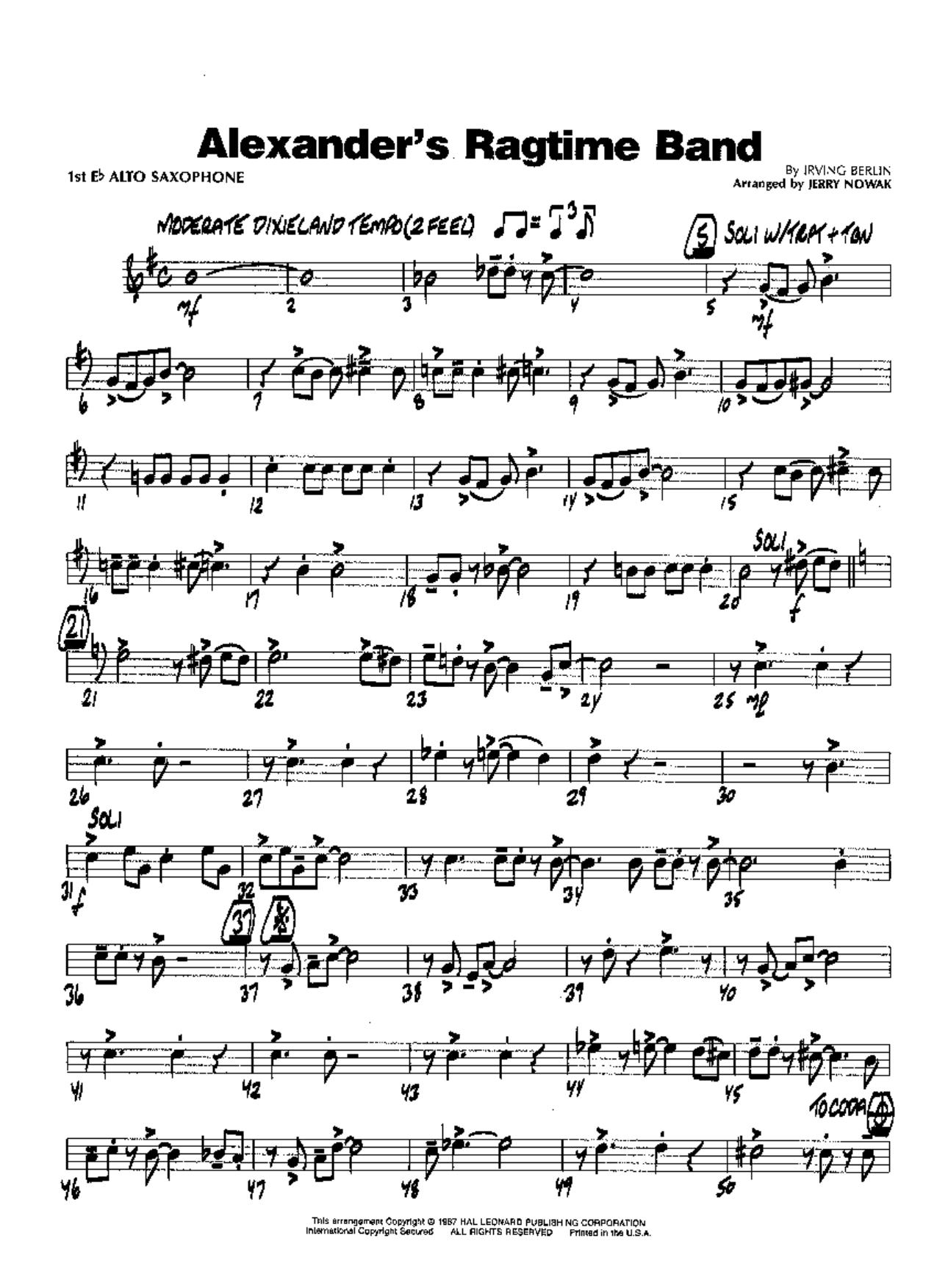
Alexander's Ragtime Band (J.Nowak)
Composed by Irving Berlin
Arranged by Jerry Nowak
- Ensemble: Big Band
- Pages: 42
- Instruments (15): 1st Eb Alto Saxophone, 2nd Eb Alto Saxophone, 1st Bb Tenor Saxophone, 2nd Bb Tenor Saxophone, Eb Baritone Saxophone, 1st Bb Trumpet, 2nd Bb Trumpet, 3rd Bb Trumpet, 1st Trombone, 2nd Trombone, 3rd Trombone, Piano, Guitar, Bass, Drums
- Difficulty: medium
- Content: Individual Parts
- Format: PDF Download (Instant)
- Price: $24.99
Irving Berlin’s iconic 1911 masterpiece "Alexander’s Ragtime Band" occupies a foundational position in American popular music, bridging the gap between 19th-century ragtime syncopation and the burgeoning jazz age that followed. Although written just before the widespread emergence of recorded jazz, the tune rapidly became a mandatory staple for early jazz pioneers like Bessie Smith, Louis Armstrong, and later swing luminaries, who recognized its irresistible rhythmic drive and buoyant melody as fertile ground for improvisation. Berlin’s composition captures the infectious, piano-driven energy of a bygone era, yet its inherently swinging architecture has allowed it to endure as a timeless vehicle for big band adaptation. Driving forward with a bright, jubilant medium-up swing feel in 4/4 time, Jerry Nowak’s chart transforms Berlin’s turn-of-the-century parlor hit into a high-octane celebration of big band swing. The mood is celebratory, nostalgic, yet thoroughly modern in its harmonic colorization. Nowak opens the arrangement with a crisp, driving percussion intro that immediately establishes the groove before the full ensemble enters with a playfully syncopated thematic statement. The energy builds progressively through clever dynamic shifts, utilizing punchy brass stabs and cascading woodwind lines to evoke the bustling atmosphere of a 1920s dance hall while keeping the toes of both performers and audience firmly tapping. Nowak approaches the classic melody with a masterful balance of tradition and clever arranging devices, ensuring the 15-piece ensemble remains fully engaged throughout. The arrangement avoids static block writing by distributing melodic fragments dynamically across the sections; the saxes enjoy rich, interlocking soli passages that highlight traditional swing phrasing, while the brass section interjects with bright, biting counter-melodies. A standout structural feature is the transition into an open solo section—allowing directors to spotlight their strongest improvisers on trumpet or tenor saxophone—which ultimately sweeps the band into a powerful, high-energy shout chorus featuring soaring trumpet leads and a thick, harmonically rich ensemble texture. Technically accessible yet musically sophisticated, this 42-page arrangement is ideally suited for advanced high school, collegiate, and community jazz ensembles looking to inject historical depth and pure crowd-pleasing energy into their repertoire. While rhythm sections will need to maintain a steady, unyielding swing momentum—paying close attention to light hi-hat chokes on beats two and four—the horn parts rely on clean articulation, accurate dynamic contrasts, and tight section blending rather than extreme altissimo registers or blistering tempos. Performing this chart provides students and seasoned players alike with an invaluable lesson in early swing style, articulation discipline, and stylistic authenticity. Conductors should establish a bright, driving medium-swing tempo (approx. quarter note = 152–160 BPM) right from the downbeat, ensuring the rhythm section locks into a buoyant, unhurried groove that never drags. The primary technical challenge lies in the execution of the dotted-eighth and sixteenth-note syncopations; musicians must articulate these figures with crisp, forward-moving energy without clipping the short notes or distorting the triplet-based swing feel. Brass players should utilize clean, precise tonguing for the punchy background figures, reserving open, resonant tones for the ensemble shout chorus. Saxophones need to focus on seamless blend during the unison and harmonized soli sections, paying careful attention to dynamic markings so the moving inner voices do not overpower the lead alto. Encourage the rhythm section pianist to reference early stride or comping styles sparingly, keeping the texture transparent to let the horns breathe. Q: What instruments and parts are included in this arrangement? A: This 42-page big band chart is scored for a 15-instrument ensemble, featuring standard instrumentation including Alto Saxophone 1, Alto Saxophone 2, Tenor Saxophone 1, Tenor Saxophone 2, Baritone Saxophone, plus respective brass and rhythm sections, along with a comprehensive conductor score. Q: What is the difficulty level of this Jerry Nowak arrangement? A: This chart is graded as medium-easy to medium, making it an excellent choice for advanced high school groups, college development bands, and community jazz orchestras seeking a rewarding challenge without extreme technical demands. Q: What is the historical style and context of the piece? A: Originally composed by Irving Berlin in 1911 as a ragtime tune, this arrangement adapts the classic composition into a swinging, high-energy jazz big band chart that bridges early syncopated popular music with the swing era. Q: What makes this specific arrangement by Jerry Nowak unique? A: Nowak uniquely balances nostalgic ragtime-era melodies with modern big band swing devices, incorporating clever dynamic shifts, engaging woodwind solis, and a dynamic shout chorus that revitalizes a century-old standard. Q: What is the performance duration and tempo of the piece? A: The arrangement runs approximately 3 to 4 minutes in duration and is designed to be performed at a bright, energetic medium-swing tempo.
Questions and answers
- What is included in the Alexander's Ragtime Band (J.Nowak) PDF?
- The verified current file contains a conductor score and individual parts across 42 pages.
- How many instruments or parts are listed for Alexander's Ragtime Band (J.Nowak)?
- The verified instrumentation list contains 15 entries for this Big Band arrangement.
- Who is credited for Alexander's Ragtime Band (J.Nowak)?
- Composer: Irving Berlin. Arranger: Jerry Nowak.
- What difficulty is listed for Alexander's Ragtime Band (J.Nowak)?
- The verified difficulty level is medium.
- Can I preview Alexander's Ragtime Band (J.Nowak) before buying?
- Yes. The product page provides a preview generated from the current PDF file.
- How is Alexander's Ragtime Band (J.Nowak) delivered?
- After successful payment, the digital PDF is made available for download. The displayed price is $24.99.
Musicians Also Search For
Alexander's Ragtime Band Jerry Nowak PDF • Alexander's Ragtime Band Jerry Nowak sheet music • Alexander's Ragtime Band arranged by Jerry Nowak • Jerry Nowak big band charts • Jerry Nowak jazz arrangements PDF • Alexander's Ragtime Band Irving Berlin sheet music • Alexander's Ragtime Band Irving Berlin big band arrangements • Irving Berlin big band charts • Alexander's Ragtime Band big band arrangements • Alexander's Ragtime Band big band PDF download • Alexander's Ragtime Band jazz sheet music • big band sheet music download • Alexander's Ragtime Band conductor score PDF • Alexander's Ragtime Band individual parts download • Alexander's Ragtime Band sheet music PDF • buy Alexander's Ragtime Band sheet music • download Alexander's Ragtime Band PDF • Alexander's Ragtime Band jazz charts • best Jerry Nowak big band arrangements • Irving Berlin arranged by Jerry Nowak • Alexander's Ragtime Band printable sheet music • big band repertoire PDF