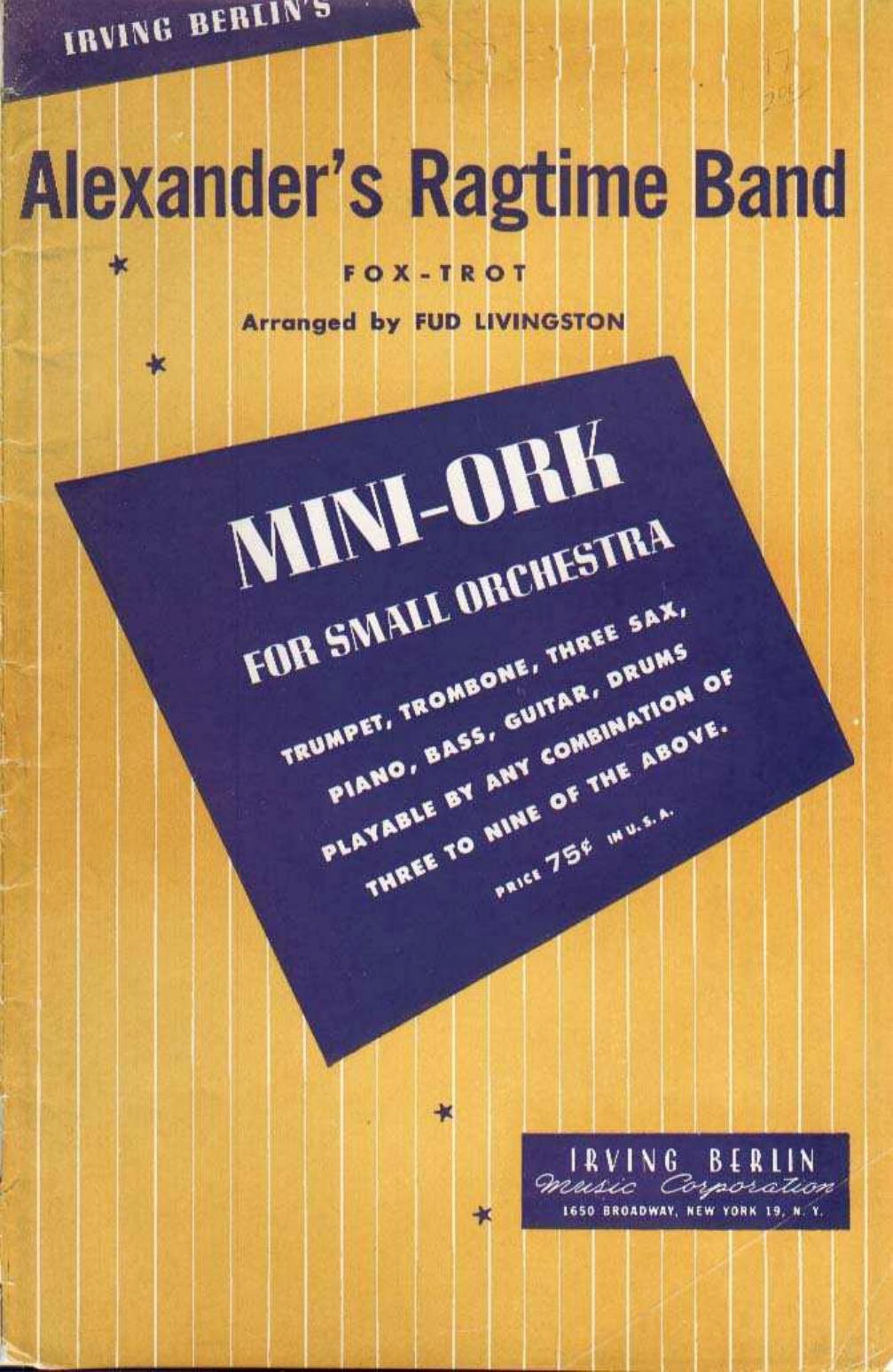
Alexander's Ragtime Band (F.Livingston) sheet music preview

Alexander's Ragtime Band (F.Livingston)

Composed by Irving Berlin

Arranged by Fud Livingston

  • Ensemble: Big Band
  • Pages: 24
  • Instruments (9): 1st Saxophone Eb Alto, 2nd Saxophone Bb Tenor, 3rd Saxophone Eb Alto, 1st Trombone, 1st Trumpet in Bb, Piano, Guitar, Bass, Drums
  • Difficulty: medium
  • Content: Individual Parts
  • Format: PDF Download (Instant)
  • Price: $24.99

Irving Berlin’s iconic 1911 masterpiece "Alexander’s Ragtime Band" occupies a foundational position in American popular music, bridging the gap between late-nineteenth-century ragtime and the burgeoning jazz age of the 1920s and 30s. Originally penned as a craze-inducing anthem that sparked a national dance obsession, the tune quickly became a staple of the early jazz repertoire, famously recorded by legends like Bessie Smith, Louis Armstrong, and Benny Goodman. It represents a vital evolutionary pivot where syncopated ragtime rhythms began to absorb the improvisational fire, blues inflection, and driving momentum of early jazz. Brought to life by master arranger Joseph "Fud" Livingston—a towering figure of the Chicago jazz scene and a prolific collaborator with the Dorseys, Red Nichols, and Bix Beiderbecke—this chart infuses Berlin’s timeless melody with an irrepressible, swinging vitality. Set in a bright, driving medium-up tempo, the arrangement crackles with the infectious energy of a 1930s small-to-medium big band session. Livingston avoids a straightforward, dated cakewalk feel, opting instead for a buoyant, four-to-the-bar swing groove that propels the ensemble forward. The mood is celebratory, nostalgic yet aggressively modern for its era, evoking the smoke-filled, high-spirited atmosphere of mid-century metropolitan dance halls. Livingston’s distinct arranging fingerprints are immediately evident in the clever re-harmonizations, tight horn voicings, and crisp counterpoint. Rather than relying on massive wall-of-sound block chords, Livingston utilizes a nimble, seven-instrument ensemble texture (featuring Alto Sax, Tenor Sax, Trumpet, Trombone, Piano, and rhythm section) to create transparent, highly mobile counter-melodies. The arrangement features snappy brass-and-reed interplay, where the melody is tossed playfully between the trumpet and the saxophone section before building toward a tightly constructed shout chorus. Livingston’s expert voice-leading ensures that every instrument has a rich, independent linear role, making the 24-page score a masterclass in economic yet sophisticated scoring. Advanced high school, collegiate, and professional or community jazz ensembles will find this arrangement an exceptionally rewarding addition to their library. Because of the exposed nature of the seven-part instrumentation, individual players must possess strong stylistic independence, excellent intonation, and a comfortable command of early-to-swing era articulation. There are prime opportunities for featured improvised solos, allowing standout horn and piano players to stretch out over authentic changes. It serves as an ideal showcase for specialized performance settings looking to program historically significant jazz literature that genuinely excites modern audiences. Navigating this Fud Livingston chart requires a deep appreciation for early swing phrasing and stylistic economy. The tempo should remain bright and buoyant—avoid rushing, as the groove relies entirely on a relaxed yet driving eighth-note feel. Articulation is paramount; horns must execute short, clipped notes with precise tongue-placement to capture the ragtime-inflected jazz bounce, utilizing subtle doits and falls only where stylistically appropriate to accent the line rather than clutter it. The rhythm section serves as the heartbeat of the ensemble. The pianist should lean into stride-infused or comping patterns that complement the horn counter-lines without overplaying, while the bass and drums maintain a steady, unhurried acoustic pulse. In rehearsal, isolate the intricate horn counterpoint sections first, ensuring that the tenor sax and trombone parts balance cleanly against the lead trumpet melody. Pay close attention to dynamic contrast; building the arrangement organically toward the climax ensures the final shout chorus retains maximum punch. Q: What specific instruments and parts are included in this 24-page arrangement? A: The arrangement is scored for a 7-instrument ensemble comprising Alto Saxophone, Tenor Saxophone, Trumpet, Trombone, Piano, and integrated rhythm section parts spanning a comprehensive 24-page manuscript score and set of parts. Q: What is the overall difficulty level of this Fud Livingston chart? A: This chart is best suited for advanced high school, collegiate, and professional small big band ensembles due to its exposed horn writing, requirement for stylistic independence, and demand for early-swing articulation. Q: What is the historical and stylistic context of this piece? A: It transforms Irving Berlin's 1911 ragtime anthem through the sophisticated, swinging lens of 1930s jazz arranger Fud Livingston, bridging early syncopated dance music with classic swing-era jazz idioms. Q: What makes this particular arrangement unique? A: Livingston utilizes brilliant, transparent voice-leading and nimble counterpoint for a seven-piece line-up, avoiding heavy block-chord scoring in favor of witty horn interplay and clever re-harmonizations. Q: What is the performance duration and recommended tempo feel? A: The arrangement is designed for a bright, driving medium-up swing tempo (around 180-200 BPM) and typically runs approximately 3 to 4 minutes in performance length.

Questions and answers

What is included in the Alexander's Ragtime Band (F.Livingston) PDF?
The verified current file contains individual parts across 24 pages.
How many instruments or parts are listed for Alexander's Ragtime Band (F.Livingston)?
The verified instrumentation list contains 9 entries for this Big Band arrangement.
Who is credited for Alexander's Ragtime Band (F.Livingston)?
Composer: Irving Berlin. Arranger: Fud Livingston.
What difficulty is listed for Alexander's Ragtime Band (F.Livingston)?
The verified difficulty level is medium.
Can I preview Alexander's Ragtime Band (F.Livingston) before buying?
Yes. The product page provides a preview generated from the current PDF file.
How is Alexander's Ragtime Band (F.Livingston) delivered?
After successful payment, the digital PDF is made available for download. The displayed price is $24.99.

Musicians Also Search For

Alexander's Ragtime Band Fud Livingston PDFAlexander's Ragtime Band Fud Livingston sheet musicAlexander's Ragtime Band arranged by Fud LivingstonFud Livingston big band chartsFud Livingston jazz arrangements PDFAlexander's Ragtime Band Irving Berlin sheet musicAlexander's Ragtime Band Irving Berlin big band arrangementsIrving Berlin big band chartsAlexander's Ragtime Band big band arrangementsAlexander's Ragtime Band big band PDF downloadAlexander's Ragtime Band jazz sheet musicbig band sheet music downloadAlexander's Ragtime Band individual parts downloadAlexander's Ragtime Band sheet music PDFbuy Alexander's Ragtime Band sheet musicdownload Alexander's Ragtime Band PDFAlexander's Ragtime Band jazz chartsbest Fud Livingston big band arrangementsIrving Berlin arranged by Fud LivingstonAlexander's Ragtime Band printable sheet musicbig band repertoire PDF

All arrangements by Fud Livingston All Irving Berlin sheet music