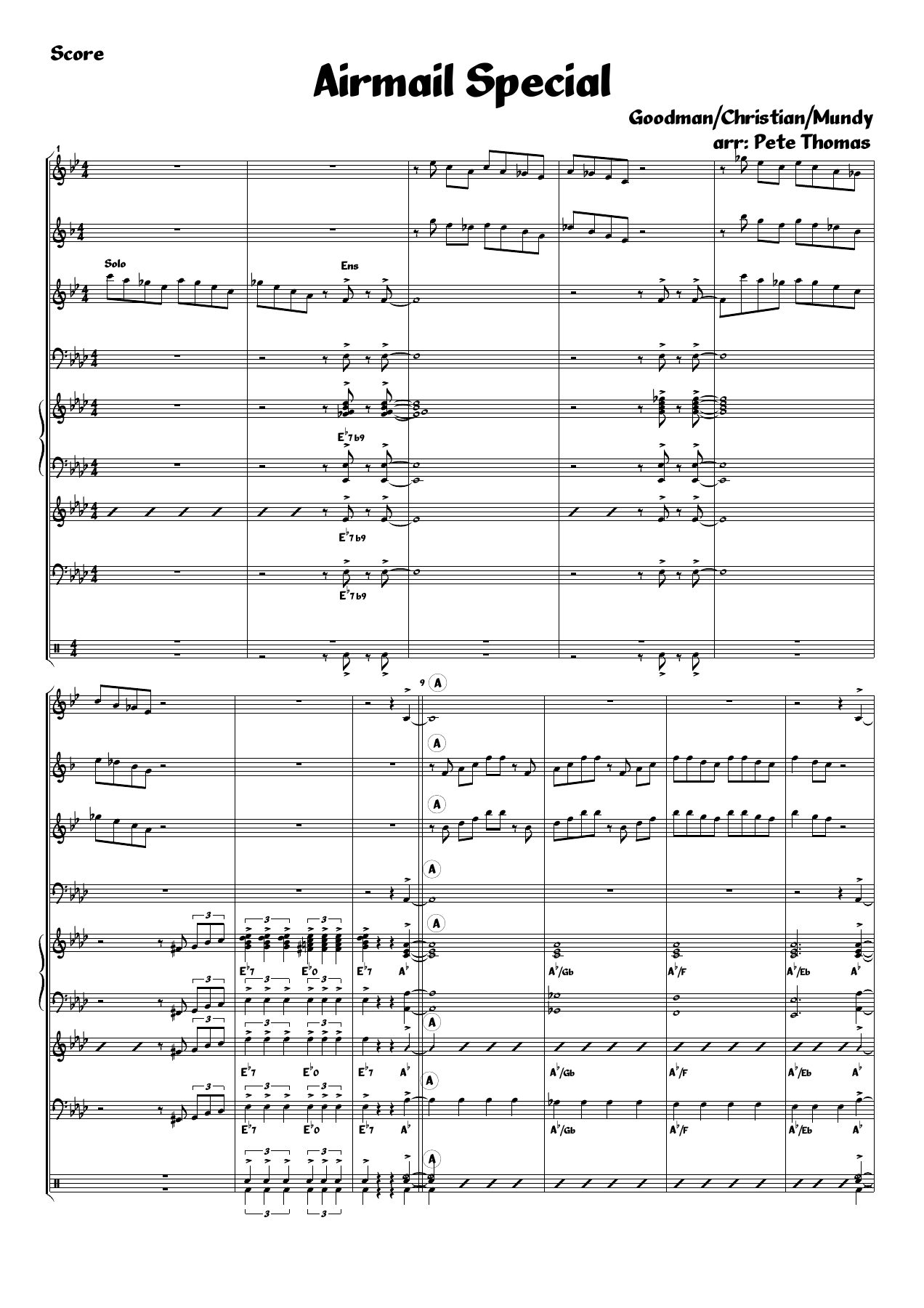
Airmail Special (3.Thomas) sheet music preview

Airmail Special (3.Thomas)

Composed by Benny Goodman, Jimmy Mundy, Charlie Christian

Arranged by 3 horns + Rhythm - Thomas

  • Ensemble: Small Ensemble
  • Style: Jazz Standard
  • Pages: 20
  • Difficulty: easy
  • Content: Sheet Music
  • Format: PDF Download (Instant)
  • Price: $12.99

"Airmail Special" stands as a quintessential jazz standard, a high-energy instrumental composed in 1941 by the legendary trio of Benny Goodman, Jimmy Mundy, and Charlie Christian. Originally titled "Good Enough to Keep" during its recording sessions, the piece was renamed to evoke the thrilling speed and innovation of early 20th-century airmail services, perfectly capturing the vibrant spirit of the Swing Era it helped define. Made famous by Benny Goodman's Sextet, the tune emerged from informal jam sessions, notably showcasing Charlie Christian's groundbreaking electric guitar work, which elevated the instrument from rhythmic accompaniment to a prominent melodic voice. Its enduring popularity is cemented by its 32-bar AABA form, often based on the "rhythm changes" progression, providing a robust framework for both tight ensemble playing and virtuosic improvisation. The piece's propulsive, riff-driven style and harmonic ingenuity, featuring alterations in the bridge that introduce tonal contrast, make it a cornerstone of the jazz repertoire, inspiring countless musicians and famously serving as a vehicle for Ella Fitzgerald's celebrated scat singing at the 1957 Newport Jazz Festival. This arrangement by 3 horns + Rhythm - Thomas masterfully captures the electrifying, up-tempo swing feel of the original, typically performed in 4/4 time at a driving tempo of 220-240 beats per minute, often in the key of C or Bb major. The musical character is one of unbridled exhilaration and rhythmic precision, evoking the thrill of a high-speed chase through its relentless momentum and bright, optimistic mood. Thomas's approach to this classic is characterized by intelligent voicings for the three horns, ensuring a full and resonant sound despite the smaller ensemble size. Expect tightly woven soli sections that demand precision and blend, alongside strategically placed shout choruses that build dynamic intensity. The arrangement honors the historical context by retaining the core melodic and harmonic integrity while infusing it with fresh, yet authentically styled, interpretative nuances. The melody is primarily carried by the horn section, often in unison or close harmony, creating a powerful and cohesive sound. This arrangement provides ample space for featured solos, typically over the "rhythm changes" form, allowing individual instrumentalists to showcase their improvisational prowess. Technical challenges include maintaining the blistering tempo with rhythmic accuracy, executing intricate horn lines with clarity, and navigating the harmonic changes with confidence, particularly in the bridge sections which introduce harmonic tension and release. The rewarding aspects of performing this arrangement lie in its infectious energy, the satisfaction of executing its demanding passages, and the collective joy of bringing such an iconic piece of jazz history to life. Specific musical moments, such as the driving call-and-response patterns and the explosive shout choruses, are designed to captivate both performers and audiences. This arrangement is ideally suited for college-level jazz ensembles, advanced high school jazz bands, and community jazz groups with proficient players. Its demands for technical facility, improvisational skill, and a deep understanding of swing articulation make it an excellent choice for developing musicians looking to tackle challenging and historically significant repertoire. Professional small ensembles will also find this arrangement a vibrant addition to their book, offering a compact yet powerful rendition of a beloved standard. The 20 pages of meticulously notated music provide comprehensive parts for each instrument, ensuring a well-prepared and impactful performance. Approaching "Airmail Special" requires a keen focus on rhythmic precision and a relentless, driving swing feel. Set the tempo firmly in the up-tempo range, ideally between 220-240 BPM, ensuring the eighth notes have a strong, consistent swing articulation. A key technical challenge lies in the horn soli sections, which demand absolute clarity of articulation and impeccable intonation to achieve a unified, powerful sound. Rehearse these sections slowly, focusing on matching attacks, releases, and dynamic shaping. The rhythm section must lay down a solid, propulsive foundation without rushing; the bass and drums should lock into a tight groove, while the piano provides crisp, harmonically rich comping. Encourage soloists to embrace the "rhythm changes" harmonic structure, drawing inspiration from Charlie Christian's original lines while developing their own improvisational voice. No special techniques like mutes or falls are explicitly required, allowing the natural brilliance of the instruments to shine. Focus on dynamic contrasts, building intensity through the shout choruses and providing clear, supportive backing for soloists. Q: What instruments/parts are included in this "Airmail Special (3.Thomas)" arrangement? A: This arrangement includes parts for three horn instruments (specific instrumentation typically varies but often includes trumpet, alto sax, and trombone or tenor sax) plus a full rhythm section, comprising piano, bass, and drums. Q: What is the difficulty level of this arrangement? A: This arrangement is considered advanced, suitable for college-level jazz ensembles, advanced high school bands, and proficient community groups due to its demanding tempo, intricate horn lines, and improvisational requirements. Q: What is the musical style and historical context of "Airmail Special"? A: "Airmail Special" is an iconic jazz standard from the Swing Era, composed in 1941 by Benny Goodman, Jimmy Mundy, and Charlie Christian. It embodies the high-energy, riff-driven swing style characteristic of that period. Q: What makes this particular "3.Thomas" arrangement unique? A: Thomas's arrangement provides intelligent voicings and tightly woven soli sections for a compact three-horn ensemble, delivering a full sound while maintaining the original's up-tempo swing feel and offering ample space for featured improvisation. Q: What is the typical performance duration and tempo for this piece? A: "Airmail Special" is an up-tempo swing number, typically performed at 220-240 beats per minute. A full performance of this arrangement, including solos, usually lasts between 3 to 5 minutes.

Musicians Also Search For

Airmail Special 3 horns + Rhythm - Thomas PDFAirmail Special 3 horns + Rhythm - Thomas sheet musicAirmail Special arranged by 3 horns + Rhythm - Thomas3 horns + Rhythm - Thomas small ensemble charts3 horns + Rhythm - Thomas jazz arrangements PDFAirmail Special Benny Goodman, Jimmy Mundy, Charlie Christian sheet musicAirmail Special Benny Goodman, Jimmy Mundy, Charlie Christian small ensemble arrangementBenny Goodman, Jimmy Mundy, Charlie Christian small ensemble chartsAirmail Special small ensemble arrangementAirmail Special small ensemble PDF downloadAirmail Special jazz ensemble sheet musicsmall ensemble sheet music instant downloadAirmail Special sheet music with partsAirmail Special Jazz Standard chartJazz Standard small ensemble arrangementsbuy Airmail Special sheet music onlinedownload Airmail Special PDFAirmail Special jazz chartbest 3 horns + Rhythm - Thomas small ensemble arrangementsBenny Goodman, Jimmy Mundy, Charlie Christian songs arranged by 3 horns + Rhythm - ThomasAirmail Special printable sheet musicsmall ensemble repertoire PDF

All arrangements by 3 horns + Rhythm - Thomas All Benny Goodman, Jimmy Mundy, Charlie Christian sheet music