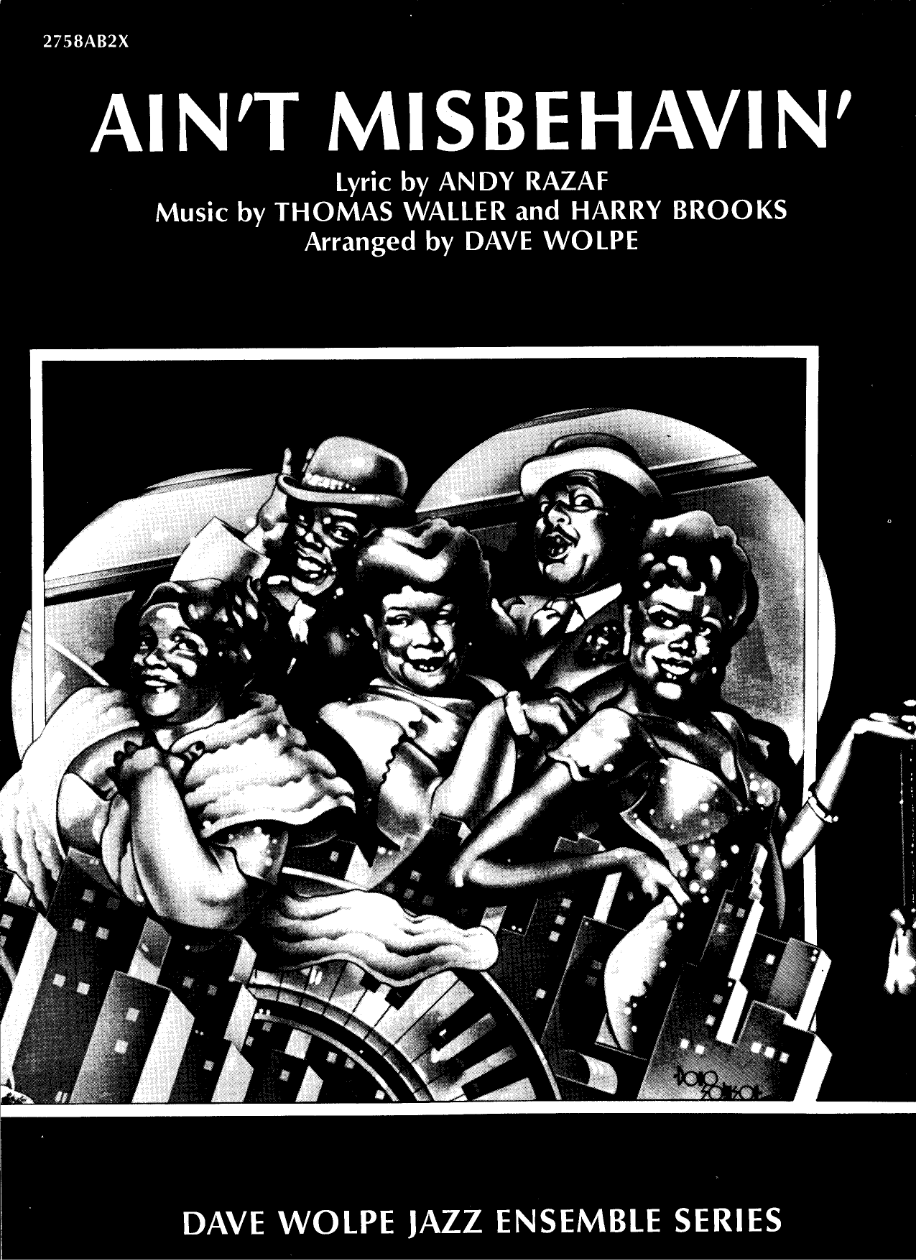
Ain't Misbehavin' (D.Wolpe) sheet music preview

Ain't Misbehavin' (D.Wolpe)

Composed by Andy Razaf, Thomas Waller, Harry Brooks

Arranged by Dave Wolpe

  • Ensemble: Small Ensemble
  • Style: Jazz Standard
  • Pages: 38
  • Difficulty: easy
  • Content: Sheet Music
  • Format: PDF Download (Instant)
  • Price: $12.99

Composed in 1929 by Andy Razaf, Thomas "Fats" Waller, and Harry Brooks, "Ain't Misbehavin'" emerged as a timeless jazz standard during the vibrant Harlem Renaissance, a period of profound cultural and artistic flourishing for African Americans. This iconic tune quickly became synonymous with Fats Waller himself, whose charismatic piano and vocal performances cemented its place in the American songbook. Its enduring appeal lies in its infectious melody, sophisticated harmonic progression, and witty lyrical narrative, capturing the playful spirit and romantic sensibilities of the late 1920s. The song's structure, typically AABA, offers a perfect framework for improvisation and arrangement, making it a perennial favorite for jazz musicians and audiences alike. Its status as a standard is undeniable, having been interpreted by countless jazz legends from Louis Armstrong to Ella Fitzgerald, each adding their unique stamp to its rich legacy. Dave Wolpe's arrangement of "Ain't Misbehavin'" for small ensemble masterfully reinterprets this classic with a medium swing feel in the key of F Major, imbuing it with a sophisticated yet accessible character. Wolpe's signature approach is evident in his intelligent voicings, which provide harmonic depth and warmth without overwhelming the smaller instrumentation. The arrangement opens with a classic ensemble statement of the melody, setting a relaxed, confident mood. Listeners will appreciate the tasteful interplay between sections, a hallmark of Wolpe's writing, which ensures every instrument contributes meaningfully to the overall texture. The arrangement avoids overly complex rhythmic figures, focusing instead on clarity and groove, making it an excellent choice for bands seeking a polished, professional sound. Performance of this arrangement offers numerous rewarding moments. The melody is primarily carried by the lead instruments, often in unison or harmonized in rich, block-chord voicings, allowing for clear articulation and expressive phrasing. There are ample opportunities for featured solos, typically over the tune's well-known chord changes, providing improvisers a comfortable and familiar harmonic landscape. Wolpe skillfully crafts a dynamic arc, building through a subtle soli section that showcases the ensemble's blend before returning to the main theme. The technical challenges are primarily centered around achieving a unified swing feel, precise articulation, and excellent balance within the small ensemble. The arrangement culminates in a satisfying, full-ensemble statement, leaving both performers and audience with a sense of musical fulfillment. This arrangement is ideally suited for college-level jazz ensembles, advanced high school bands, and community jazz groups seeking to expand their repertoire with a meticulously crafted standard. Its manageable technical demands, combined with Wolpe's elegant writing, make it an excellent teaching tool for developing ensemble cohesion, stylistic interpretation, and improvisational skills. The small ensemble format encourages individual responsibility and active listening, fostering a tight-knit musical rapport. Professional groups will also find this arrangement a tasteful and engaging addition to their sets, offering a fresh yet respectful take on a beloved jazz classic. Conductors should emphasize a relaxed, unhurried medium swing feel throughout, ensuring a solid rhythmic foundation from the rhythm section. The key of F Major provides a comfortable range for most instruments, but attention should be paid to intonation, particularly in the harmonized melody lines. Articulation is paramount; encourage a light, detached swing eighth-note feel, avoiding overly aggressive attacks. Solo sections should be approached with stylistic awareness, encouraging melodic improvisation that respects the song's harmonic and melodic character. There are no special techniques like plungers or falls explicitly notated, allowing the ensemble to focus on fundamental jazz performance practices. Rehearsal time should be dedicated to balancing the ensemble, especially in the soli passages, ensuring each voice is heard without dominating. Focus on the ensemble's collective interpretation of dynamics and phrasing to achieve a cohesive, musical performance. Q: What instruments and parts are included in the "Ain't Misbehavin' (D.Wolpe)" arrangement? A: This small ensemble arrangement typically includes parts for lead trumpet, alto saxophone, tenor saxophone, trombone, piano, bass, and drums. Specific instrumentation may vary slightly, but it is designed for a compact jazz combo setup. Q: What is the difficulty level of this arrangement? A: This arrangement is rated as medium difficulty, making it suitable for college-level jazz ensembles, advanced high school bands, and proficient community jazz groups. It requires solid fundamental jazz playing skills and an understanding of swing feel. Q: What musical style and historical context does this arrangement represent? A: This arrangement is a classic jazz standard, originally composed in 1929 during the Harlem Renaissance. It embodies the medium swing feel and melodic sophistication characteristic of early 20th-century jazz, popularized by artists like Fats Waller. Q: What makes Dave Wolpe's arrangement of "Ain't Misbehavin'" unique? A: Dave Wolpe's arrangement is distinguished by its tasteful, accessible voicings for small ensemble, maintaining the integrity of the original while adding a fresh, sophisticated touch. It features clear melodic lines, well-structured solo sections, and a focus on ensemble blend and groove. Q: What is the typical performance duration and tempo for this arrangement? A: The typical performance duration for "Ain't Misbehavin' (D.Wolpe)" is approximately 3-4 minutes, depending on the number and length of improvised solos. It is designed to be played at a medium swing tempo, around 120-140 beats per minute.

Musicians Also Search For

Ain't Misbehavin' Dave Wolpe PDFAin't Misbehavin' Dave Wolpe sheet musicAin't Misbehavin' arranged by Dave WolpeDave Wolpe small ensemble chartsDave Wolpe jazz arrangements PDFAin't Misbehavin' Andy Razaf, Thomas Waller, Harry Brooks sheet musicAin't Misbehavin' Andy Razaf, Thomas Waller, Harry Brooks small ensemble arrangementAndy Razaf, Thomas Waller, Harry Brooks small ensemble chartsAin't Misbehavin' small ensemble arrangementAin't Misbehavin' small ensemble PDF downloadAin't Misbehavin' jazz ensemble sheet musicsmall ensemble sheet music instant downloadAin't Misbehavin' sheet music with partsAin't Misbehavin' Jazz Standard chartJazz Standard small ensemble arrangementsbuy Ain't Misbehavin' sheet music onlinedownload Ain't Misbehavin' PDFAin't Misbehavin' jazz chartbest Dave Wolpe small ensemble arrangementsAndy Razaf, Thomas Waller, Harry Brooks songs arranged by Dave WolpeAin't Misbehavin' printable sheet musicsmall ensemble repertoire PDF

All arrangements by Dave Wolpe All Andy Razaf, Thomas Waller, Harry Brooks sheet music