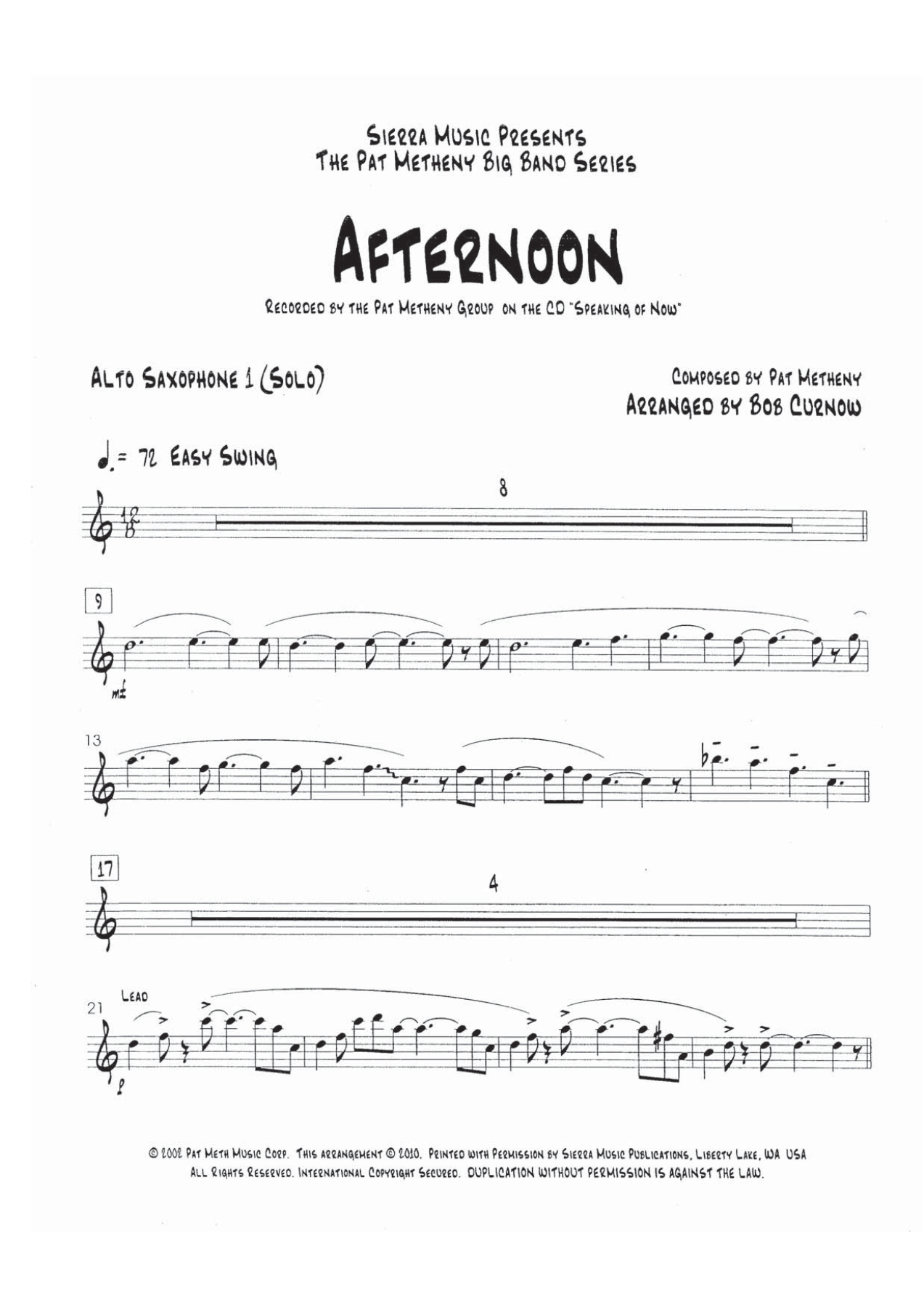
Afternoon (B.Curnow)
Composed by Bob Curnow
Arranged by Bob Curnow
- Ensemble: Big Band
- Style: Jazz Standard
- Pages: 53
- Instruments (17): Alto Saxophone 1 (Solo), Alto Saxophone 2, Tenor Saxophone 1, Tenor Saxophone 2, Baritone Saxophone, Flugelhorn / Trumpet 1, Flugelhorn / Trumpet 2, Flugelhorn / Trumpet 3, Flugelhorn / Trumpet 4 (Solo), Trombone 1, Trombone 2, Trombone 3, Bass Trombone 4, Piano, Guitar, Bass, Drums (Brushes & Sticks)
- Difficulty: advanced
- Content: Individual Parts
- Format: PDF Download (Instant)
- Price: $24.99
"Afternoon," a captivating original composition by Bob Curnow, stands as a testament to the enduring appeal and sophisticated harmonic language of the modern jazz standard. While not a traditional "standard" in the sense of a Tin Pan Alley tune, Curnow's work has achieved a similar status within contemporary big band repertoire due to its compelling melody, rich harmonic landscape, and the arranger's masterful treatment. Composed and arranged by Curnow himself, this piece embodies the vibrant, post-bop era of big band jazz, reflecting the intricate interplay and expansive sound palettes that defined the genre from the late 20th century onwards. It's a piece that has resonated with countless musicians and audiences, celebrated for its depth and accessibility, making it a staple in advanced jazz ensemble libraries. Musically, "Afternoon" unfolds with a medium-swing feel, typically set at a comfortable tempo that allows for both rhythmic precision and expressive melodic contour. The key signature and harmonic progressions are thoughtfully constructed, leaning into extended harmonies and sophisticated voice leading that are characteristic of Curnow's writing. The mood is generally uplifting and reflective, evoking a sense of warmth and understated elegance rather than high-octane energy. The piece balances moments of lush, interwoven textures with sections of driving rhythmic intensity, creating a dynamic journey for both performers and listeners. It's a composition that rewards careful listening and nuanced performance, bringing forth a sense of sophisticated joy. Bob Curnow's arrangement of his own composition is, predictably, definitive. His approach is characterized by meticulous attention to detail in voicings, ensuring clarity and balance across the 17-instrument big band. Expect his signature dense, yet transparent, brass and saxophone soli sections that showcase the ensemble's blend and precision. While a traditional shout chorus builds excitement, Curnow often integrates these climactic moments seamlessly within the larger harmonic and melodic framework, rather than as an abrupt departure. The arrangement features a prominent melody carried initially by the saxophone section, often doubled or harmonized in rich four-part voicings, before being passed to the brass. There are ample opportunities for featured solos, typically for tenor saxophone and trumpet, allowing individual voices to shine within the ensemble context. The technical challenges lie in maintaining seamless transitions, executing complex rhythmic figures with precision, and navigating the extended harmonic language with confident intonation. The reward is a deeply satisfying performance of a truly beautiful and intelligently crafted piece. This arrangement is ideally suited for advanced high school, collegiate, community, and professional big bands. Its demands on ensemble blend, intonation, rhythmic accuracy, and improvisational skill make it an excellent vehicle for developing musicianship at a high level. Bands with strong lead players in all sections and capable improvisers will find "Afternoon" to be a challenging yet immensely rewarding addition to their repertoire, offering a sophisticated piece that showcases the ensemble's musical maturity and expressive capabilities. "Afternoon" by Bob Curnow thrives on a consistent, relaxed medium-swing feel, typically around 132-144 BPM. The conductor should emphasize a light, buoyant quarter-note pulse, avoiding any stiffness, particularly in the rhythm section. Key technical challenges include navigating the intricate inner voicings within the saxophone and brass soli sections, requiring careful balance and precise intonation. Rehearsal time should be dedicated to isolating these passages, ensuring each voice is heard clearly and blends harmonically. The extended harmonies demand keen ear training from all players. While no special techniques like plunger mutes or doits are explicitly notated throughout, musicians should be prepared for standard jazz articulations, including falls and scoops where appropriate to the style. Attention to dynamic contrasts is crucial; Curnow's writing often features subtle shifts that enhance the emotional arc of the piece. Encourage soloists to embrace the melodic and harmonic sophistication of the tune, focusing on lyrical improvisation within the established mood. Q: What instruments and parts are included in this arrangement? A: This arrangement is scored for a standard 17-instrument big band, including Alto Saxophone 1 & 2, Tenor Saxophone 1 & 2, Baritone Saxophone, Trumpet 1-4, Trombone 1-4, Piano, Bass, and Drums. Q: What is the difficulty level of "Afternoon (B.Curnow)"? A: This arrangement is considered advanced, suitable for strong high school, collegiate, community, and professional jazz ensembles due to its sophisticated harmonies, intricate voicings, and demands on ensemble precision and improvisational skill. Q: What is the musical style and historical context of this piece? A: "Afternoon" is an original composition by Bob Curnow in the modern jazz standard style, reflecting the post-bop big band era with its rich harmonic language, medium-swing feel, and sophisticated melodic development. Q: What makes Bob Curnow's arrangement of "Afternoon" unique? A: Curnow's arrangement is distinctive for its definitive treatment of his own composition, featuring meticulously crafted, dense yet transparent voicings, seamless soli sections, and a sophisticated harmonic approach that showcases the full expressive range of the big band. Q: What is the typical performance duration or tempo for this piece? A: "Afternoon" is typically performed at a medium-swing tempo, generally ranging from 132-144 beats per minute, resulting in a performance duration of approximately 6-8 minutes, depending on the length of improvised solos.
Questions and answers
- What is included in the Afternoon (B.Curnow) PDF?
- The verified current file contains individual parts across 53 pages.
- How many instruments or parts are listed for Afternoon (B.Curnow)?
- The verified instrumentation list contains 17 entries for this Big Band arrangement.
- Who is credited for Afternoon (B.Curnow)?
- Composer: Bob Curnow. Arranger: Bob Curnow.
- What difficulty is listed for Afternoon (B.Curnow)?
- The verified difficulty level is advanced.
- What style is listed for Afternoon (B.Curnow)?
- The catalog lists the style as Jazz Standard.
- Can I preview Afternoon (B.Curnow) before buying?
- Yes. The product page provides a preview generated from the current PDF file.
- How is Afternoon (B.Curnow) delivered?
- After successful payment, the digital PDF is made available for download. The displayed price is $24.99.
Musicians Also Search For
Afternoon Bob Curnow PDF • Afternoon Bob Curnow sheet music • Afternoon arranged by Bob Curnow • Bob Curnow big band charts • Bob Curnow jazz arrangements PDF • Afternoon Bob Curnow big band arrangements • Afternoon big band arrangements • Afternoon big band PDF download • Afternoon jazz sheet music • big band sheet music download • Afternoon individual parts download • Afternoon sheet music PDF • Afternoon Jazz Standard charts • Jazz Standard big band arrangements • buy Afternoon sheet music • download Afternoon PDF • Afternoon jazz charts • best Bob Curnow big band arrangements • Afternoon printable sheet music • big band repertoire PDF