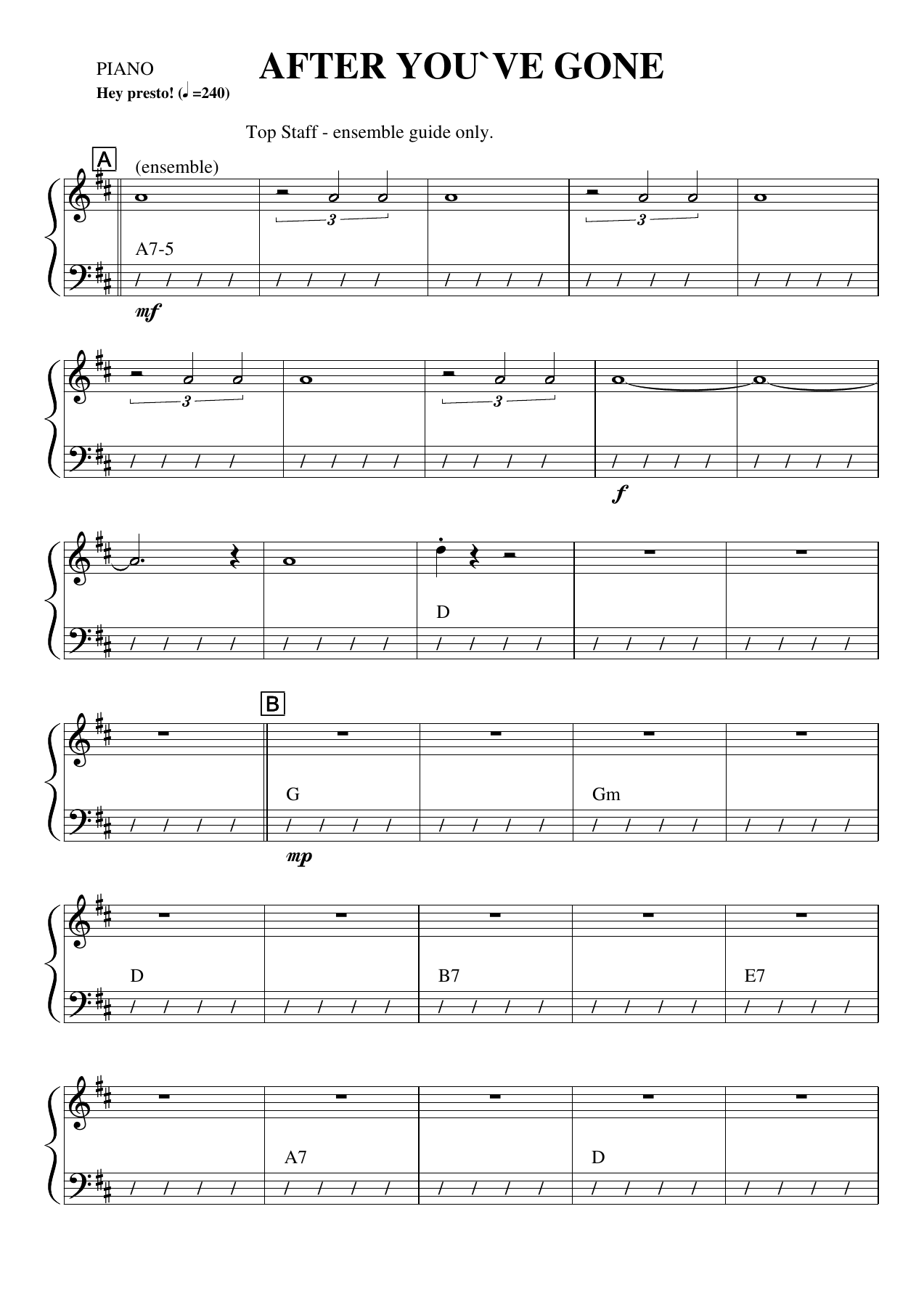
After You've Gone (Q.Jones) sheet music preview

After You've Gone (Q.Jones)

Composed by Turner Layton

Arranged by Q. Jones

  • Ensemble: Big Band Vocal
  • Style: Jazz Standard
  • Pages: 57
  • Instruments (16): Alto 1, Alto 2, Tenor 1, Tenor 2, Baritone Saxophone, Trumpet 1, Trumpet 2, Trumpet 3, Trumpet 4, Trombone 1, Trombone 2, Trombone 3, Trombone 4, Piano, Bass, Drums
  • Difficulty: easy
  • Content: Individual Parts
  • Format: PDF Download (Instant)
  • Price: $24.99

"After You've Gone," a timeless jazz standard, traces its origins to the early 20th century, composed by Turner Layton with lyrics by Henry Creamer in 1918. This vaudeville-era tune quickly transcended its initial context, becoming a cornerstone of the burgeoning jazz repertoire. Its infectious melody and poignant lyrical themes of lost love resonated deeply, leading to countless interpretations by jazz luminaries throughout the 1920s and beyond. Artists like Louis Armstrong, Bessie Smith, and Benny Goodman cemented its status as a standard, ensuring its enduring presence in the jazz canon. The piece embodies the vibrant spirit of early jazz, characterized by its strong melodic lines, clear harmonic progression, and an inherent drive that lends itself perfectly to improvisation and rhythmic exploration. Q. Jones's arrangement of "After You've Gone" for big band with vocal soloist breathes fresh life into this classic, reimagining it with a sophisticated yet powerful medium-swing feel. Set in the key of F major, the arrangement maintains the original's emotional core while infusing it with a contemporary big band sensibility. The mood is one of energetic nostalgia, a celebratory yet reflective journey through a familiar melody. Jones masterfully crafts dynamic contrasts, moving from intimate vocal moments supported by lush brass pads to full-ensemble explosions of sound. The arrangement evokes the feeling of a classic big band era performance, brimming with both precision and spontaneous joy, making it an exhilarating experience for both performers and audience. Q. Jones's distinctive arranging style is immediately apparent in this treatment. Known for his ingenious voicings and ability to create a massive sound from a standard big band lineup, Jones employs rich, often dense harmonies that add depth and complexity without sacrificing clarity. The arrangement features several signature elements: a driving rhythm section foundation, meticulously crafted brass and saxophone soli sections that interweave with remarkable precision, and powerful shout choruses that build to thrilling climaxes. The vocal melody is initially presented with a nuanced, almost conversational backing, gradually building in intensity. Jones's approach often involves unexpected harmonic twists and clever counter-melodies that keep the listener engaged, showcasing his unparalleled skill in blending traditional big band aesthetics with modern harmonic sensibilities. The vocal soloist carries the primary melody throughout, with opportunities for expressive interpretation. A featured instrumental solo, typically for tenor saxophone or trumpet, offers a chance for improvisation over the classic chord changes, providing a contrasting texture before the full ensemble returns. Technical challenges include precise articulation in the fast-moving soli passages, maintaining tight ensemble blend and balance, and executing dynamic shifts with conviction. The rhythm section must lay down a rock-solid, swinging foundation. The reward lies in performing a truly iconic piece with a fresh, powerful sound, experiencing the thrill of a well-executed shout chorus, and delivering a performance that captures the timeless appeal of "After You've Gone." This arrangement is particularly well-suited for college and community big bands seeking a challenging yet accessible piece, as well as professional ensembles looking to add a vibrant, historically rich standard to their repertoire. Conductors should emphasize a consistent, driving medium-swing feel from the outset, ensuring the rhythm section establishes a solid foundation without rushing. Articulation is paramount, especially in the brass and saxophone soli sections; encourage crisp, unified attacks and releases to achieve Q. Jones's signature precision. Pay close attention to dynamic markings, as the arrangement thrives on dramatic contrasts between subtle vocal accompaniment and powerful full-ensemble passages. Rehearsal time should be dedicated to balancing the dense voicings, particularly in the shout choruses, to ensure all melodic and harmonic lines are clear. The vocal soloist should be encouraged to bring their own interpretation to the melody, while adhering to the established swing feel. Falls and scoops should be executed with stylistic accuracy, adding to the authentic big band sound. Q: What instruments and parts are included in this arrangement? A: This arrangement includes parts for a standard big band lineup: 5 saxophones (2 alto, 2 tenor, 1 baritone), 4 trumpets, 4 trombones, piano, bass, drums, and a dedicated vocal soloist part. Q: What is the difficulty level of "After You've Gone (Q.Jones)"? A: This arrangement is considered advanced intermediate to advanced. It presents challenges in ensemble precision, dynamic control, and intricate soli passages, making it suitable for experienced college, community, or professional big bands. Q: What is the musical style and historical context of this piece? A: "After You've Gone" is a classic jazz standard from the early 20th century, arranged here in a vibrant medium-swing big band style. It represents the enduring appeal of early jazz melodies reinterpreted with modern big band orchestration. Q: What makes Q. Jones's arrangement of "After You've Gone" unique? A: Q. Jones's treatment is distinguished by his sophisticated harmonic voicings, meticulously crafted soli sections, powerful shout choruses, and dynamic contrasts, all while maintaining a driving medium-swing feel that reimagines this classic with a contemporary big band sound. Q: What is the typical performance duration and tempo for this arrangement? A: The typical performance duration for this arrangement is approximately 3-4 minutes. It should be performed at a consistent medium-swing tempo, around 130-140 beats per minute, to capture its intended energetic yet nuanced feel.

Questions and answers

What is included in the After You've Gone (Q.Jones) PDF?
The verified current file contains individual parts across 57 pages.
How many instruments or parts are listed for After You've Gone (Q.Jones)?
The verified instrumentation list contains 16 entries for this Big Band Vocal arrangement.
Who is credited for After You've Gone (Q.Jones)?
Composer: Turner Layton. Arranger: Q. Jones.
What difficulty is listed for After You've Gone (Q.Jones)?
The verified difficulty level is easy.
What style is listed for After You've Gone (Q.Jones)?
The catalog lists the style as Jazz Standard.
Can I preview After You've Gone (Q.Jones) before buying?
Yes. The product page provides a preview generated from the current PDF file.
How is After You've Gone (Q.Jones) delivered?
After successful payment, the digital PDF is made available for download. The displayed price is $24.99.

Musicians Also Search For

After You've Gone Q. Jones PDFAfter You've Gone Q. Jones sheet musicAfter You've Gone arranged by Q. JonesQ. Jones big band vocal chartsQ. Jones jazz arrangements PDFAfter You've Gone Turner Layton sheet musicAfter You've Gone Turner Layton big band vocal arrangementsTurner Layton big band vocal chartsAfter You've Gone big band vocal arrangementsAfter You've Gone big band vocal PDF downloadAfter You've Gone jazz sheet musicbig band vocal sheet music downloadAfter You've Gone individual parts downloadAfter You've Gone sheet music PDFAfter You've Gone Jazz Standard chartsJazz Standard big band vocal arrangementsbuy After You've Gone sheet musicdownload After You've Gone PDFAfter You've Gone jazz chartsbest Q. Jones big band vocal arrangementsTurner Layton arranged by Q. JonesAfter You've Gone printable sheet musicbig band vocal repertoire PDF

All arrangements by Q. Jones All Turner Layton sheet music