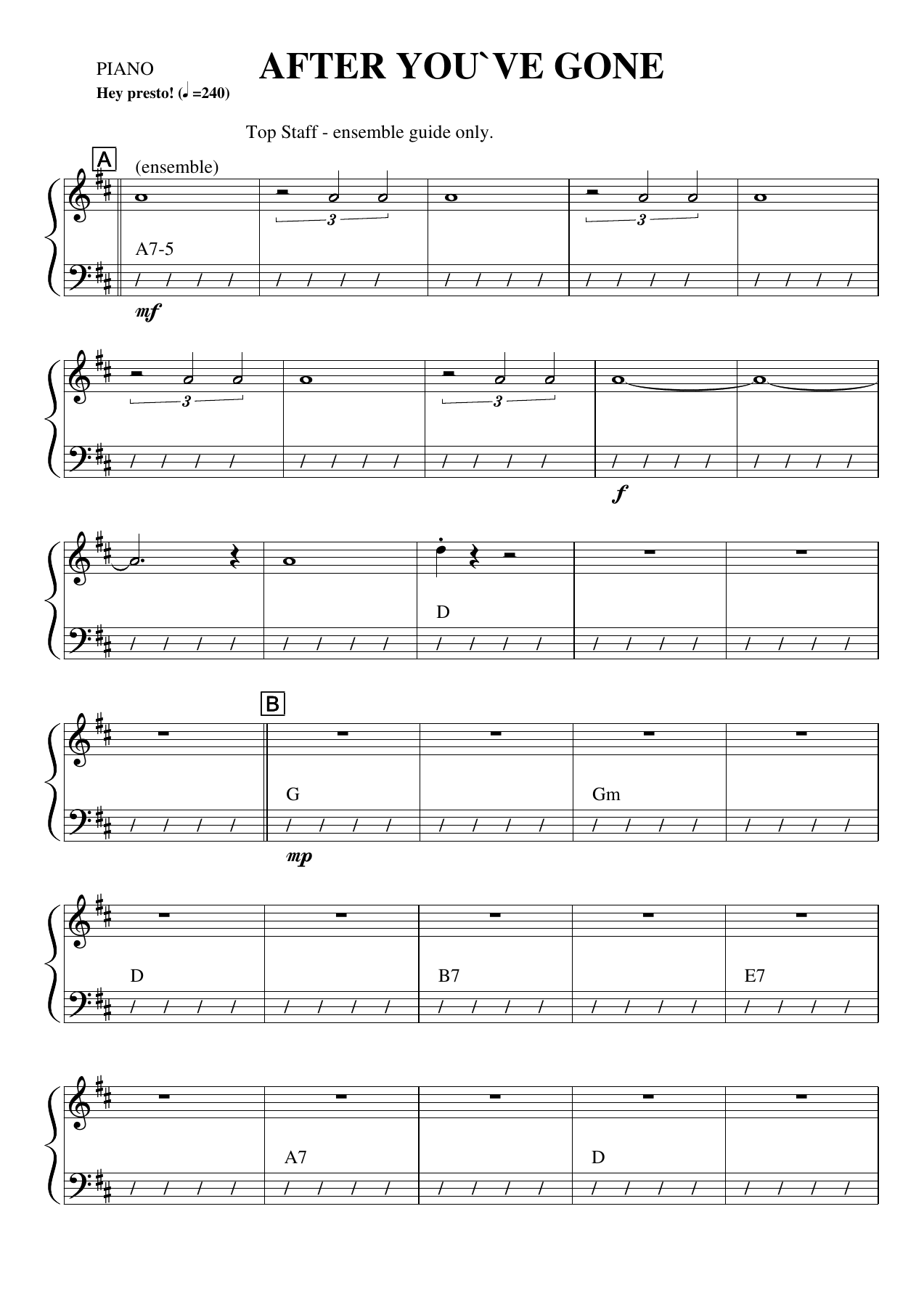
After You've Gone (Q.Jones)
Composed by Turner Layton
Arranged by Q.Jones
- Ensemble: Big Band Vocal
- Style: Jazz Standard
- Pages: 45
- Instruments (17): 1st Alto, 2nd Alto, 1st Tenor, 2nd Tenor, Baritone, 1st Trumpet, 2nd Trumpet, 3rd Trumpet, 4th Trumpet, 1st Trombone, 2nd Trombone, 3rd Trombone, 4th Trombone (Bass), Guitar, Piano, Bass, Drums
- Difficulty: easy
- Content: Individual Parts
- Format: PDF Download (Instant)
- Price: $24.99
"After You've Gone," a timeless jazz standard, originated in 1918, a collaboration between composer Turner Layton and lyricist Henry Creamer. This enduring tune quickly became a staple of the early jazz and vaudeville eras, its infectious melody and poignant lyrics resonating with audiences for generations. Made famous by countless artists, from Bessie Smith and Louis Armstrong in its early days to later interpretations by Benny Goodman and Ella Fitzgerald, its status as a jazz standard is cemented by its ubiquitous presence in the Great American Songbook and its enduring appeal to improvisers. The piece embodies the vibrant, swinging spirit of the pre-swing and early swing eras, often characterized by its driving rhythm and opportunities for both vocal and instrumental virtuosity. Q.Jones’s masterful arrangement of "After You've Gone" for big band with vocal feature transforms this classic into a dynamic showcase, maintaining its historical essence while infusing it with contemporary big band energy. The arrangement typically unfolds at an up-tempo swing feel, propelling the piece forward with relentless drive in a bright, accessible key. Jones's signature approach often involves sophisticated yet playable voicings, creating a rich harmonic tapestry that supports the vocal line without overpowering it. Expect crisp ensemble figures, artfully constructed soli sections that highlight different instrumental sections, and a powerful shout chorus that builds to an exhilarating climax, all hallmarks of Q.Jones's distinctive arranging style. The mood is generally ebullient and energetic, reflecting the song's inherent optimism despite its lyrical theme of departure. The arrangement thoughtfully features the vocalist throughout, carrying the primary melodic statements, often introduced by a punchy ensemble figure or a subtle brass pad. Instrumental solos are strategically placed, typically offering opportunities for a trumpet, trombone, or saxophone to shine, providing contrast and additional improvisational flair. Technical challenges include maintaining the demanding up-tempo swing feel with precision, navigating intricate ensemble passages, and ensuring tight articulation across all sections. The rewarding aspect lies in the sheer exhilaration of performing a classic standard with such vibrant energy, the interplay between the vocalist and the powerful big band, and the opportunity to engage an audience with a familiar yet freshly interpreted tune. This arrangement is ideally suited for college-level jazz ensembles, advanced community big bands, and professional groups. Its demands for precise ensemble playing, strong rhythmic integrity, and capable improvisers make it an excellent vehicle for developing musicians to tackle challenging big band repertoire while offering seasoned players a thrilling and engaging chart. The blend of historical reverence and modern big band arranging techniques ensures it will be a standout piece in any concert program, appealing to both performers and listeners alike. Conductors should emphasize a relentless, driving up-tempo swing feel, ensuring the rhythm section provides a solid, unwavering foundation. The tempo marking should aim for a bright, energetic pace, typically around quarter note = 200-220 bpm, allowing for both precision and exuberance. Key technical challenges include maintaining clean articulation in the brass soli sections and achieving tight ensemble unison and octave passages, particularly in the shout chorus. Encourage brass players to use a bright, focused tone, and saxophones to blend seamlessly in their soli work. Dynamic contrasts are crucial; ensure the band breathes together to execute sharp accents and sudden dynamic shifts effectively. Rehearsal time should be dedicated to perfecting the hand-offs between the vocalist and the ensemble, ensuring smooth transitions and impactful entrances. Pay close attention to the balance between the vocalist and the band, allowing the singer to project clearly without being overwhelmed. Q: What instruments and parts are included in this arrangement? A: This big band vocal arrangement typically includes parts for a standard big band instrumentation: 5 saxophones (AATTB), 4 trumpets, 4 trombones, piano, bass, drums, guitar, and a dedicated vocal lead sheet. Q: What is the difficulty level of "After You've Gone (Q.Jones)"? A: This arrangement is considered advanced intermediate to advanced, suitable for college-level jazz ensembles, advanced community big bands, and professional groups due to its up-tempo demands, intricate ensemble passages, and solo opportunities. Q: What is the musical style and historical context of this piece? A: "After You've Gone" is a classic jazz standard from 1918, embodying the vibrant, driving swing feel of the early jazz and pre-swing eras. Q.Jones's arrangement updates this historical context with modern big band voicings. Q: What makes Q.Jones's arrangement of "After You've Gone" unique? A: Q.Jones's treatment is distinguished by its sophisticated yet playable voicings, dynamic soli sections, and a powerful shout chorus, all while maintaining an up-tempo swing feel that showcases both the vocalist and the full ensemble. Q: What is the approximate performance duration and recommended tempo for this arrangement? A: The performance duration typically ranges from 3:00 to 4:00 minutes, depending on the length of improvised solos. It is best performed at an up-tempo swing feel, generally around quarter note = 200-220 bpm.
Questions and answers
- What is included in the After You've Gone (Q.Jones) PDF?
- The verified current file contains individual parts across 45 pages.
- How many instruments or parts are listed for After You've Gone (Q.Jones)?
- The verified instrumentation list contains 17 entries for this Big Band Vocal arrangement.
- Who is credited for After You've Gone (Q.Jones)?
- Composer: Turner Layton. Arranger: Q.Jones.
- What difficulty is listed for After You've Gone (Q.Jones)?
- The verified difficulty level is easy.
- What style is listed for After You've Gone (Q.Jones)?
- The catalog lists the style as Jazz Standard.
- Can I preview After You've Gone (Q.Jones) before buying?
- Yes. The product page provides a preview generated from the current PDF file.
- How is After You've Gone (Q.Jones) delivered?
- After successful payment, the digital PDF is made available for download. The displayed price is $24.99.
Musicians Also Search For
After You've Gone Q.Jones PDF • After You've Gone Q.Jones sheet music • After You've Gone arranged by Q.Jones • Q.Jones big band vocal charts • Q.Jones jazz arrangements PDF • After You've Gone Turner Layton sheet music • After You've Gone Turner Layton big band vocal arrangements • Turner Layton big band vocal charts • After You've Gone big band vocal arrangements • After You've Gone big band vocal PDF download • After You've Gone jazz sheet music • big band vocal sheet music download • After You've Gone individual parts download • After You've Gone sheet music PDF • After You've Gone Jazz Standard charts • Jazz Standard big band vocal arrangements • buy After You've Gone sheet music • download After You've Gone PDF • After You've Gone jazz charts • best Q.Jones big band vocal arrangements • Turner Layton arranged by Q.Jones • After You've Gone printable sheet music • big band vocal repertoire PDF