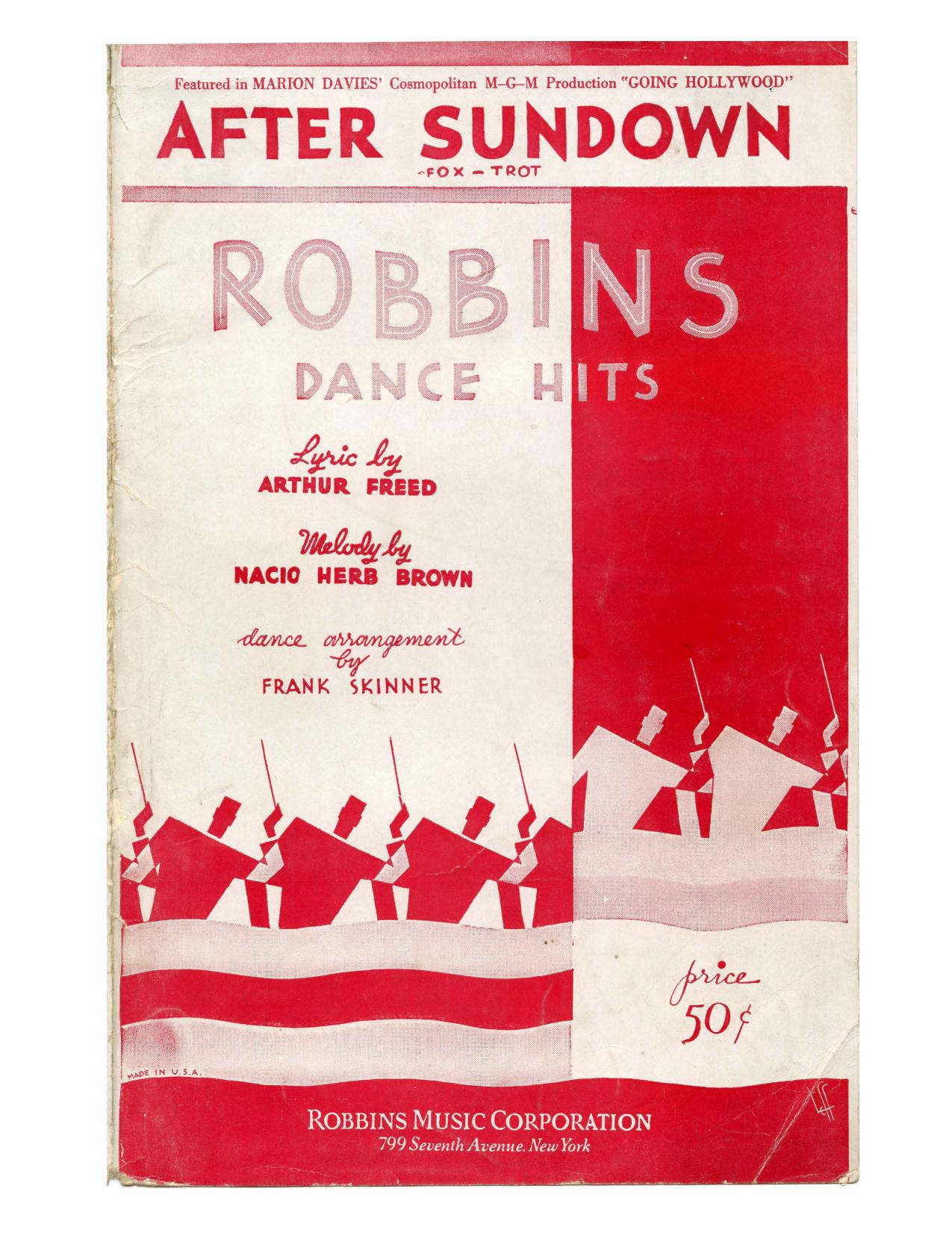
After Sundown (F.Skinner)
Composed by Frank Skinner
Arranged by Frank Skinner
- Ensemble: Big Band
- Pages: 31
- Instruments (13): Vocal Trio (1st Tenor, 2nd Tenor, Baritone), 1st Saxophone Eb Alto, 3rd Saxophone Eb Alto, 2nd Saxophone Bb Tenor, 1st Trumpet in Bb, 2nd Trumpet in Bb, 1st Trombone, Piano, Bass, Drums, Banjo, 1st Violins A, Cello
- Difficulty: medium
- Content: Individual Parts
- Format: PDF Download (Instant)
- Price: $24.99
Emerging from the golden age of radio broadcast and theatrical dance orchestras, "After Sundown" encapsulates the sophisticated, highly polished aesthetic of 1930s swing and sophisticated popular songcraft. Frank Skinner, celebrated equally for his pioneering work in commercial Manhattan dance band arranging and his later Oscar-nominated Hollywood film scores, crafted a specialized arrangement that bridges intimate vocal styling with rich instrumental textures. Originally conceived during an era when top-tier radio ensembles and hotel orchestras demanded sophisticated harmonic variety to captivate live audiences, the composition captures an evocative, twilight mood—balancing melancholic introspection with the warm, driving pulse characteristic of pre-war American jazz. Musically, the piece unfolds at a relaxed, medium-swing tempo in 4/4 time, establishing an alluring mood that shifts fluidly between sultry vulnerability and buoyant rhythmic energy. Skinner anchors the foundational character through lush chordal extensions, subtle chromatic passing tones, and clever counter-melodies that weave seamlessly behind the ensemble. The harmonic language relies on characteristic extended jazz voicings—utilizing major sevenths, minor ninths, and diminished transitions that evoke the sophisticated smoky atmosphere of a high-end 1930s supper club. The emotional trajectory builds steadily from a reflective, moody opening statement into a satisfyingly rich climax, offering listeners and performers a masterclass in dynamic contrast and atmospheric storytelling. Skinner’s arrangement prominently features an integrated Vocal Trio alongside a tight, flexible eight-instrument ensemble comprising Alto Saxophone, Tenor Saxophone, Trumpet, Trombone, and a rhythm-supporting foundational framework. The melodic material is shared fluidly between the vocal voices and the instrumental horns, with the saxophones and brass frequently combining to deliver warm, harmonized soli sections rather than relying on heavy, modern block-chords. The instrumentalists alternate between supporting the vocal triad with cascading harmonic counter-lines and stepping forward to execute crisp, idiomatic swing phrases. Technical demands center on precision of articulation, immaculate balance between the vocalists and horns, and a deep stylistic understanding of early swing phrasing—specifically the proper execution of dotted eighth-and-sixteenth figures and relaxed backbeat placement. Ensembles ranging from ambitious high school jazz expansion groups and collegiate chamber jazz ensembles to professional vintage-style repertory bands will find this 31-page publication deeply rewarding. Because the scoring is tailored for an eight-instrument configuration with a vocal trio rather than a massive standard big band, every player functions as an essential soloist within the texture, leaving nowhere to hide. This intimate instrumentation builds vital chamber-jazz listening skills, making it an exceptional programming choice for conductors seeking to showcase stylistic versatility, historical depth, and refined ensemble blend outside of standard contemporary big band literature. Conductors should approach "After Sundown" with an emphasis on transparency, stylistic cohesion, and vocal clarity. - **Tempo and Feel:** Maintain a steady, relaxed medium-swing feel (approx. Quarter Note = 112–120 BPM). Avoid rushing the triplets; the groove relies on a laid-back, conversational phrasing style typical of 1930s dance orchestras. - **Vocal Integration:** The Vocal Trio must balance closely with the horn lines. Ensure the instrumentalists dynamically back off whenever the vocals carry the primary lyric line. Blend and intonation within the trio are paramount. - **Articulation and Mutes:** Horn players should utilize subtle, warm vibrato appropriate for the era. Standard cup or straight mutes for the trumpet and trombone add authentic textural variety where indicated, keeping the overall timbre soft and velvety rather than aggressive. - **Rehearsal Strategy:** Isolate the rhythm section first to lock in the foundational swing pulse before layering the saxophone and brass counterlines. Pay careful attention to dynamic markings; the piece achieves its dramatic impact through smooth crescendos into phrase peaks rather than forced volume. Q: What instruments and specific parts are included in this arrangement? A: This arrangement is scored for an 8-instrument ensemble featuring a Vocal Trio, Alto Saxophone, Tenor Saxophone, Trumpet, Trombone, and accompanying rhythm section components across a 31-page score and part set. Q: What is the difficulty level of this Frank Skinner chart? A: It is moderately challenging, best suited for intermediate to advanced high school, collegiate, and professional musicians who possess a strong command of 1930s swing phrasing and ensemble balance. Q: What is the historical style and musical context of "After Sundown"? A: Written and arranged in the swing and dance-band idiom of the 1930s by master arranger Frank Skinner, it reflects the sophisticated harmonic style popularized in American radio broadcasts and hotel ballrooms. Q: What makes this particular arrangement unique? A: Skinner’s signature writing seamlessly integrates a Vocal Trio with a compact, 8-instrument horn and rhythm setup, prioritizing intimate voicings and clever counterpoint over heavy, modern big band power chords. Q: What is the performance duration and recommended tempo feel? A: The piece performs at a relaxed medium-swing tempo (around 112–120 BPM) and typically runs approximately 3 to 4 minutes, making it an ideal contrasting feature for a jazz concert program.
Questions and answers
- What is included in the After Sundown (F.Skinner) PDF?
- The verified current file contains individual parts across 31 pages.
- How many instruments or parts are listed for After Sundown (F.Skinner)?
- The verified instrumentation list contains 13 entries for this Big Band arrangement.
- Who is credited for After Sundown (F.Skinner)?
- Composer: Frank Skinner. Arranger: Frank Skinner.
- What difficulty is listed for After Sundown (F.Skinner)?
- The verified difficulty level is medium.
- Can I preview After Sundown (F.Skinner) before buying?
- Yes. The product page provides a preview generated from the current PDF file.
- How is After Sundown (F.Skinner) delivered?
- After successful payment, the digital PDF is made available for download. The displayed price is $24.99.
Musicians Also Search For
After Sundown Frank Skinner PDF • After Sundown Frank Skinner sheet music • After Sundown arranged by Frank Skinner • Frank Skinner big band charts • Frank Skinner jazz arrangements PDF • After Sundown Frank Skinner big band arrangements • After Sundown big band arrangements • After Sundown big band PDF download • After Sundown jazz sheet music • big band sheet music download • After Sundown individual parts download • After Sundown sheet music PDF • buy After Sundown sheet music • download After Sundown PDF • After Sundown jazz charts • best Frank Skinner big band arrangements • After Sundown printable sheet music • big band repertoire PDF