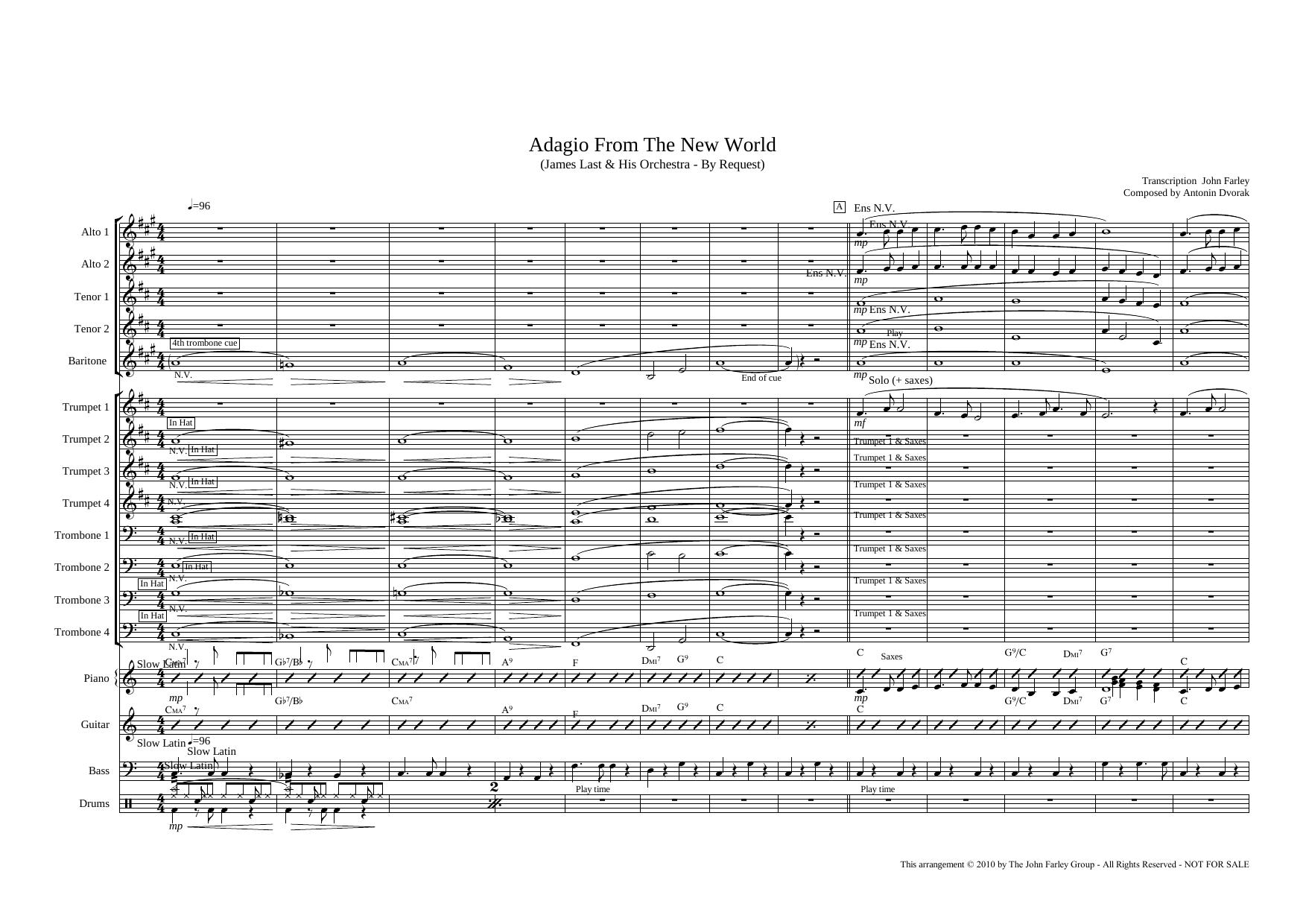
Adagio From The New World (J.Farley) sheet music preview

Adagio From The New World (J.Farley)

Composed by Antonín Dvořák

Arranged by John Farley

  • Ensemble: Big Band
  • Pages: 25
  • Instruments (17): Alto Saxophone 1, Alto Saxophone 2, Tenor Saxophone 1, Tenor Saxophone 2, Baritone Saxophone, Trumpet 1, Trumpet 2, Trumpet 3, Trumpet 4, Trombone 1, Trombone 2, Trombone 3, Trombone 4, Piano, Guitar, Bass, Drums
  • Difficulty: medium
  • Content: Individual Parts
  • Format: PDF Download (Instant)
  • Price: $24.99

Antonín Dvořák’s iconic Largo movement from his 1893 *Symphony No. 9 in E Minor ("From the New World")* stands as one of the most resonant melodies in Western classical music, famously infused with the spirit of American spirituals and folk traditions. While Dvořák originally penned this haunting, nostalgic theme for a full orchestral canvas—popularized later by William Arms Fisher’s vocal arrangement "Goin' Home"—its pentatonic simplicity and deep emotional gravity have long made it a prime vehicle for jazz interpretation. Arrangers across the decades have been drawn to its sublime contour, finding within its melancholic phrases a natural bridge to the rich, expressive harmonic language of jazz. In this masterful setting by John Farley, the famous English horn melody is reimagined as a lush, atmospheric jazz ballad that balances reverence for Dvořák’s original thematic blueprint with sophisticated contemporary reharmonization. Set in a spacious, rubato-leaning 4/4 feel that settles into a gentle, flowing ballad tempo, the arrangement explores an expansive harmonic palette rich with extended dominant chords, chromatic mediants, and subtle modal shifts. The mood shifts seamlessly from introspective and melancholic to soaring and triumphant, evoking the vast, open landscapes that inspired Dvořák during his time in America while remaining deeply rooted in the sophisticated voicings of modern orchestral jazz. Farley constructs a brilliant chamber big band texture tailored for a streamlined seven-instrument ensemble comprising Alto Saxophone, Tenor Saxophone, Trumpet, Trombone, Piano, and a dynamic rhythm section foundation. Rather than relying on a massive wall of brass, Farley utilizes sparse, transparent voicings that give every single voice independent linear importance. The melodic weight is shared gracefully between the Alto and Tenor saxophones, often locking into tight, beautiful counterpoint before opening up into a lush horn soli. A poignant, reflective improvised solo section is provided for the piano, supported by rich, shifting horn pads that create a sense of suspended time. The arrangement builds organically toward a climactic, emotionally charged peak before receding into a delicate, whisper-quiet coda that leaves a lasting impression on the listener. Advanced high school, collegiate, and professional chamber jazz ensembles will find this chart an exceptional vehicle for developing deep ensemble listening, intonation, and expressive rubato phrasing. Because the instrumentation is lean—distilling the power of a full 17-piece big band down to seven essential voices—every player carries a high degree of responsibility, requiring mature tone control and sensitive balance. Conductors will appreciate how naturally the chart fits smaller horn sections while still delivering the dramatic scope, dynamic contrast, and harmonic sophistication expected of a major concert work. It serves as a stunning centerpiece for any advanced jazz concert, festival performance, or collegiate recital. Balancing lyrical transparency with rich harmonic density is the primary challenge of this arrangement. The conductor must establish a fluid, breathing tempo that avoids a rigid mechanical grid, encouraging the ensemble to lean into the rubato contours of Dvořák’s original melody. For the horn players, breath support and blend are paramount; intonation on extended chords—particularly the altered dominants in the bridge—requires careful tuning within the saxophone and brass sections. Players should utilize a warm, centered tone with a minimum of vibrato during exposition, opening up to a wider, more expressive vibrato only at the arrangement's dynamic peak. Rhythm section players must approach their roles with restraint and sensitivity. The pianist should voice the chordal accompaniments with clear, open-spaced grips that avoid muddying the low register, allowing the bass lines to move freely. Percussionists should treat the ride cymbal and brushes with the utmost delicacy, prioritizing color and texture over a driving timekeeping pulse. Rehearsals should initially focus on sectional balance and intonation without tempo, ensuring that the interwoven countermelodies can be heard clearly across the entire ensemble before integrating the improvised solo sections. Q: What instruments and parts are included in this arrangement? A: This arrangement is scored for a 7-instrument ensemble consisting of Alto Saxophone, Tenor Saxophone, Trumpet, Trombone, Piano, and a rhythm section foundation, spanning a comprehensive 25-page score and parts manuscript. Q: What is the difficulty level of this chart? A: It is designed for advanced high school, collegiate, and professional chamber jazz ensembles due to its demand for mature intonation, subtle rubato phrasing, and transparent ensemble balance. Q: What is the musical style and historical context of the piece? A: It adapts Antonín Dvořák’s famous 1893 classical masterpiece from *Symphony No. 9 ("From the New World")* into a sophisticated, contemporary jazz ballad format rich with extended harmonies. Q: What makes John Farley’s arrangement unique? A: Farley distills the emotional scope of a full symphonic movement into a lean 7-piece instrumentation, utilizing transparent voicings, intricate counterpoint, and modern reharmonizations that keep every player actively engaged. Q: What is the performance duration and tempo feel? A: The piece is performed at a slow, expressive ballad tempo with a flowing, rubato-leaning 4/4 feel, resulting in a performance duration of approximately 4 to 5 minutes depending on solo extensions.

Questions and answers

What is included in the Adagio From The New World (J.Farley) PDF?
The verified current file contains a conductor score and individual parts across 25 pages.
How many instruments or parts are listed for Adagio From The New World (J.Farley)?
The verified instrumentation list contains 17 entries for this Big Band arrangement.
Who is credited for Adagio From The New World (J.Farley)?
Composer: Antonín Dvořák. Arranger: John Farley.
What difficulty is listed for Adagio From The New World (J.Farley)?
The verified difficulty level is medium.
Can I preview Adagio From The New World (J.Farley) before buying?
Yes. The product page provides a preview generated from the current PDF file.
How is Adagio From The New World (J.Farley) delivered?
After successful payment, the digital PDF is made available for download. The displayed price is $24.99.

Musicians Also Search For

Adagio From The New World John Farley PDFAdagio From The New World John Farley sheet musicAdagio From The New World arranged by John FarleyJohn Farley big band chartsJohn Farley jazz arrangements PDFAdagio From The New World Antonín Dvořák sheet musicAdagio From The New World Antonín Dvořák big band arrangementsAntonín Dvořák big band chartsAdagio From The New World big band arrangementsAdagio From The New World big band PDF downloadAdagio From The New World jazz sheet musicbig band sheet music downloadAdagio From The New World conductor score PDFAdagio From The New World individual parts downloadAdagio From The New World sheet music PDFbuy Adagio From The New World sheet musicdownload Adagio From The New World PDFAdagio From The New World jazz chartsbest John Farley big band arrangementsAntonín Dvořák arranged by John FarleyAdagio From The New World printable sheet musicbig band repertoire PDF

All arrangements by John Farley All Antonín Dvořák sheet music