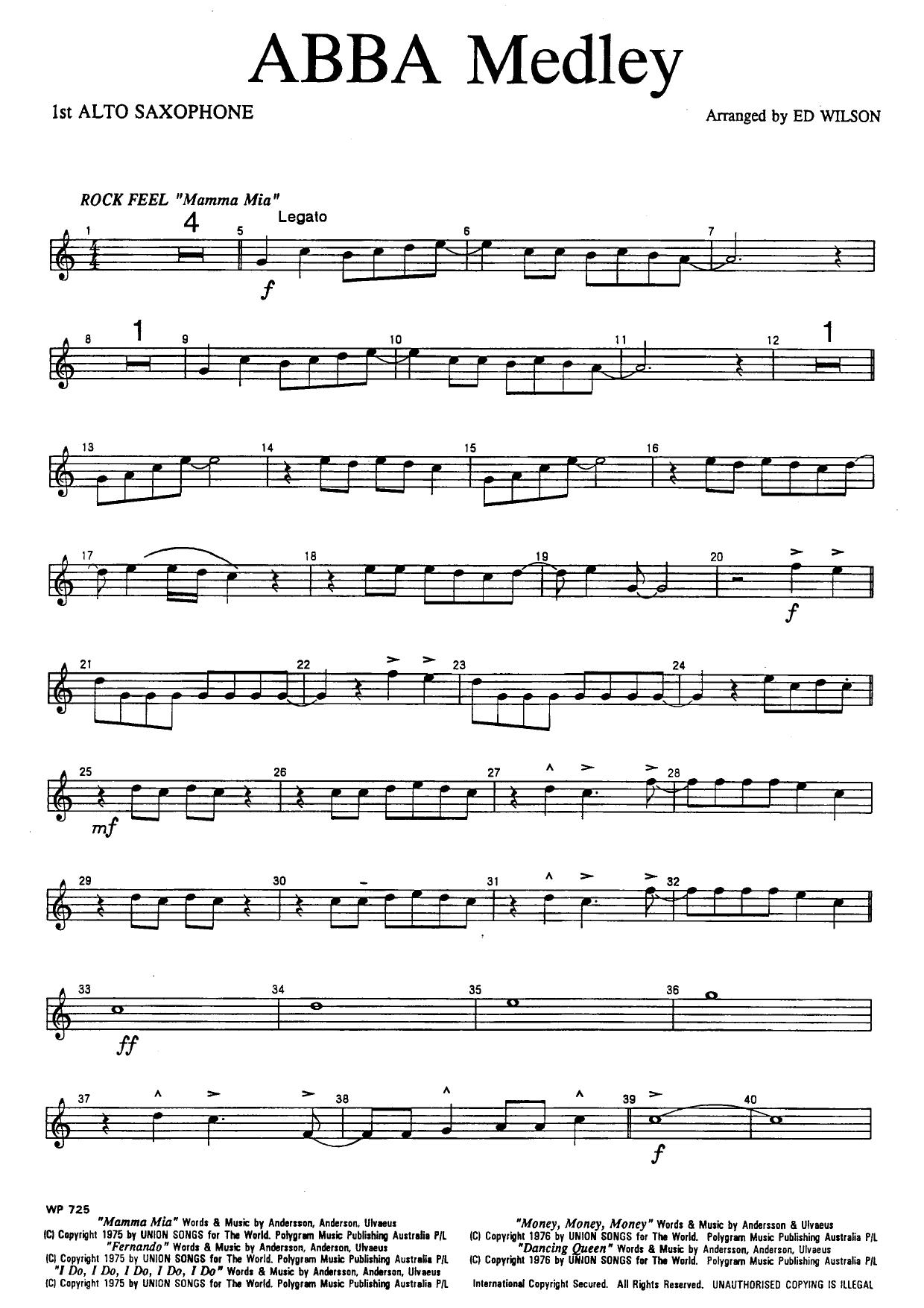
ABBA Medley Vocal (E.Wilson)
Composed by Ed Wilson
Arranged by Ed Wilson
- Ensemble: Big Band
- Pages: 77
- Instruments (18): 1st Alto Saxophone, 2nd Alto Saxophone, 1st Tenor Saxophone, 2nd Tenor Saxophone, Baritone Saxophone, 1st Trumpet, 2nd Trumpet, 3rd Trumpet, 4th Trumpet, 1st Trombone, 2nd Trombone, 3rd Trombone, 4th Trombone, Guitar, Piano, Bass, Drum Kit, Vocal (Optional)
- Difficulty: advanced
- Content: Individual Parts
- Format: PDF Download (Instant)
- Price: $24.99
Timeless Scandinavian pop artistry meets the sophisticated palette of the modern jazz orchestra in this dynamic big band setting. Originally forged by the iconic Swedish powerhouse ABBA during the golden era of 1970s pop-dance innovation, these immortal melodies have been structurally reimagined to bridge the gap between catchy vocal earworms and intricate jazz orchestration. While the source material belongs firmly in the pop canon, the enduring harmonic complexity and rich vocal stylings of Benny Andersson and Björn Ulvaeus's songwriting provide fertile ground for creative jazz reharmonization, making them remarkably compatible with a swinging big band framework. Balancing driving contemporary grooves with lush, cinematic ballad pacing, the arrangement captures an infectious blend of nostalgia and high-octane modern swing. The mood shifts effortlessly from sultry, rubato vocal intros to pulsing, high-energy dance grooves underpinned by crisp horn shots and sophisticated extended dominant voicings. The emotional trajectory moves from introspective warmth to exhilarating, brass-heavy euphoria, ensuring the audience stays fully engaged throughout the medley's multi-movement journey. Ed Wilson approaches the score with a masterclass in textural variety, masterfully exploiting the full colors of an 18-piece ensemble. Rather than relying on simple head-chart formatting, Wilson constructs intricate woodwind solis and dynamic counter-melodies that weave seamlessly around the lead vocal line. Rich saxophone voicings, reminiscent of the West Coast cool school mixed with contemporary fusion harmony, support the singer, while punchy, well-placed brass stabs and a meticulously structured shout chorus drive the climax. Modulations are handled with seamless grace, lifting the energy higher with each successive section of the medley. The vocal soloist anchors the performance, sharing the spotlight with tightly integrated horn background figures and brief, high-impact instrumental interludes. The instrumental sections—comprising two altos, two tenors, and a baritone sax, alongside four trumpets and four trombones—face moderate technical demands, requiring clean articulation, accurate section blend, and reliable upper-register endurance from the lead trumpet. Rhythm section players must possess a strong sense of internal time, shifting fluidly between straight-eighth contemporary feels and traditional swing grooves. Advanced high school ensembles with strong section leaders, collegiate jazz orchestras, and professional freelance big bands will find this chart an exceptional addition to their repertoire. It offers audiences a nostalgic yet intellectually stimulating trip down memory lane while providing the band with rich harmonic textures and deeply satisfying groove moments that stand far above standard pops-orchestra arrangements. Success with this arrangement hinges on stylistic versatility and crisp articulation, as the ensemble must navigate multiple distinct grooves. Conductors should establish a rock-solid rhythmic foundation in the rhythm section before layering in the horns; the drummer must drive the transition points between the swing sections and straight-eighth Latin-infused grooves without rushing the tempo. The brass section should utilize controlled, warm vibrato on the ballad segments, transitioning to bright, aggressive fat attacks and well-placed short accents during the uptempo shout choruses. Pay close attention to the dynamic balance between the vocal soloist and the horns—the 18-piece ensemble must dynamically drop underneath the vocal to ensure lyrical clarity, particularly during dense reharmonized passages. Saxophone players should prioritize a unified sectional intonation, especially during the exposed a cappella or rhythm-backed solis where minor pitch discrepancies will be readily exposed. Rehearsals should isolate the modulation transitions to ensure smooth intonation shifts across the entire band. Q: What instrumentation and parts are included in this 18-instrument big band package? A: The arrangement is scored for a standard 18-piece big band configuration consisting of a vocal soloist, two alto saxophones, two tenor saxophones, one baritone saxophone, four trumpets, four trombones, and a complete four-piece rhythm section (piano, guitar, bass, and drums), backed by a comprehensive 77-page full score and part set. Q: What is the overall difficulty level of this arrangement? A: This chart is graded as advanced-intermediate to advanced, making it best suited for college jazz ensembles, advanced high school bands, and professional community big bands with strong lead players and a competent vocal soloist. Q: How does the musical style reflect both ABBA's legacy and jazz tradition? A: It takes the instantly recognizable melodic motifs of ABBA’s biggest 1970s hits and runs them through a sophisticated jazz filter, utilizing extended chord extensions, modern big band arranging techniques, and shifting rhythmic feels ranging from vocal swing to contemporary grooves. Q: What makes Ed Wilson’s arrangement uniquely suited for modern performances? A: Unlike basic lead sheets or cheesy pops medleys, Wilson provides fully realized, intricate horn voicings, dynamic counter-melodies, and a meticulously crafted shout chorus that elevates pop melodies into legitimate, high-art jazz orchestra literature. Q: What is the performance duration and general tempo framework of the medley? A: While performance time varies slightly based on chosen rubato pacing and soloist vamp sections, the medley typically runs between 6 to 8 minutes, moving organically through contrasting medium-swing, ballad, and up-tempo feel changes.
Questions and answers
- What is included in the ABBA Medley Vocal (E.Wilson) PDF?
- The verified current file contains individual parts across 77 pages.
- How many instruments or parts are listed for ABBA Medley Vocal (E.Wilson)?
- The verified instrumentation list contains 18 entries for this Big Band arrangement.
- Who is credited for ABBA Medley Vocal (E.Wilson)?
- Composer: Ed Wilson. Arranger: Ed Wilson.
- What difficulty is listed for ABBA Medley Vocal (E.Wilson)?
- The verified difficulty level is advanced.
- Can I preview ABBA Medley Vocal (E.Wilson) before buying?
- Yes. The product page provides a preview generated from the current PDF file.
- How is ABBA Medley Vocal (E.Wilson) delivered?
- After successful payment, the digital PDF is made available for download. The displayed price is $24.99.
Musicians Also Search For
ABBA Medley Vocal Ed Wilson PDF • ABBA Medley Vocal Ed Wilson sheet music • ABBA Medley Vocal arranged by Ed Wilson • Ed Wilson big band charts • Ed Wilson jazz arrangements PDF • ABBA Medley Vocal Ed Wilson big band arrangements • ABBA Medley Vocal big band arrangements • ABBA Medley Vocal big band PDF download • ABBA Medley Vocal jazz sheet music • big band sheet music download • ABBA Medley Vocal individual parts download • ABBA Medley Vocal sheet music PDF • buy ABBA Medley Vocal sheet music • download ABBA Medley Vocal PDF • ABBA Medley Vocal jazz charts • best Ed Wilson big band arrangements • ABBA Medley Vocal printable sheet music • big band repertoire PDF