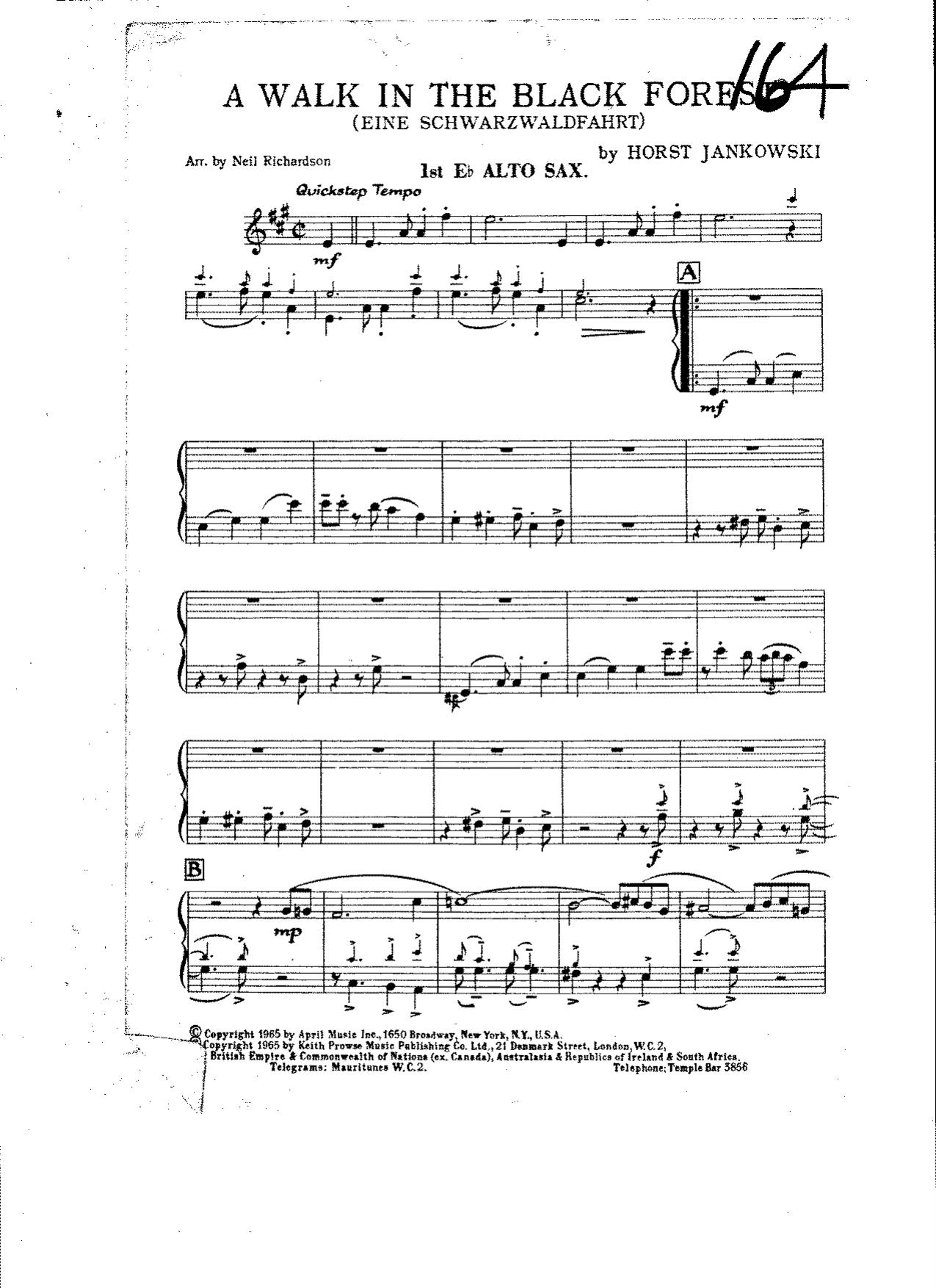
A Walk In The Black Forest (H.Jankowski)
Composed by Horst Jankowski
Arranged by H.Jankowski
- Ensemble: Big Band
- Style: Jazz Standard
- Pages: 40
- Instruments (17): 1st Eb Alto Saxophone, 2nd Bb Tenor Saxophone, 3rd Eb Alto Saxophone, 4th Bb Tenor Saxophone, 5th Eb Baritone Saxophone, 1st Bb Trumpet, 2nd Bb Trumpet, 3rd Bb Trumpet, 4th Bb Trumpet, 1st Trombone, 2nd Trombone, 3rd Trombone, 4th Trombone, Piano, Guitar, Bass, Drums
- Difficulty: easy
- Content: Individual Parts
- Format: PDF Download (Instant)
- Price: $24.99
Horst Jankowski’s infectious 1965 masterpiece "A Walk In The Black Forest" ("Eine Schwarzwaldfahrt") stands as one of the most recognizable milestones of easy-listening jazz and middle-of-the-road orchestral pop, capturing the buoyant optimism of mid-1960s European light jazz. Originally recorded by the German pianist and composer with a rhythm section and lush string arrangements, the tune became an international sensation, topping charts across the globe and earning a permanent place in the repertoire of light jazz orchestras and contemporary big bands. Its enduring appeal lies in its deceptively simple, highly melodic motif that mimics the carefree stride of a woodland stroll, underpinned by a driving, cheerful rhythm section groove that bridges traditional popular song forms with breezy modal jazz sensibilities. Brisk, bright, and relentlessly uplifting, this big band adaptation thrives on a steady, medium-up swing-rock hybrid tempo in a crisp, accessible concert key. The mood is unabashedly joyful, evoking a cinematic sense of motion, sunshine breaking through pine trees, and mid-century lounge sophistication. The arrangement opens with a playful, rhythm-section-driven vamp before introducing the primary melody in the saxes, punctuated by crisp brass stabs. The harmonic language remains largely diatonic and colorfully extended, relying on major 7ths, dominant 9ths, and clever chromatic passing tones that give the chart its sophisticated yet instantly hummable quality. Horst Jankowski’s personal structural approach emphasizes dynamic contrast and textural variety, treating the big band not merely as a wall of sound, but as an interactive chamber jazz ensemble. The arrangement features tight, cooperative woodwind solis, sparkling piano interludes that nod to the composer's keyboard-centric origins, and a brilliantly orchestrated shout chorus that builds tension through dynamic layering rather than sheer volume. Brass voicings avoid heavy, dense cluster chords in favor of open, transparent intervals that let the melody cut cleanly through the ensemble texture, making clever use of muted trumpet accents and warm trombone countermelodies to flesh out the pastoral harmonic background. Carrying the melodic weight primarily through the alto saxophone and piano sections, the chart also carves out space for an open improvised solo section—ideally suited for piano or tenor saxophone—over a straightforward, accessible blues-inflected progression. Technical challenges are well-balanced; while the brass sections must maintain clean articulation and light phrasing at brisk tempos, and the rhythm section must lock into an unyielding, driving groove, there are few extreme altissimo or high-note endurance hurdles. This makes the arrangement exceptionally rewarding for advanced high school ensembles looking to master light-touch articulation, as well as college and professional community big bands seeking a high-energy, crowd-pleasing change of pace that rewards precision and stylistic lightness over brute force. The key to successfully interpreting "A Walk In The Black Forest" lies in maintaining a strict, buoyant tempo without rushing. Conductors should rehearse the rhythm section first to establish a rock-solid, driving medium swing-rock groove that avoids heavy backbeats; the bassline should bounce with an acoustic, walking-adjacent feel while the drummer utilizes crisp ride-cymbal patterns and light cross-stick work on the verses. Articulation across the ensemble must be short and detached (*staccatissimo*), particularly on the repeating melodic figures, ensuring that every sixteenth- and eighth-note figure sparkles. Brass players should utilize cup mutes or gentle straight mutes where indicated to achieve the signature 1960s lounge texture, avoiding excessive vibrato. Rehearsals should focus heavily on the dynamic shifts between the quiet, conversational verse sections and the fuller, brass-heavy transitional interludes, ensuring the ensemble breathes together as one cohesive unit. Q: What instruments and parts are included in this 31-page big band arrangement? A: The package includes a comprehensive conductor score alongside standard big band instrumentation: 5 saxophones (with double parts where applicable), 4 trumpets, 4 trombones, and a full rhythm section comprising piano, guitar, bass, and drums. Q: What is the difficulty level of this arrangement? A: This chart is graded at a medium (Grade 3.5) difficulty level, making it well-suited for advanced high school, collegiate, and professional community big bands that can handle crisp articulation and moderate stylistic versatility. Q: What musical style and historical era does this piece represent? A: It represents the 1960s European light jazz and easy-listening orchestral jazz movement, blending catchy melodic pop-jazz writing with traditional big band swing accompaniment. Q: What makes this specific arrangement by Horst Jankowski unique? A: It faithfully translates Jankowski’s original piano-and-strings aesthetic into a dynamic big band format, emphasizing transparent horn voicings, interactive woodwind solis, and a breezy, optimistic mood unlike heavy bebop or contemporary fusion charts. Q: What is the performance duration and recommended tempo feel? A: The arrangement runs approximately 3 to 4 minutes and is best performed at a brisk, cheerful medium-up tempo with a bright, bouncing swing-rock groove that keeps the energy consistently high.
Questions and answers
- What is included in the A Walk In The Black Forest (H.Jankowski) PDF?
- The verified current file contains individual parts across 40 pages.
- How many instruments or parts are listed for A Walk In The Black Forest (H.Jankowski)?
- The verified instrumentation list contains 17 entries for this Big Band arrangement.
- Who is credited for A Walk In The Black Forest (H.Jankowski)?
- Composer: Horst Jankowski. Arranger: H.Jankowski.
- What difficulty is listed for A Walk In The Black Forest (H.Jankowski)?
- The verified difficulty level is easy.
- What style is listed for A Walk In The Black Forest (H.Jankowski)?
- The catalog lists the style as Jazz Standard.
- Can I preview A Walk In The Black Forest (H.Jankowski) before buying?
- Yes. The product page provides a preview generated from the current PDF file.
- How is A Walk In The Black Forest (H.Jankowski) delivered?
- After successful payment, the digital PDF is made available for download. The displayed price is $24.99.
Musicians Also Search For
A Walk In The Black Forest H.Jankowski PDF • A Walk In The Black Forest H.Jankowski sheet music • A Walk In The Black Forest arranged by H.Jankowski • H.Jankowski big band charts • H.Jankowski jazz arrangements PDF • A Walk In The Black Forest Horst Jankowski sheet music • A Walk In The Black Forest Horst Jankowski big band arrangements • Horst Jankowski big band charts • A Walk In The Black Forest big band arrangements • A Walk In The Black Forest big band PDF download • A Walk In The Black Forest jazz sheet music • big band sheet music download • A Walk In The Black Forest individual parts download • A Walk In The Black Forest sheet music PDF • A Walk In The Black Forest Jazz Standard charts • Jazz Standard big band arrangements • buy A Walk In The Black Forest sheet music • download A Walk In The Black Forest PDF • A Walk In The Black Forest jazz charts • best H.Jankowski big band arrangements • Horst Jankowski arranged by H.Jankowski • A Walk In The Black Forest printable sheet music • big band repertoire PDF