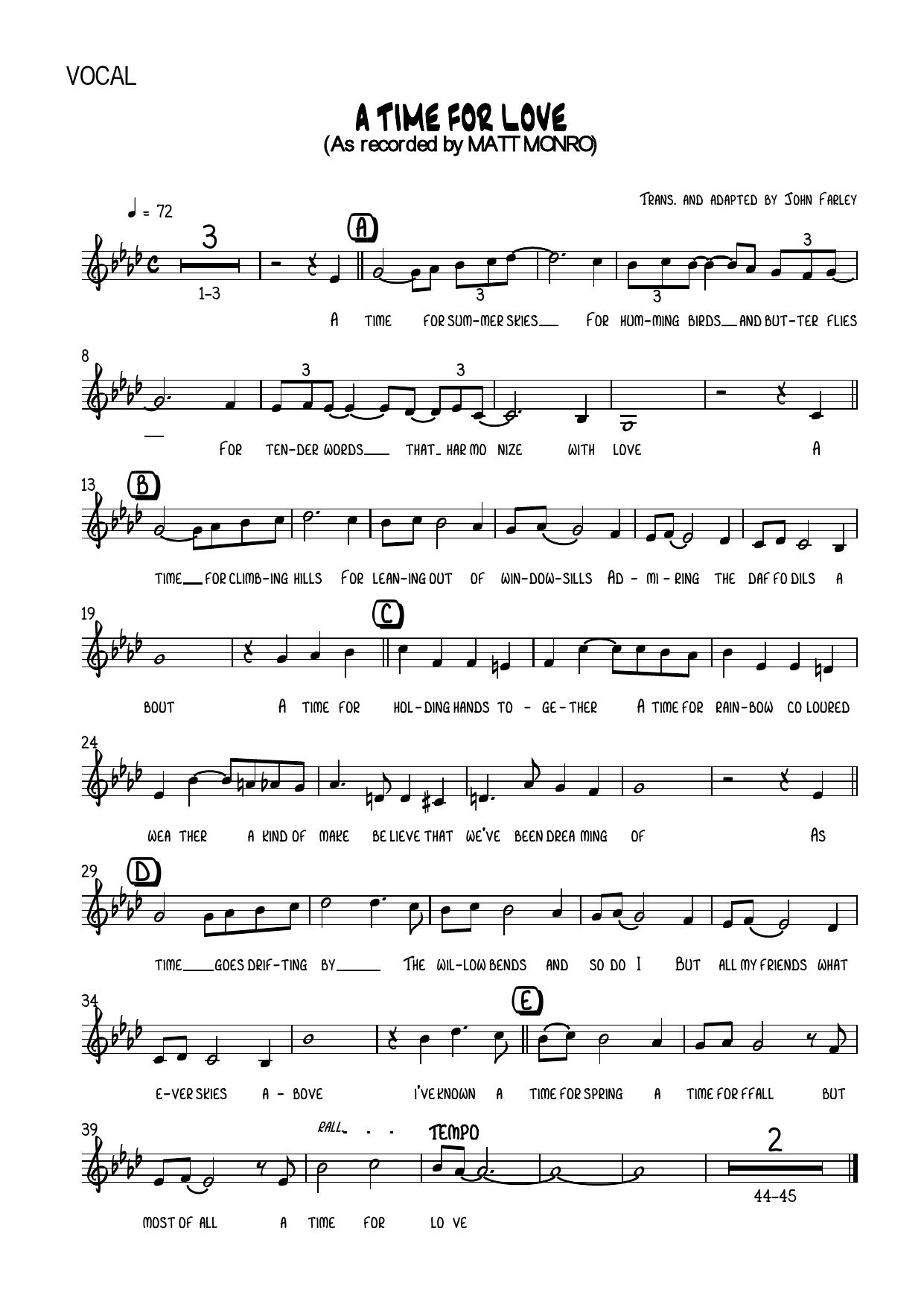
A Time For Love (Matt Monro - John Farley)
Composed by Johnny Mandel
Arranged by John Farley) 2
- Ensemble: Big Band Vocal
- Style: Ballad
- Pages: 24
- Instruments (18): Vocal, Alto Saxophone 1, Alto Saxophone 2, Tenor Saxophone 1, Tenor Saxophone 2, Baritone Saxophone, Trumpet 1, Trumpet 2, Trumpet 3, Trumpet 4, Trombone 1, Trombone 2, Trombone 3, Bass Trombone, Piano, Guitar, String Bass, Drum Set
- Difficulty: medium
- Content: Individual Parts
- Format: PDF Download (Instant)
- Price: $24.99
Johnny Mandel's "A Time For Love" stands as a quintessential ballad from the golden age of cinematic and vocal jazz, first introduced in the 1966 film *An American Dream*. While the film itself may be largely forgotten, Mandel's poignant melody and Paul Francis Webster's evocative lyrics have cemented its place in the Great American Songbook. It quickly became a favorite among jazz vocalists and instrumentalists alike, with iconic interpretations by artists such as Tony Bennett, Barbra Streisand, and most notably, Matt Monro, whose smooth, sophisticated delivery defined its romantic character. The song embodies the lush, orchestral jazz sound prevalent in the mid-20th century, characterized by rich harmonies, soaring melodic lines, and a profound emotional depth that resonates across generations. Its enduring appeal lies in its timeless expression of longing and affection, making it a staple for any ensemble seeking to capture classic jazz elegance. This arrangement, skillfully crafted by John Farley, reimagines the Matt Monro classic for a contemporary big band with a featured vocalist, maintaining the original's tender, slow ballad tempo in 4/4. The musical character is one of profound intimacy and understated power, primarily in the key of C major, allowing the vocalist's timbre to shine with warmth and clarity. Farley’s treatment evokes a mood of sophisticated romance and heartfelt introspection, building from delicate accompaniment to moments of orchestral grandeur. The arrangement’s energy is carefully controlled, emphasizing dynamic contrast and lyrical phrasing over overt power, ensuring that the emotional core of the song remains paramount. Farley's distinctive arranging approach is evident in his masterful use of voicings and dynamic layering. The introduction sets a contemplative tone with harmonically rich brass and woodwind textures, immediately establishing the ballad's mood. The vocalist carries the primary melody throughout, supported by beautifully crafted ensemble figures that never overshadow but always enhance. There are no extended instrumental solos in the traditional sense; instead, Farley integrates brief, lyrical counter-melodies and obbligato lines from various sections, particularly the alto saxophone and flugelhorn, adding instrumental color and depth without interrupting the vocal narrative. A key feature is the gradual build in intensity, culminating in a powerful, yet never bombastic, ensemble soli section that underscores the vocal climax before returning to a serene, reflective outro. Farley's signature is in his ability to create a full, luxurious sound palette, utilizing extended harmonies and subtle modulations that keep the listener engaged without deviating from the song's inherent beauty. Performing this arrangement is a rewarding experience for both the vocalist and the ensemble. The primary technical challenge for the band lies in maintaining impeccable balance and blend, especially during the delicate accompanying passages and the nuanced dynamic shifts. Articulation must be precise, with particular attention to smooth legato phrasing from the brass and woodwinds. The rhythm section needs to provide a steady, supportive foundation with a sensitive touch, allowing the vocalist ample space. The arrangement is well-suited for college-level ensembles and above, including community and professional big bands, that possess strong section players and a vocalist capable of delivering a mature, expressive interpretation. Its musicality and emotional depth make it an ideal choice for concerts, festivals, or any performance requiring a touch of classic vocal jazz sophistication. This arrangement of "A Time For Love" requires a sensitive, unhurried approach to tempo, ideally around quarter note = 60-66 BPM, maintaining a very slow, expressive ballad feel. The key technical challenge lies in achieving seamless blend and balance, particularly within the brass and saxophone sections, to support the vocalist without overpowering them. Emphasize long, sustained tones with precise intonation, especially in the low brass and woodwind pads. Dynamics are crucial; ensure a clear distinction between piano and forte passages, building intensity gradually. The rhythm section should focus on a light, supportive touch, with the bassist providing a warm, melodic foundation and the drummer using brushes or mallets for texture. Rehearsal should prioritize listening across sections and to the vocalist, ensuring that all ensemble figures complement the vocal line. No special techniques like plungers or doits are required; focus on pure tone and lyrical phrasing. Q: What instruments and parts are included in this arrangement? A: This arrangement is scored for a standard big band with a featured vocalist. It includes parts for 5 saxophones (AATTB, with doubles for flute/clarinet where indicated), 4 trumpets, 4 trombones, piano, bass, drums, and a dedicated vocal lead sheet. Q: What is the difficulty level of "A Time For Love (Matt Monro - John Farley)"? A: This arrangement is rated as medium-advanced. It requires strong section players, excellent balance and blend, and a vocalist with a mature interpretive ability. It is suitable for college, community, and professional big bands. Q: What is the musical style and historical context of this piece? A: This is a classic vocal jazz ballad from the mid-1960s, originally composed by Johnny Mandel for the film *An American Dream*. It embodies the lush, sophisticated orchestral jazz sound popularized by artists like Matt Monro and Tony Bennett. Q: What makes John Farley's arrangement of "A Time For Love" unique? A: Farley's arrangement is distinguished by its rich, extended harmonies, elegant voicings, and meticulous dynamic shaping. It features subtle counter-melodies and ensemble soli sections that enhance the vocal line, creating a full yet sensitive soundscape without traditional instrumental solos. Q: What is the typical performance duration and tempo for this arrangement? A: The typical performance duration for this arrangement is approximately 4:00-4:30 minutes. It should be performed at a very slow ballad tempo, around quarter note = 60-66 BPM, emphasizing a lyrical and expressive feel.
Questions and answers
- What is included in the A Time For Love (Matt Monro - John Farley) PDF?
- The verified current file contains a conductor score and individual parts across 24 pages.
- How many instruments or parts are listed for A Time For Love (Matt Monro - John Farley)?
- The verified instrumentation list contains 18 entries for this Big Band Vocal arrangement.
- Who is credited for A Time For Love (Matt Monro - John Farley)?
- Composer: Johnny Mandel. Arranger: John Farley) 2.
- What difficulty is listed for A Time For Love (Matt Monro - John Farley)?
- The verified difficulty level is medium.
- What style is listed for A Time For Love (Matt Monro - John Farley)?
- The catalog lists the style as Ballad.
- Can I preview A Time For Love (Matt Monro - John Farley) before buying?
- Yes. The product page provides a preview generated from the current PDF file.
- How is A Time For Love (Matt Monro - John Farley) delivered?
- After successful payment, the digital PDF is made available for download. The displayed price is $24.99.
Musicians Also Search For
A Time For Love John Farley) 2 PDF • A Time For Love John Farley) 2 sheet music • A Time For Love arranged by John Farley) 2 • John Farley) 2 big band vocal charts • John Farley) 2 jazz arrangements PDF • A Time For Love Johnny Mandel sheet music • A Time For Love Johnny Mandel big band vocal arrangements • Johnny Mandel big band vocal charts • A Time For Love big band vocal arrangements • A Time For Love big band vocal PDF download • A Time For Love jazz sheet music • big band vocal sheet music download • A Time For Love conductor score PDF • A Time For Love individual parts download • A Time For Love sheet music PDF • A Time For Love Ballad charts • Ballad big band vocal arrangements • buy A Time For Love sheet music • download A Time For Love PDF • A Time For Love jazz charts • best John Farley) 2 big band vocal arrangements • Johnny Mandel arranged by John Farley) 2 • A Time For Love printable sheet music • big band vocal repertoire PDF