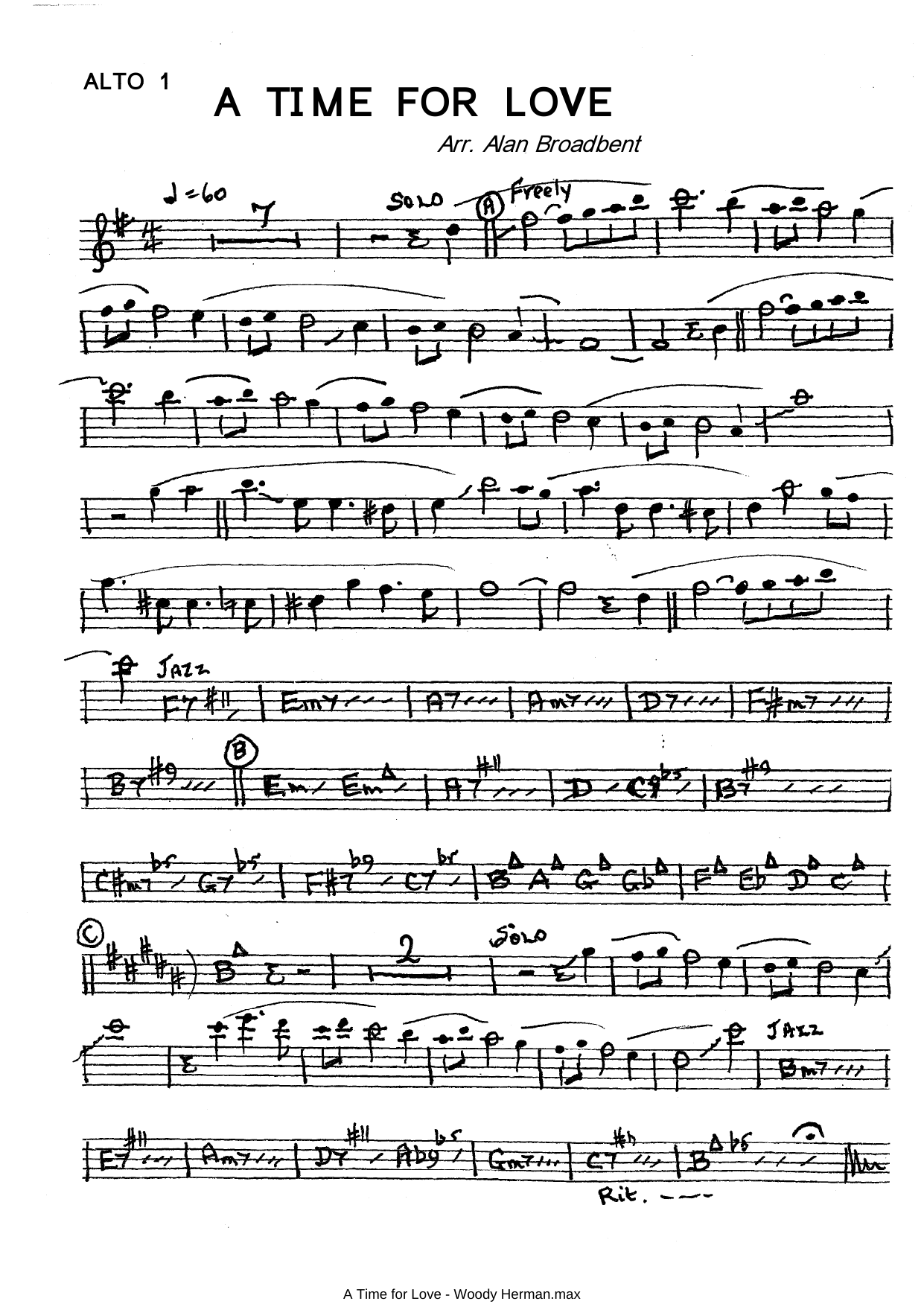
A Time For Love (A.Broadbent)
Composed by Johnny Mandel
Arranged by Woody Herman
- Ensemble: Big Band
- Pages: 24
- Instruments (16): Alto 1, Alto 2, Tenor 1, Tenor 2, Baritone, Trumpet 1, Trumpet 2, Trumpet 3, Trumpet 4, 'Bone 1, 'Bone 2, 'Bone 3, Trombone 4, Bass, Drums, Piano
- Difficulty: medium
- Content: Individual Parts
- Format: PDF Download (Instant)
- Price: $24.99
Johnny Mandel’s exquisite ballad "A Time For Love," originally introduced in the 1966 film *An Eye for an Eye* and later immortalized by vocal and instrumental jazz icons alike, stands as one of the most sophisticated melodic statements of the mid-20th-century American songbook. Its rich, chromatic harmonic progression and hauntingly nostalgic melody have long attracted master interpreters. Among them, Alan Broadbent’s sublime conceptualization—brought to life and recorded through the lens of the legendary Woody Herman Orchestra—transforms Mandel’s cinematic theme into a masterclass in big band nuance, balancing lush, impressionistic textures with the deep-rooted swing and expressive gravity that defined Herman's classic ensembles. This arrangement unfolds as a breathtaking, emotionally resonant ballad characterized by a flowing, rubato-leaning pulse that eventually settles into an expansive, breath-controlled half-time or slow-swing feel. The tonal landscape is thick with extended jazz harmonies—featuring gorgeous major-seventh extensions, altered dominants, and sliding chromatic voice-leading that evoke a smoky, late-night atmosphere. Broadbent’s scoring avoids heavy-handed brass climaxes in favor of crystalline woodwind interleavings and velvety muted trumpet layers. The emotional trajectory shifts seamlessly from tender vulnerability to sweeping, cinematic grandeur, demanding absolute restraint and dynamic control from every section in the band. Woody Herman’s signature approach to ballads was never merely about backing a soloist; it was about treating the entire big band as a living, breathing vocal choir. In this chart, the saxophone section—anchored by a rich, expressive alto lead and supported by a warm tenor and baritone foundation—frequently carries the primary melodic weight, employing lush parallel voicings reminiscent of West Coast cool jazz sophistication. The arrangement features a deeply poignant, exposed improvised solo space (traditionally tailored for the lead alto or tenor) that floats effortlessly over a cushion of cascading, harmonically rich background figures. The technical challenges lie not in fast fingers or extreme altissimo ranges, but in intonation, breath support, sustained tone quality at whisper-soft dynamics, and the ability to phrase with a unified, vocal-like legato across the entire ensemble. Advanced college ensembles, top-tier high school jazz bands, and professional or community big bands will find this arrangement an exceptional vehicle for developing ensemble listening skills and lyrical maturity. Because it eschews high-energy pyrotechnics in favor of profound emotional delivery, it serves as a brilliant contrast piece in a competitive festival program or a sophisticated concert set. Performing this chart requires musicians to look past the ink on the 24 pages of parts and tap into a shared sense of storytelling, making the final chord resonate long after the sound has faded. Conductors approaching this arrangement must prioritize balance and blend above all else, ensuring the rhythm section maintains an ultra-transparent texture. The tempo should hover around a relaxed, unhurried ballad feel where subdivision is internalized rather than overtly stated by the ride cymbal. Pianists and guitarists should voice chords sparsely, leaning into open-position voicings that highlight Broadbent’s exquisite upper-structure extensions without muddying the low end. Horn players must exercise extreme care with intonation during exposed chordal passages; use long-tone warm-ups focusing on dynamic crescendos and decrescendos within a tight vibrato framework. Muted brass sections should aim for a warm, woody timbre rather than a biting edge, allowing the flugelhorn or muted trumpet timbres to melt into the saxophone backgrounds. Rehearsals should begin by having the ensemble sing their respective voice-leading lines to internalize the horizontal motion of Mandel’s harmony before picking up their instruments. Q: What instruments and parts are included in this 24-page arrangement? A: The chart is scored for a standard big band instrumentation consisting of 8 specific instrumental parts across saxophone (Alto, Tenor, Baritone), trumpet, and trombone sections, alongside a full rhythm section. Q: What is the difficulty level of this arrangement? A: This piece is rated at an advanced (Grade 4.5 to 5) difficulty level, primarily due to the intense demand for breath control, blend, intonation, and mature ballad phrasing rather than technical speed. Q: What is the historical and stylistic background of this piece? A: Composed by Johnny Mandel and famously interpreted through the Woody Herman orbit with arranging contributions by Alan Broadbent, this chart represents the pinnacle of West Coast-influenced, sophisticated big band ballad playing from the post-bop era. Q: What makes this specific arrangement by Woody Herman / Alan Broadbent unique? A: It distinguishes itself through its impressionistic, lush chord voicings, vocal-like saxophone soli writing, and a cinematic approach that treats the big band as an intimate chamber orchestra rather than a high-volume powerhouse. Q: What is the performance duration and tempo feel of the piece? A: The arrangement is designed as a spacious, expressive concert ballad lasting approximately 4 to 5 minutes, driven by a relaxed, fluid tempo feel with rubato-inspired phrasing opportunities.
Questions and answers
- What is included in the A Time For Love (A.Broadbent) PDF?
- The verified current file contains individual parts across 24 pages.
- How many instruments or parts are listed for A Time For Love (A.Broadbent)?
- The verified instrumentation list contains 16 entries for this Big Band arrangement.
- Who is credited for A Time For Love (A.Broadbent)?
- Composer: Johnny Mandel. Arranger: Woody Herman.
- What difficulty is listed for A Time For Love (A.Broadbent)?
- The verified difficulty level is medium.
- Can I preview A Time For Love (A.Broadbent) before buying?
- Yes. The product page provides a preview generated from the current PDF file.
- How is A Time For Love (A.Broadbent) delivered?
- After successful payment, the digital PDF is made available for download. The displayed price is $24.99.
Musicians Also Search For
A Time For Love Woody Herman PDF • A Time For Love Woody Herman sheet music • A Time For Love arranged by Woody Herman • Woody Herman big band charts • Woody Herman jazz arrangements PDF • A Time For Love Johnny Mandel sheet music • A Time For Love Johnny Mandel big band arrangements • Johnny Mandel big band charts • A Time For Love big band arrangements • A Time For Love big band PDF download • A Time For Love jazz sheet music • big band sheet music download • A Time For Love individual parts download • A Time For Love sheet music PDF • buy A Time For Love sheet music • download A Time For Love PDF • A Time For Love jazz charts • best Woody Herman big band arrangements • Johnny Mandel arranged by Woody Herman • A Time For Love printable sheet music • big band repertoire PDF