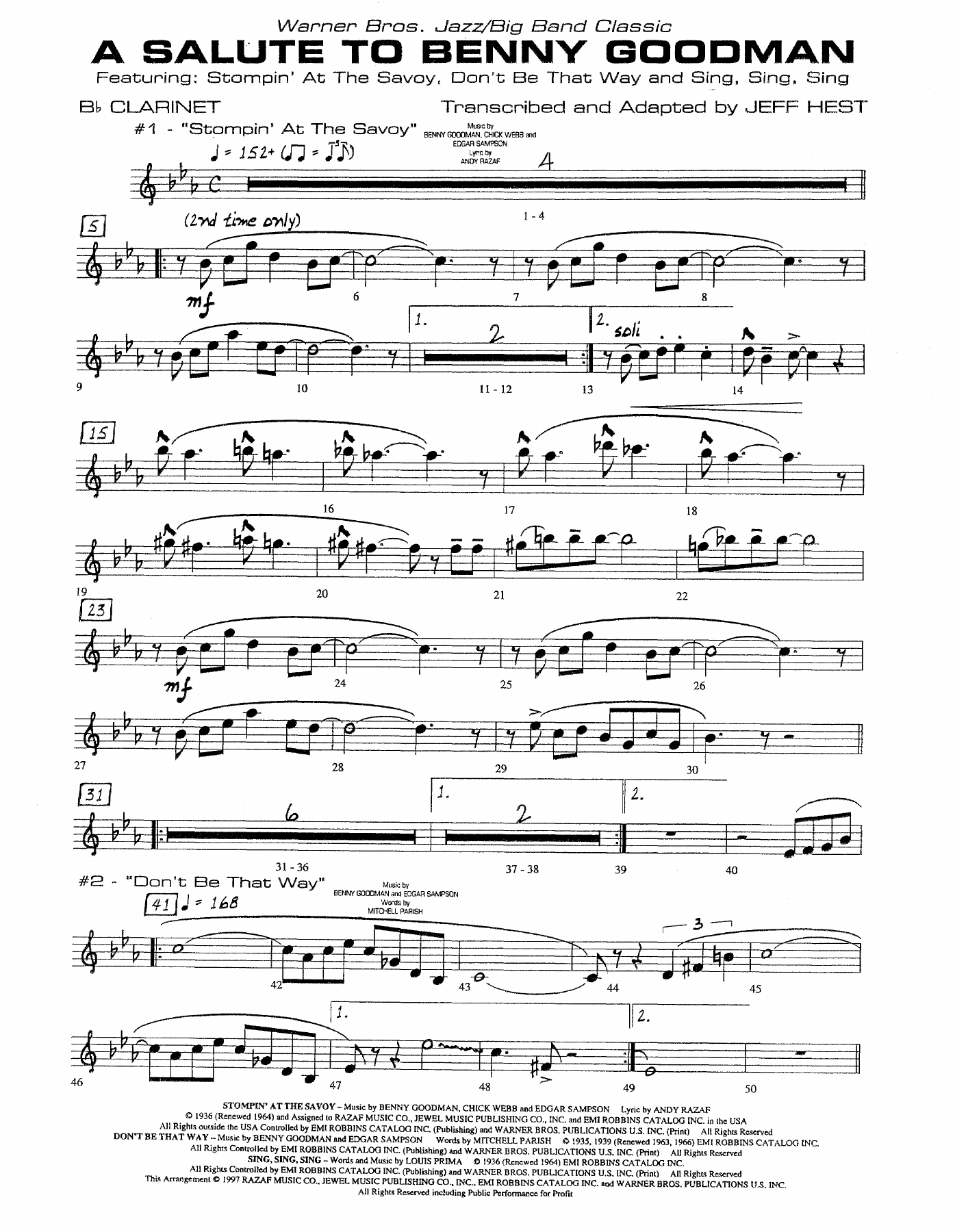
A Salute To Benny Goodman (J.Hest) sheet music preview

A Salute To Benny Goodman (J.Hest)

Composed by Benny Goodman

Arranged by J.Hest

  • Ensemble: Big Band
  • Style: Jazz Standard
  • Pages: 105
  • Instruments (18): Bb Clarinet, 1st Eb Alto Saxophone, 2nd Eb Alto Saxophone, 1st Bb Tenor Saxophone, 2nd Bb Tenor Saxophone, Baritone Saxophone, 1st Bb Trumpet, 2nd Bb Trumpet, 3rd Bb Trumpet, 4th Bb Trumpet, 1st Trombone, 2nd Trombone, 3rd Trombone, 4th Trombone, Guitar, Piano, Bass, Drum Set
  • Difficulty: advanced
  • Content: Individual Parts
  • Format: PDF Download (Instant)
  • Price: $24.99

The swing era, a vibrant period spanning the 1930s and 1940s, found its quintessential voice in the clarinet artistry and bandleading prowess of Benny Goodman. Often dubbed the "King of Swing," Goodman was instrumental in popularizing jazz for a mainstream audience, breaking racial barriers, and establishing the big band as the dominant musical force of his time. His iconic recordings, characterized by their precision, driving rhythm, and sophisticated arrangements, became the bedrock of the jazz standard repertoire. This arrangement, "A Salute To Benny Goodman" by J.Hest, pays homage to that golden age, distilling the essence of Goodman's style into a fresh yet authentic big band chart. It captures the infectious energy and melodic clarity that defined his sound, evoking the excitement of a classic 1930s dance hall while offering a contemporary big band experience. J.Hest's masterful treatment of this jazz standard is a clinic in period-appropriate arranging with a modern sensibility. The piece is set at a medium-up swing tempo, typically around 180-200 BPM, in a bright, driving 4/4 feel that immediately sets the toes tapping. The arrangement opens with a classic Goodman-esque clarinet lead, often doubled or harmonized with the alto saxophone, instantly establishing the melodic theme. Hest employs tight, articulate voicings throughout, particularly in the saxophone soli sections, which are reminiscent of Goodman's famed reed section precision. Brass figures are punchy and well-articulated, providing strong rhythmic support and dynamic contrast without overpowering the melodic lines. Expect sophisticated harmonic extensions that add color and depth while remaining true to the swing idiom, avoiding overly modern dissonances that would detract from the historical feel. The chart features a compelling shout chorus that builds dynamically, showcasing the full power of the big band, culminating in a powerful, yet controlled, ensemble statement. Performance-wise, "A Salute To Benny Goodman" offers rewarding challenges and numerous standout moments. The melody is predominantly carried by the lead alto saxophone and clarinet (often played by Alto 1 or a dedicated clarinetist), requiring a strong, clear tone and excellent articulation. Featured solo opportunities are provided for both the clarinet (or lead alto) and tenor saxophone, allowing improvisers to channel their inner Goodman or Young. Technical demands include precise ensemble articulation, particularly in the brass, and maintaining a consistent, driving swing feel throughout. The saxophone section will need to navigate intricate soli passages with tight intonation and rhythmic accuracy. What makes this piece particularly rewarding is its ability to transport both performers and audience back to the swing era, celebrating a pivotal figure in jazz history. This arrangement is ideally suited for advanced high school, college, community, and professional big bands looking to perform a classic-sounding chart that is both historically informed and brilliantly conceived. Its 17-instrument scoring ensures a full, rich sound, making it a valuable addition to any big band library. "A Salute To Benny Goodman" should be approached with a focus on rhythmic precision and stylistic authenticity. The ideal tempo range is a medium-up swing, approximately 180-200 BPM, maintaining a consistent, driving 4/4 feel. Articulation is paramount; brass should play short, crisp notes with clear attacks, while saxophones need a light, precise touch for soli passages. Encourage a "vertical" approach to ensemble playing, ensuring chords are precisely in tune and rhythmically aligned. Key challenges include the intricate saxophone soli sections, which require diligent practice for intonation and rhythmic accuracy. The lead alto/clarinet melody lines demand a strong, clear tone and confident projection. Soloists should be encouraged to study Benny Goodman's melodic and rhythmic vocabulary for stylistic improvisation. No special mutes are explicitly required, but brass players should be prepared for dynamic contrasts, from subtle swells to powerful shout chorus blasts. Rehearsal time should be dedicated to balancing the lead clarinet/alto voice against the ensemble and refining the ensemble's collective swing feel. Q: Which instruments and parts are included in this arrangement? A: This arrangement is scored for a standard 17-piece big band. It includes Alto Saxophone 1, Alto Saxophone 2, Tenor Saxophone 1, Tenor Saxophone 2, Baritone Saxophone, Trumpet 1, Trumpet 2, Trumpet 3, Trumpet 4, Trombone 1, Trombone 2, Trombone 3, Trombone 4, Piano, Bass, Drums, and Guitar. Q: What is the difficulty level of "A Salute To Benny Goodman (J.Hest)"? A: This arrangement is considered advanced high school, college, or community band level. It requires proficient instrumentalists, particularly strong lead players in the saxophone and trumpet sections, and soloists comfortable with swing improvisation. Q: What musical style and historical context does this arrangement represent? A: This piece is a jazz standard arranged in the classic swing big band style, paying tribute to Benny Goodman. It captures the essence of the 1930s-1940s swing era, characterized by driving rhythms, clear melodies, and sophisticated ensemble voicings. Q: What makes J.Hest's arrangement of this piece unique? A: J.Hest's arrangement is distinctive for its authentic swing-era voicings, precise articulation demands, and well-crafted soli sections that evoke Goodman's sound while offering a fresh big band experience. It features compelling solo opportunities and a powerful shout chorus. Q: What is the typical performance duration and recommended tempo for this piece? A: The typical performance duration for "A Salute To Benny Goodman" is approximately 3-4 minutes, depending on the length of solos. The recommended tempo is a medium-up swing, in the range of 180-200 beats per minute.

Musicians Also Search For

A Salute To Benny Goodman J.Hest PDFA Salute To Benny Goodman J.Hest sheet musicA Salute To Benny Goodman arranged by J.HestJ.Hest big band chartsJ.Hest jazz arrangements PDFA Salute To Benny Goodman Benny Goodman sheet musicA Salute To Benny Goodman Benny Goodman big band arrangementBenny Goodman big band chartsA Salute To Benny Goodman big band arrangementA Salute To Benny Goodman big band PDF downloadA Salute To Benny Goodman jazz ensemble sheet musicbig band sheet music instant downloadA Salute To Benny Goodman conductor score PDFA Salute To Benny Goodman individual parts downloadA Salute To Benny Goodman sheet music with partsA Salute To Benny Goodman Jazz Standard chartJazz Standard big band arrangementsbuy A Salute To Benny Goodman sheet music onlinedownload A Salute To Benny Goodman PDFA Salute To Benny Goodman jazz chartbest J.Hest big band arrangementsBenny Goodman songs arranged by J.HestA Salute To Benny Goodman printable sheet musicbig band repertoire PDF

All arrangements by J.Hest All Benny Goodman sheet music