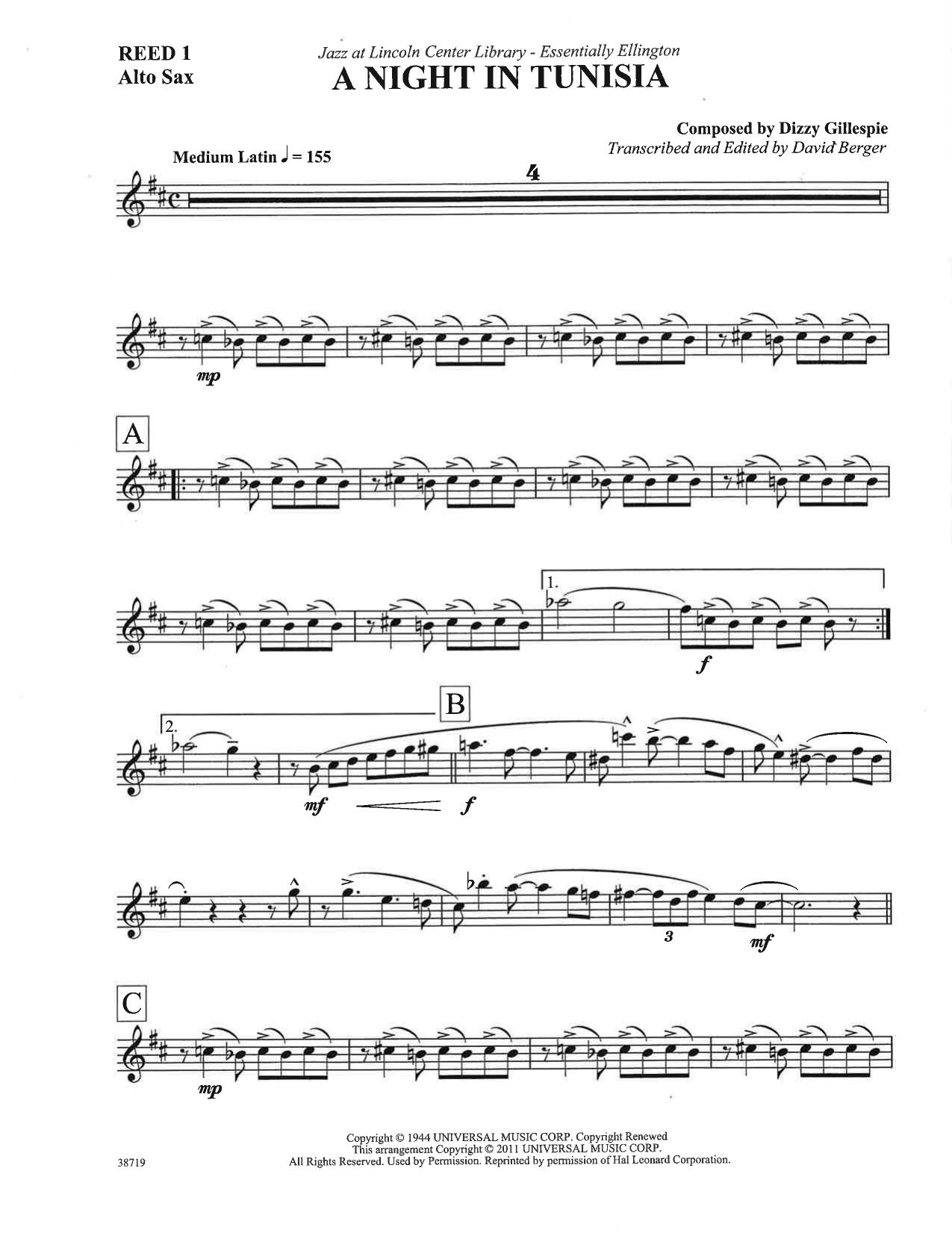
A Night In Tunisia (D.Berger)
Composed by Dizzy Gillespie
Arranged by Gil Fuller-D.GILLESPIE
- Ensemble: Big Band
- Pages: 59
- Instruments (16): Reed 1 Alto Sax, Reed 2 Alto Sax, Reed 3 Tenor Sax, Reed 4 Tenor Sax, Reed 5 Baritone Sax, Trumpet 1, Trumpet 2, Trumpet 3, Trumpet 4, Trombone 1, Trombone 2, Trombone 3, Piano, Bass, Drums, Guitar
- Difficulty: advanced
- Content: Individual Parts
- Format: PDF Download (Instant)
- Price: $24.99
Dizzy Gillespie’s immortal anthem "A Night in Tunisia," co-written with Frank Paparelli and first recorded in 1942, stands as one of the towering pillars of twentieth-century jazz composition. Representing the vital bridge between the late swing era and the birth of modern bebop, the tune marries an infectious Afro-Cuban rhythmic foundation with intricate, modal-leaning bebop harmonies and a haunting, exotic melody. Its famous augmented-fourth interval vamp and driving habanera-infused groove revolutionized how jazz musicians incorporated Latin American rhythms, cementing its status as an absolute rite of passage for improvisers worldwide. Masterminded by Dizzy Gillespie alongside arranger Gil Fuller—the brilliant mind behind several of Gillespie’s most iconic large-ensemble charts—this definitive big band adaptation crackles with explosive energy and sophisticated counterpoint. Operating at a brisk, driving tempo, the arrangement opens with the signature syncopated bassline and low-register reed vamps that instantly evoke the mysterious, nocturnal atmosphere of the Mediterranean coast. The harmonic palette is richly colored by extended bebop voicings, crisp brass stabs, and intricate woodwind interludes that alternate seamlessly between straight-eighth Afro-Cuban grooves and blistering swing sections. The tension builds relentlessly through harmonically dense ensemble solis before erupting into a roaring shout chorus that showcases the full dynamic range and power of a classic jazz orchestra. Throughout the chart, the melodic weight is shared dynamically across the sections, with the brass carrying punchy punctuations while the saxophones weave intricate, chromatic counter-lines. Open solo sections provide ample space for featured horn players to stretch out over Gillespie’s iconic harmonic changes, demanding both technical fluidity and a strong sense of rhythmic displacement. The primary technical challenges lie in executing the lightning-fast unison lines, maintaining pristine articulation during rapid double-time passages, and locking in the shifting micro-grooves between the Latin rhythm section feels and straight-ahead swing. Conquering these hurdles rewards the ensemble with an exhilarating rush of collective swing and historical authenticity that never fails to electrify an audience. Tailored for advanced college ensembles, top-tier high school jazz bands, and professional repertory orchestras, this 59-page publication demands a mature section-leader mentality and exceptional sight-reading capabilities. Because of its historical weight and demanding rhythmic interplay, it functions brilliantly as a high-impact centerpiece for festival performances, formal auditorium concerts, or commemorative tribute sets celebrating the architects of modern jazz. Unlocking the brilliance of this Gil Fuller and Dizzy Gillespie collaboration requires meticulous attention to articulation, stylistic contrast, and rhythmic precision. The tempo must remain brisk and unyielding, yet relaxed enough to allow the underlying Afro-Cuban groove to breathe without rushing the downbeats. Conductors should spend early rehearsals isolating the transition zones where the ensemble shifts from the straight-eighth Latin feel to the driving, four-to-the-bar swing choruses; these pivots must feel seamless rather than jarring. Brass players should utilize controlled, bright tones with minimal heavy vibrato to maintain the authentic 1940s bebop edge, deploying precise short accents on off-beat stabs. Saxophones need to focus on smooth, fluid air support during the fast unison bebop lines, ensuring that every chromatic note speaks clearly. Percussionists must ground the ensemble with a crisp, driving ride cymbal and authentic conga or timbale integration if available, keeping the foundational habanera pulse distinct beneath the horn sections' complex counter-melodies. Q: What specific instruments and parts are included in this arrangement? A: Scored for an 8-instrument core plus rhythm section configuration, the arrangement includes parts for Alto Saxophone, Tenor Saxophone, Baritone Saxophone, Trumpet, and Trombone, supplemented by full big band rhythm section support across its 59 comprehensive pages. Q: What is the difficulty level of this big band chart? A: This arrangement is graded as advanced, making it best suited for collegiate ensembles, elite high school jazz bands, and professional repertory groups with strong section-playing skills and experienced improvisers. Q: What is the historical style and background of this piece? A: Composed by Dizzy Gillespie and arranged in collaboration with Gil Fuller, this chart captures the pioneering bebop and Afro-Cuban jazz fusion of the 1940s, transforming one of jazz's most celebrated standards into a powerhouse big band vehicle. Q: What makes this specific arrangement by Gil Fuller and D. Gillespie unique? A: It is celebrated for its authentic historical pedigree, featuring Fuller's signature dense voicings, brilliant dynamic contrasts, and an iconic structuring that brilliantly balances complex bebop lines with driving Latin-infused grooves. Q: What is the approximate performance duration and tempo guideline? A: While performance time varies based on the length of improvised solo choruses, the chart is designed to run approximately 4 to 5 minutes at an energetic, driving tempo that demands sustained focus and stamina from the entire ensemble.
Questions and answers
- What is included in the A Night In Tunisia (D.Berger) PDF?
- The verified current file contains a conductor score and individual parts across 59 pages.
- How many instruments or parts are listed for A Night In Tunisia (D.Berger)?
- The verified instrumentation list contains 16 entries for this Big Band arrangement.
- Who is credited for A Night In Tunisia (D.Berger)?
- Composer: Dizzy Gillespie. Arranger: Gil Fuller-D.GILLESPIE.
- What difficulty is listed for A Night In Tunisia (D.Berger)?
- The verified difficulty level is advanced.
- Can I preview A Night In Tunisia (D.Berger) before buying?
- Yes. The product page provides a preview generated from the current PDF file.
- How is A Night In Tunisia (D.Berger) delivered?
- After successful payment, the digital PDF is made available for download. The displayed price is $24.99.
Musicians Also Search For
A Night In Tunisia Gil Fuller-D.GILLESPIE PDF • A Night In Tunisia Gil Fuller-D.GILLESPIE sheet music • A Night In Tunisia arranged by Gil Fuller-D.GILLESPIE • Gil Fuller-D.GILLESPIE big band charts • Gil Fuller-D.GILLESPIE jazz arrangements PDF • A Night In Tunisia Dizzy Gillespie sheet music • A Night In Tunisia Dizzy Gillespie big band arrangements • Dizzy Gillespie big band charts • A Night In Tunisia big band arrangements • A Night In Tunisia big band PDF download • A Night In Tunisia jazz sheet music • big band sheet music download • A Night In Tunisia conductor score PDF • A Night In Tunisia individual parts download • A Night In Tunisia sheet music PDF • buy A Night In Tunisia sheet music • download A Night In Tunisia PDF • A Night In Tunisia jazz charts • best Gil Fuller-D.GILLESPIE big band arrangements • Dizzy Gillespie arranged by Gil Fuller-D.GILLESPIE • A Night In Tunisia printable sheet music • big band repertoire PDF