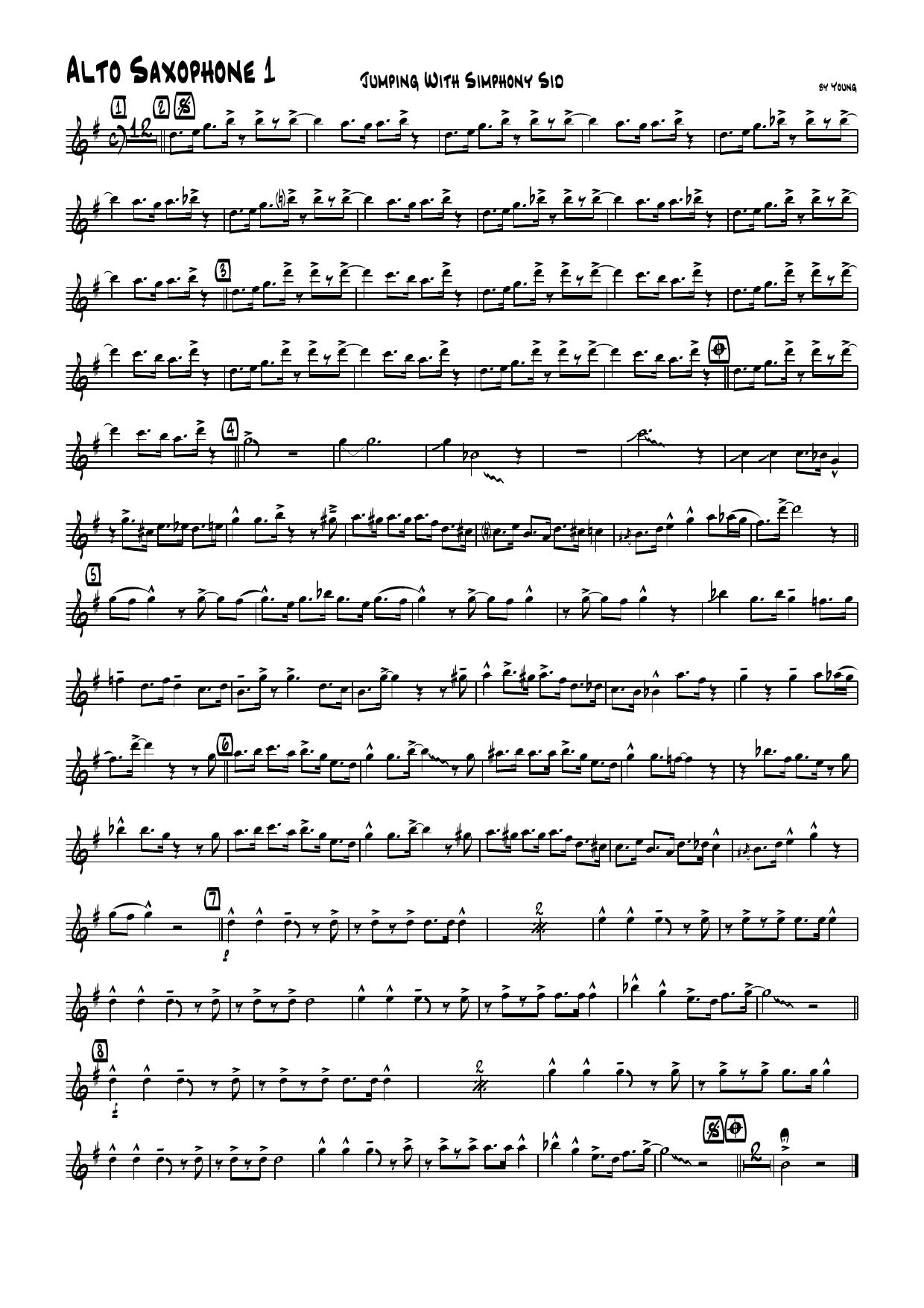
A Night In Tunisia - 13 Arr (G.Fuller-D.GILLESPIE)
Composed by Dizzy Gillespie
Arranged by Gil Fuller-D.GILLESPIE
- Ensemble: Big Band
- Pages: 18
- Instruments (17): Alto Saxophone 1, Alto Saxophone 2, Tenor Saxophone 1, Tenor Saxophone 2, Baritone Saxophone, Trumpet in Bb 1, Trumpet in Bb 2, Trumpet in Bb 3, Trumpet in Bb 4, Trombone 1, Trombone 2, Trombone 3, Trombone 4, Guitar, Piano, Bass, Drum Set
- Difficulty: easy
- Content: Individual Parts
- Format: PDF Download (Instant)
- Price: $24.99
Dizzy Gillespie’s immortal anthem "A Night in Tunisia," co-written with Frank Paparelli in 1942, stands as one of the definitive cornerstones of the bebop movement and a foundational blueprint for Afro-Cuban jazz integration. Emerging from the vibrant late-night jam sessions at Minton’s Playhouse and Clark Monroe’s Uptown House, Gillespie crafted a masterclass in modal tension, exotic scalar lines, and infectious syncopation. When recorded by Gillespie's landmark big bands and small groups throughout the 1940s and 1950s, the composition permanently altered the landscape of modern jazz by bridging American swing with Caribbean and Middle Eastern rhythmic concepts. Its signature descending bassline, dramatic breaks, and labyrinthine head have challenged and inspired generations of improvisers, cementing its status as an absolute jazz standard. Driving forward with a high-octane energy that fuses blistering bebop acceleration with an authentic Latin-tinged groove, this chart crackles with electricity from the opening measure. The mood shifts masterfully between suspenseful, harmonically dense modal vamps and explosive, unbridled swing passages that demand absolute precision. The arrangement captures the exotic, nocturnal atmosphere of the original concept while amplifying its sonic scope for a full horn section, creating an intense emotional narrative filled with dark, chromatic tension and triumphant, soaring brass resolutions. Collaboratively shaped by the visionary compositional and arranging minds of Gil Fuller and Dizzy Gillespie, this historical 13-instrument scoring showcases the pioneering arranging style that defined the 1946 Gillespie big band sound. Fuller, known for his sophisticated, dense block-chording and advanced bebop reharmonizations, expertly pairs with Gillespie’s innate understanding of horn mechanics to produce a chart rich in chromatic counterpoint and thick, extended harmonies. The arrangement avoids predictable scoring clichés, instead utilizing sharp interjections, interlocking woodwind passages, and a powerhouse shout chorus that reinterprets the iconic melody through a lens of aggressive modernism. Melodic execution is shared dynamically across the frontline, featuring robust soli sections that test the articulation, agility, and stamina of the saxophone and brass departments. Open solo spaces provide ample room for featured improvisers to stretch out over standard changes, while ensemble punch-figures keep the accompanying sections heavily engaged. The technical demands—ranging from rapid-fire unison bebop lines to complex rhythmic unisons spanning extreme registers—make this chart exceptionally well-suited for advanced college ensembles, top-tier community big bands, and professional repertory orchestras looking to honor the true pedigree of early bebop arranging. Unlocking the authentic drive of this arrangement requires meticulous attention to the juxtaposition between the straight-eighth Afro-Cuban groove and the swinging bebop sections. The rhythm section must anchor the chart with a relentless, driving pulse, ensuring the bass player locks tightly with the ride cymbal to maintain forward momentum beneath complex horn figures. Brass players should approach high-register passages with a controlled, bright tone rather than forced volume, particularly during the dense tutti shout choruses where intonation among the trumpet section can easily skew sharp. Articulation is paramount: short notes must be clipped and uniform, while accented lines require a weighted, punchy front-end attack. Conductors should spend early rehearsals isolating the tricky metric modulations and rapid unison scalar passages at a reduced tempo, gradually building speed only after every section can cleanly articulate the intricate bebop vocabulary without rushing the downbeats. Q: What instruments and parts are included in this 13-instrument configuration? A: The arrangement is scored for an 8-instrument horn frontline consisting of Alto Saxophone, Tenor Saxophone, Baritone Saxophone, Trumpet, and Trombone parts, supported by a standard rhythm section framework. Q: What is the difficulty level of this specific arrangement? A: This chart is graded as advanced, demanding a high degree of technical facility, strong sight-reading skills, and precise articulation from all horn players, making it ideal for advanced college and professional big bands. Q: What is the historical style and context of this version? A: This arrangement reflects the pioneering 1940s bebop and Afro-Cuban jazz fusion style championed by Dizzy Gillespie and arranger Gil Fuller, capturing the adventurous harmonic language of the early bop big band era. Q: What makes this Gil Fuller-Dizzy Gillespie collaboration unique? A: It features Fuller’s signature dense block-chording and sophisticated reharmonizations integrated directly with Gillespie's iconic melodic lines, producing a distinctively aggressive and harmonically rich treatment of the standard. Q: What is the recommended performance tempo and duration for this piece? A: The chart typically performs at an energetic, driving tempo around 200 to 220 BPM for the swing sections, yielding an approximate duration of 3 to 4 minutes depending on open solo rotations.
Questions and answers
- What is included in the A Night In Tunisia - 13 Arr (G.Fuller-D.GILLESPIE) PDF?
- The verified current file contains individual parts across 18 pages.
- How many instruments or parts are listed for A Night In Tunisia - 13 Arr (G.Fuller-D.GILLESPIE)?
- The verified instrumentation list contains 17 entries for this Big Band arrangement.
- Who is credited for A Night In Tunisia - 13 Arr (G.Fuller-D.GILLESPIE)?
- Composer: Dizzy Gillespie. Arranger: Gil Fuller-D.GILLESPIE.
- What difficulty is listed for A Night In Tunisia - 13 Arr (G.Fuller-D.GILLESPIE)?
- The verified difficulty level is easy.
- Can I preview A Night In Tunisia - 13 Arr (G.Fuller-D.GILLESPIE) before buying?
- Yes. The product page provides a preview generated from the current PDF file.
- How is A Night In Tunisia - 13 Arr (G.Fuller-D.GILLESPIE) delivered?
- After successful payment, the digital PDF is made available for download. The displayed price is $24.99.
Musicians Also Search For
A Night In Tunisia - 13 Arr Gil Fuller-D.GILLESPIE PDF • A Night In Tunisia - 13 Arr Gil Fuller-D.GILLESPIE sheet music • A Night In Tunisia - 13 Arr arranged by Gil Fuller-D.GILLESPIE • Gil Fuller-D.GILLESPIE big band charts • Gil Fuller-D.GILLESPIE jazz arrangements PDF • A Night In Tunisia - 13 Arr Dizzy Gillespie sheet music • A Night In Tunisia - 13 Arr Dizzy Gillespie big band arrangements • Dizzy Gillespie big band charts • A Night In Tunisia - 13 Arr big band arrangements • A Night In Tunisia - 13 Arr big band PDF download • A Night In Tunisia - 13 Arr jazz sheet music • big band sheet music download • A Night In Tunisia - 13 Arr individual parts download • A Night In Tunisia - 13 Arr sheet music PDF • buy A Night In Tunisia - 13 Arr sheet music • download A Night In Tunisia - 13 Arr PDF • A Night In Tunisia - 13 Arr jazz charts • best Gil Fuller-D.GILLESPIE big band arrangements • Dizzy Gillespie arranged by Gil Fuller-D.GILLESPIE • A Night In Tunisia - 13 Arr printable sheet music • big band repertoire PDF