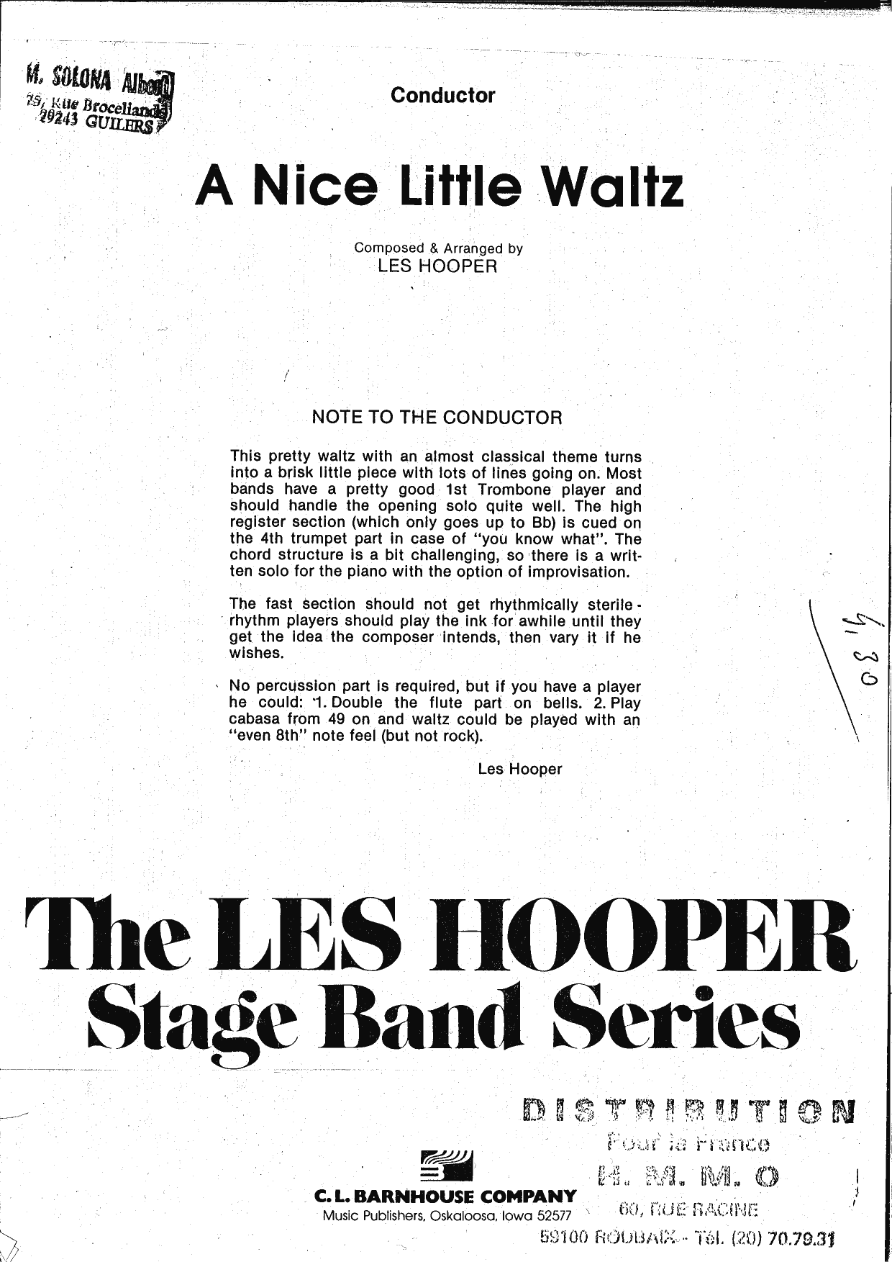
A Nice Little Waltz (L.Hooper)
Composed by Les Hooper
Arranged by Les Hooper
- Ensemble: Big Band Dance
- Style: Slow Waltz
- Pages: 78
- Instruments (17): Alto Saxophone 1, Alto Saxophone 2, Tenor Saxophone 1, Tenor Saxophone 2, Baritone Saxophone, Trumpet 1, Trumpet 2, Trumpet 3, Trumpet 4, Trombone 1, Trombone 2, Trombone 3, Bass Trombone, Piano, Bass, Drums, Guitar
- Difficulty: advanced
- Content: Individual Parts
- Format: PDF Download (Instant)
- Price: $24.99
"A Nice Little Waltz" by Les Hooper stands as a quintessential example of contemporary big band writing, showcasing Hooper's masterful command of orchestration and harmonic sophistication within the often-understated slow waltz idiom. While not a traditional jazz standard, this original composition has become a staple in the repertoire of discerning jazz ensembles, celebrated for its elegant melody and lush textures. Hooper, a prolific composer, arranger, and educator, emerged from the vibrant Los Angeles jazz scene, where his work often blurred the lines between classic big band tradition and modern harmonic exploration. This piece embodies that spirit, offering a fresh perspective on the 3/4 time signature, moving beyond simple dance steps into a realm of rich jazz expression. Musically, "A Nice Little Waltz" unfolds with a gentle, flowing tempo, establishing a serene and introspective mood. The piece is characterized by its lyrical melodic lines, often passed between sections, creating a seamless tapestry of sound. Hooper’s signature harmonic language is immediately apparent, employing extended chords, subtle dissonances, and sophisticated voice leading that give the waltz a contemporary, yet accessible, feel. The overall energy is one of refined elegance, evoking a sense of calm reflection rather than overt showmanship. Its key center, likely in a comfortable concert key, allows for the exploration of these harmonies without undue technical strain, focusing instead on blend and musicality. Les Hooper's arranging approach to his own composition is both intricate and intuitive. The primary melodic statements are initially carried by the saxophone section, often voiced in close harmony, creating a warm, inviting sound. These are then skillfully echoed and developed by the brass, sometimes with muted textures adding to the piece's delicate character. Hooper masterfully employs layered voicings, ensuring that each instrument contributes meaningfully to the overall sound, avoiding muddy textures even in dense harmonic passages. While there isn't a traditional "shout chorus" in the bombastic sense, the arrangement builds to moments of rich, full ensemble expression, particularly through carefully constructed soli sections that highlight the band's collective strength. The piece features ample opportunity for improvisation, typically offering solo space for a tenor saxophone and/or trombone, allowing individual musicians to interpret the waltz's melancholic beauty. Performing "A Nice Little Waltz" is a deeply rewarding experience. The technical challenges lie less in blistering tempos or extreme ranges, and more in achieving precise intonation, balanced voicings, and a unified sense of rhythmic flow in 3/4. The ensemble must focus on dynamic control and phrasing to convey the piece's nuanced emotional landscape. This arrangement is ideally suited for advanced high school, college, community, and professional big bands. Its sophisticated harmonies and demand for musical maturity make it an excellent vehicle for developing ensemble blend, expressive playing, and an appreciation for contemporary big band writing that prioritizes beauty and depth over sheer power. Conductors should emphasize a consistent, unhurried slow waltz feel, focusing on a gentle lilt rather than a strict, metronomic pulse. The primary challenge lies in achieving seamless transitions between melodic statements and maintaining impeccable intonation within the lush, often close-voiced harmonies, particularly in the saxophone and trombone sections. Encourage musicians to listen across sections to blend and balance, especially during layered entrances. Dynamics are crucial; ensure crescendos and decrescendos are smooth and deliberate, contributing to the piece's emotional arc. Soli sections require precise rhythmic unity and articulation for maximum impact. While no specific mutes are explicitly required beyond standard brass mutes (straight, cup), exploring subtle plunger or harmon mute textures in certain brass lines can add character if desired, though the score should be followed first. Rehearsal time should be dedicated to shaping phrases and ensuring the underlying pulse remains fluid and expressive throughout. Q: What instruments and parts are included in this arrangement? A: This arrangement is scored for a full 17-piece big band dance ensemble, including Alto Saxophone 1, Alto Saxophone 2, Tenor Saxophone 1, Tenor Saxophone 2, Baritone Saxophone, Trumpet 1-4, Trombone 1-4, Piano, Bass, and Drums. Q: What is the difficulty level of "A Nice Little Waltz"? A: This arrangement is considered advanced, suitable for college, community, or professional big bands. It demands strong musicianship, excellent intonation, and a developed sense of ensemble blend and phrasing, rather than extreme technical virtuosity. Q: What is the musical style and historical context of this piece? A: "A Nice Little Waltz" is an original contemporary big band composition by Les Hooper, written in a slow waltz style. It showcases modern jazz harmonies and sophisticated orchestration, characteristic of the Los Angeles jazz scene from the latter half of the 20th century. Q: What makes Les Hooper's arrangement of "A Nice Little Waltz" unique? A: Hooper's arrangement is distinguished by its elegant melodic lines, rich, layered harmonic voicings, and a sophisticated approach to the waltz form. It emphasizes ensemble blend and expressive playing, offering a refined, introspective mood rather than a traditional hard-swinging big band sound. Q: What is the typical performance duration and tempo for this arrangement? A: The performance duration typically ranges from 4 to 5 minutes, depending on the length of improvised solos. The tempo should be a consistent, unhurried slow waltz, around quarter note = 100-112 BPM, allowing the lyrical melodies and rich harmonies to unfold gracefully.
Musicians Also Search For
A Nice Little Waltz Les Hooper PDF • A Nice Little Waltz Les Hooper sheet music • A Nice Little Waltz arranged by Les Hooper • Les Hooper big band dance charts • Les Hooper jazz arrangements PDF • A Nice Little Waltz Les Hooper big band dance arrangement • A Nice Little Waltz big band dance arrangement • A Nice Little Waltz big band dance PDF download • A Nice Little Waltz jazz ensemble sheet music • big band dance sheet music instant download • A Nice Little Waltz individual parts download • A Nice Little Waltz sheet music with parts • A Nice Little Waltz Slow Waltz chart • Slow Waltz big band dance arrangements • buy A Nice Little Waltz sheet music online • download A Nice Little Waltz PDF • A Nice Little Waltz jazz chart • best Les Hooper big band dance arrangements • A Nice Little Waltz printable sheet music • big band dance repertoire PDF