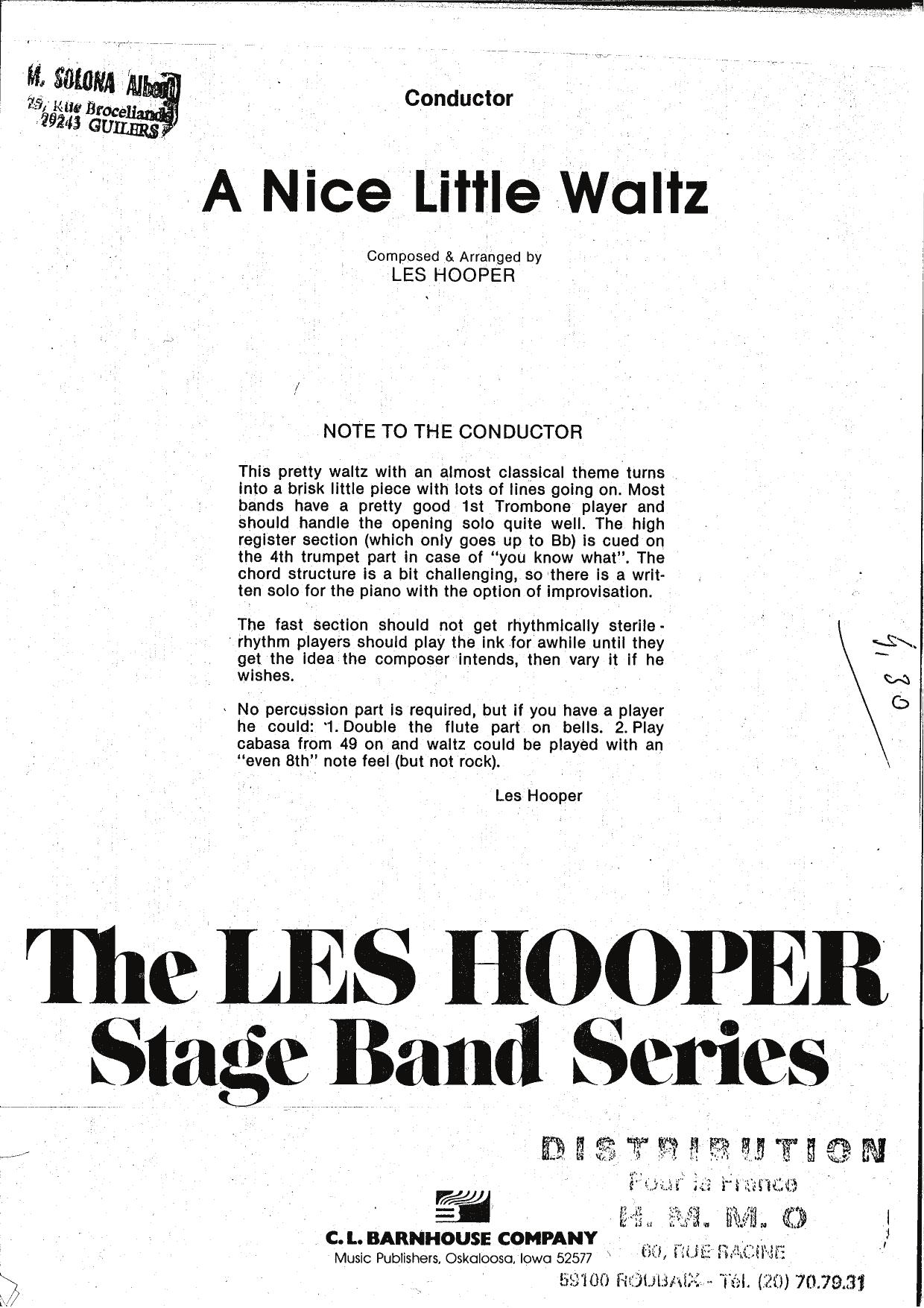
A Nice Little Waltz (L.Hooper)
Composed by Les Hooper
Arranged by Les Hooper
- Ensemble: Big Band
- Pages: 78
- Instruments (17): 1st Eb Alto Saxophone, 2nd Eb Alto Saxophone, 1st Bb Tenor Saxophone, 2nd Bb Tenor Saxophone, Eb Baritone Saxophone, 1st Bb Trumpet, 2nd Bb Trumpet, 3rd Bb Trumpet, 4th Bb Trumpet, 1st Trombone, 2nd Trombone, 3rd Trombone, 4th Trombone, Guitar, Bass, Piano, Drums
- Difficulty: advanced
- Content: Individual Parts
- Format: PDF Download (Instant)
- Price: $24.99
Master composer and arranger Les Hooper brings his signature contemporary big band sophistication to "A Nice Little Waltz," a captivating departure from standard 4/4 swing that showcases the rich compositional palette of modern jazz writing. Emerging from the vibrant tradition of advanced contemporary big band jazz that flourished in the late 20th century, Hooper’s writing bridges the gap between intricate, harmonically dense orchestral textures and an infectious, grooving accessibility. This composition redefines the traditional three-quarter time feel, infusing a classical dance meter with modern jazz sensibilities, sophisticated extended chord structures, and a breezy, optimistic charm that has made Hooper's charts staples for discerning ensembles worldwide. Driving the musical character is a luminous, floating medium-waltz tempo that balances playful lyricism with intricate harmonic motion. The arrangement unfolds in a bright, inviting key, evoking an atmosphere of refined elegance contrasted by bursts of driving rhythmic energy. Hooper avoids the predictability common to triple-meter jazz charts by employing shifting accents, syncopated figures across the bar line, and fluid developmental sections that keep both performers and listeners constantly engaged. The mood shifts effortlessly from introspective, harmonically rich woodwind textures to jubilant, high-energy ensemble statements that demand both precision and a light, driving touch. Hooper’s distinctive arranging approach shines through lush, contemporary saxophone voicings, transparent brass scoring, and clever counterpoint that allows every section of the 17-piece big band to share the spotlight. The woodwinds frequently carry the melodic weight with delicate, interwoven lines, while the brass provide warm, punctuation-driven background figures that never overpower the primary voice. A standout feature of the chart is its dynamic developmental arc, leading into a brilliantly crafted shout chorus that reinterpreting the main theme with towering block-chord harmonies and driving rhythmic momentum. Solos are thoughtfully integrated into the form, providing ample space for featured improvisers to stretch out over sophisticated changes while the ensemble maintains a vibrant, breathing accompaniment. Advanced high school, collegiate, and professional big bands will find this arrangement an exceptional vehicle for developing sectional blend, dynamic control, and fluency in odd-meter jazz phrasing. Because the piece relies heavily on transparent textures and dynamic nuance rather than brute volume, it serves as a masterclass in ensemble listening and balance. Performers will find immense professional satisfaction in navigating Hooper’s clever harmonic turns and rhythmic subversions, making "A Nice Little Waltz" a memorable highlight for any sophisticated concert program or festival performance. Conductors should approach "A Nice Little Waltz" with a primary focus on maintaining a light, buoyant 3/4 feel without letting the tempo drag or rush. The primary technical challenge lies in executing clean, uniform articulations across all sections during syncopated cross-rhythms that blur the bar lines. Rhythm section players, particularly the drummer, must balance a conversational, interactive approach with a steady, driving pulse that anchors the waltz groove. Pianists and guitarists should carefully voice the extended seventh and ninth chords to preserve the clarity of Hooper’s modern harmonic palette without cluttering the texture. Rehearsal time is best spent isolating the interweaving counterlines in the saxophones and ensuring the dynamic contrast between the subdued transitional passages and the soaring ensemble climaxes is sharply exaggerated. Encourage the brass to use a warm, focused tone rather than excessive edge, ensuring the inherent lyricism of the waltz remains at the forefront of every phrase. Q: What instrumentation and parts are included in this publication? A: This 78-page publication includes a full conductor score and complete parts for a standard 17-instrument big band, featuring Alto Saxophone 1, Alto Saxophone 2, Tenor Saxophone 1, Tenor Saxophone 2, Baritone Saxophone, four trumpets, four trombones, piano, guitar, bass, and drums. Q: What is the difficulty level of this arrangement? A: This arrangement is graded as advanced, making it best suited for accomplished college, advanced high school, or professional big bands that are comfortable with extended jazz harmonies and non-standard meter phrasing. Q: What is the musical style and historical context of the piece? A: Composed and arranged by Les Hooper, the piece represents modern, contemporary big band jazz from the late-20th-century tradition, fusing the elegance of a traditional 3/4 waltz with sophisticated jazz voicings and contemporary grooves. Q: What makes this specific arrangement unique within big band literature? A: Unlike standard 4/4 swing charts, this arrangement brilliantly repurposes the three-quarter time feel through Les Hooper's signature transparent scoring, intricate woodwind counterpoint, and shifting rhythmic accents that subvert traditional waltz expectations. Q: What is the performance tempo and duration of the piece? A: The arrangement is set at a medium, flowing waltz tempo with a performance duration typically ranging between 4 and 6 minutes, depending on the length of the improvised solo sections.
Questions and answers
- What is included in the A Nice Little Waltz (L.Hooper) PDF?
- The verified current file contains a conductor score and individual parts across 78 pages.
- How many instruments or parts are listed for A Nice Little Waltz (L.Hooper)?
- The verified instrumentation list contains 17 entries for this Big Band arrangement.
- Who is credited for A Nice Little Waltz (L.Hooper)?
- Composer: Les Hooper. Arranger: Les Hooper.
- What difficulty is listed for A Nice Little Waltz (L.Hooper)?
- The verified difficulty level is advanced.
- Can I preview A Nice Little Waltz (L.Hooper) before buying?
- Yes. The product page provides a preview generated from the current PDF file.
- How is A Nice Little Waltz (L.Hooper) delivered?
- After successful payment, the digital PDF is made available for download. The displayed price is $24.99.
Musicians Also Search For
A Nice Little Waltz Les Hooper PDF • A Nice Little Waltz Les Hooper sheet music • A Nice Little Waltz arranged by Les Hooper • Les Hooper big band charts • Les Hooper jazz arrangements PDF • A Nice Little Waltz Les Hooper big band arrangements • A Nice Little Waltz big band arrangements • A Nice Little Waltz big band PDF download • A Nice Little Waltz jazz sheet music • big band sheet music download • A Nice Little Waltz conductor score PDF • A Nice Little Waltz individual parts download • A Nice Little Waltz sheet music PDF • buy A Nice Little Waltz sheet music • download A Nice Little Waltz PDF • A Nice Little Waltz jazz charts • best Les Hooper big band arrangements • A Nice Little Waltz printable sheet music • big band repertoire PDF