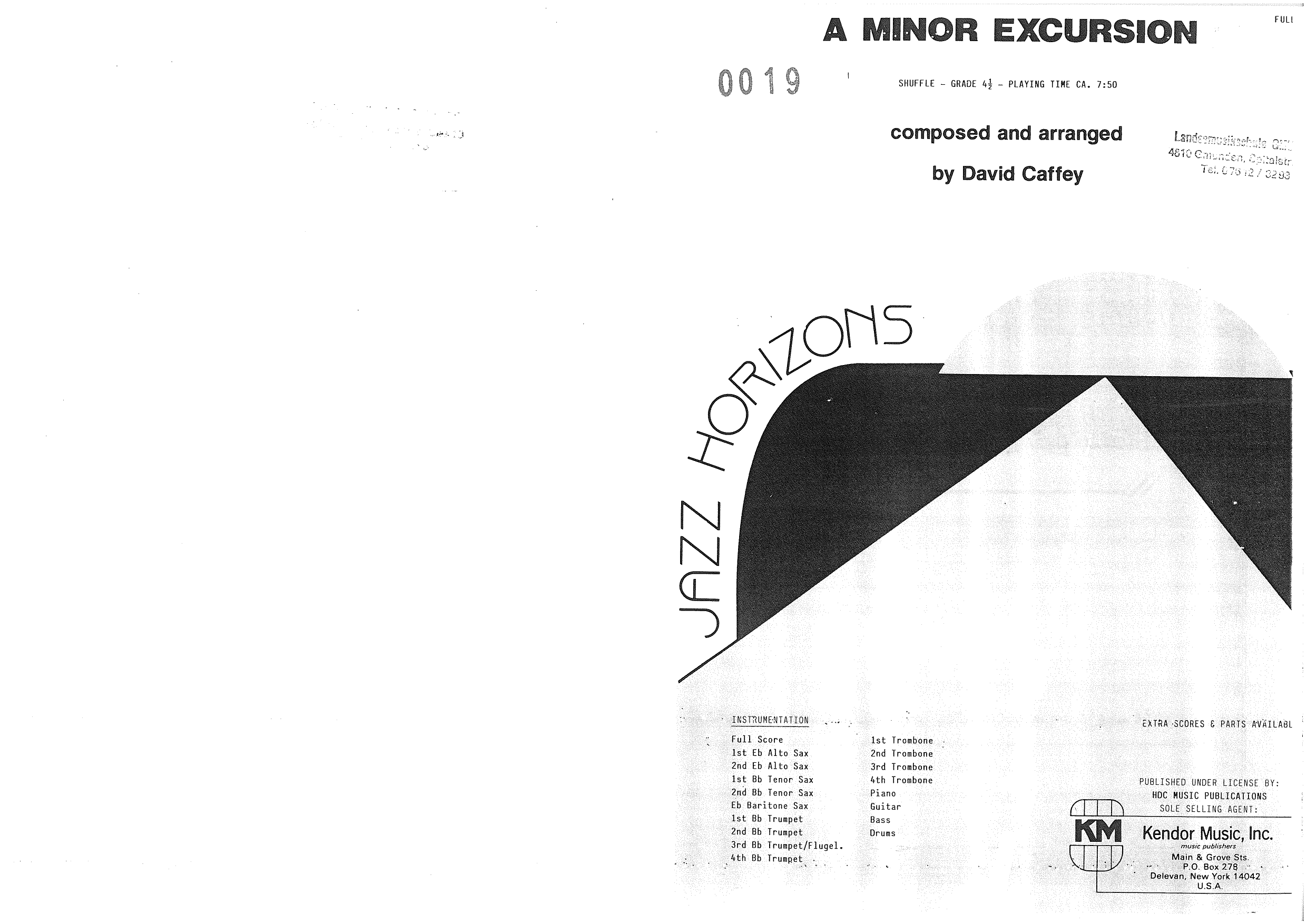
A Minor Excursion (D.Caffey)
Composed by D. Caffey
Arranged by D.Caffey
- Ensemble: Big Band
- Pages: 59
- Instruments (17): 1st Eb Alto Saxophone, 2nd Eb Alto Saxophone, 1st Bb Tenor Saxophone, 2nd Bb Tenor Saxophone, Eb Baritone Saxophone, 1st Bb Trumpet, 2nd Bb Trumpet, 3rd Bb Trumpet/Flugelhorn, 4th Bb Trumpet, 1st Trombone, 2nd Trombone, 3rd Trombone, 4th Trombone, Piano, Guitar, Bass, Drums
- Difficulty: advanced
- Content: Individual Parts
- Format: PDF Download (Instant)
- Price: $24.99
"A Minor Excursion," composed and arranged by D. Caffey, stands as a sophisticated contribution to contemporary big band literature, bridging the rich harmonic vocabulary of modern post-bop with the driving rhythmic momentum of traditional jazz ensemble writing. Emerging from Caffey’s deep immersion in modern compositional idioms, the piece reflects an era where big band writers pushed the boundaries of standard chord progressions, infusing modal flexibility and intricate counterpoint into a standard 16-piece instrumentation framework. While drawing inspiration from the rich legacy of writers like Thad Jones and Bob Mintzer, Caffey carves out a distinct voice that challenges both the intellect and technical prowess of the modern jazz orchestra. Driven by an assertive, energetic medium-up swing feel in 4/4 time, the work immediately establishes a tense, nocturnal mood anchored by its minor-mode framework. The harmonic landscape is rich with extended alt-chords, chromatic mediant relationships, and shifting tonal centers that evoke a sense of restless exploration. The energy builds organically from a moody, secretive intro into a sweeping main theme delivered with urgent articulation. Caffey’s arranging style shines through in the sophisticated voicings of the sax section, utilizing tight clusters and open-interval spreads that create a dense, modern texture. Interlocking brass lines punctuate the arrangement with crisp staccato hits and soaring dynamic contrasts, culminating in a powerhouse shout chorus that demands absolute precision and breath support from the entire ensemble. Melodic duties are distributed thoughtfully across the ensemble, with the alto and tenor saxophones frequently carrying the primary thematic weight before handing off intricate counter-lines to the brass. Open solo sections provide a prime platform for featured improvisers to stretch out over challenging yet logical changes, making it a stellar showcase for advanced soloists. Technical challenges abound across all 59 pages of the score and parts, particularly in the rhythm section where the drummer must maintain a relentless, interactive swing groove while navigating shifting accents, and in the brass section where high-register demands and rapid articulation are standard. However, the reward lies in the sheer visceral impact of the ensemble passages, where the interplay between stacked woodwinds and brass roars creates an unforgettable sonic experience. Advanced college ensembles, top-tier high school jazz bands with exceptional section leaders, and professional community big bands will find "A Minor Excursion" an ideal centerpiece for festival performances or formal concerts. The work rewards meticulous sectional rehearsal and rewards groups that possess strong internal time, clean articulation, and a mature grasp of modern swing phrasing. Conductors looking to elevate their ensemble’s dynamic control, harmonic awareness, and stylistic versatility will discover that Caffey’s chart provides a rigorous, immensely satisfying masterclass in contemporary big band execution. Rehearsal for "A Minor Excursion" should begin by isolating the rhythm section to lock in the underlying medium-up swing feel; the drummer and bassist must establish a driving, conversational groove that supports the complex horn lines without rushing. Conductor focus should immediately turn to the dynamic balance within the sax soli sections, ensuring that internal voicings blend seamlessly rather than letting the top voice overpower the ensemble. Brass players must approach high-register passages with controlled air support, utilizing clean articulations on the accented syncopations to prevent the texture from muddying. Pay close attention to the dynamic swells leading into the shout chorus, mapping out the sub-ito dynamics carefully so the final peak achieves maximum impact without forcing the tone. Rehearsals are most effective when sectionalized first, allowing players to master the chromatic lines independently before attempting the interlocking counterpoint at full tempo. Q: What instruments and parts are included in this arrangement? A: This arrangement is scored for a standard 16-piece big band instrumentation, featuring Alto Sax 1, Alto Sax 2, Tenor Sax 1, Tenor Sax 2, Baritone Sax, 4 Trumpets, 4 Trombones, Piano, Guitar, Bass, and Drums, spread across a comprehensive 59-page score and part set. Q: What is the difficulty level of "A Minor Excursion"? A: This piece is graded as advanced, making it best suited for college jazz orchestras, advanced high school bands, and professional or top-tier community big bands with strong section players and capable improvisers. Q: What is the musical style and historical context of the piece? A: Written by D. Caffey, the piece is a contemporary jazz composition rooted in the post-bop tradition, combining the sophisticated harmonic language of modern jazz writers with the high-energy drive of the classic big band era. Q: What makes this D. Caffey arrangement unique? A: The arrangement stands out for its intricate modal chromaticism, dense woodwind voicings, and a meticulously crafted shout chorus that demands high technical precision and dynamic contrast from the entire ensemble. Q: What is the recommended tempo and expected duration of the performance? A: The piece is performed at an energetic medium-up swing tempo (approximately quarter note = 208-216), resulting in a dynamic performance duration of roughly 6 to 7 minutes depending on solo choruses.
Questions and answers
- What is included in the A Minor Excursion (D.Caffey) PDF?
- The verified current file contains a conductor score and individual parts across 59 pages.
- How many instruments or parts are listed for A Minor Excursion (D.Caffey)?
- The verified instrumentation list contains 17 entries for this Big Band arrangement.
- Who is credited for A Minor Excursion (D.Caffey)?
- Composer: D. Caffey. Arranger: D.Caffey.
- What difficulty is listed for A Minor Excursion (D.Caffey)?
- The verified difficulty level is advanced.
- Can I preview A Minor Excursion (D.Caffey) before buying?
- Yes. The product page provides a preview generated from the current PDF file.
- How is A Minor Excursion (D.Caffey) delivered?
- After successful payment, the digital PDF is made available for download. The displayed price is $24.99.
Musicians Also Search For
A Minor Excursion D.Caffey PDF • A Minor Excursion D.Caffey sheet music • A Minor Excursion arranged by D.Caffey • D.Caffey big band charts • D.Caffey jazz arrangements PDF • A Minor Excursion D. Caffey sheet music • A Minor Excursion D. Caffey big band arrangements • D. Caffey big band charts • A Minor Excursion big band arrangements • A Minor Excursion big band PDF download • A Minor Excursion jazz sheet music • big band sheet music download • A Minor Excursion conductor score PDF • A Minor Excursion individual parts download • A Minor Excursion sheet music PDF • buy A Minor Excursion sheet music • download A Minor Excursion PDF • A Minor Excursion jazz charts • best D.Caffey big band arrangements • D. Caffey arranged by D.Caffey • A Minor Excursion printable sheet music • big band repertoire PDF