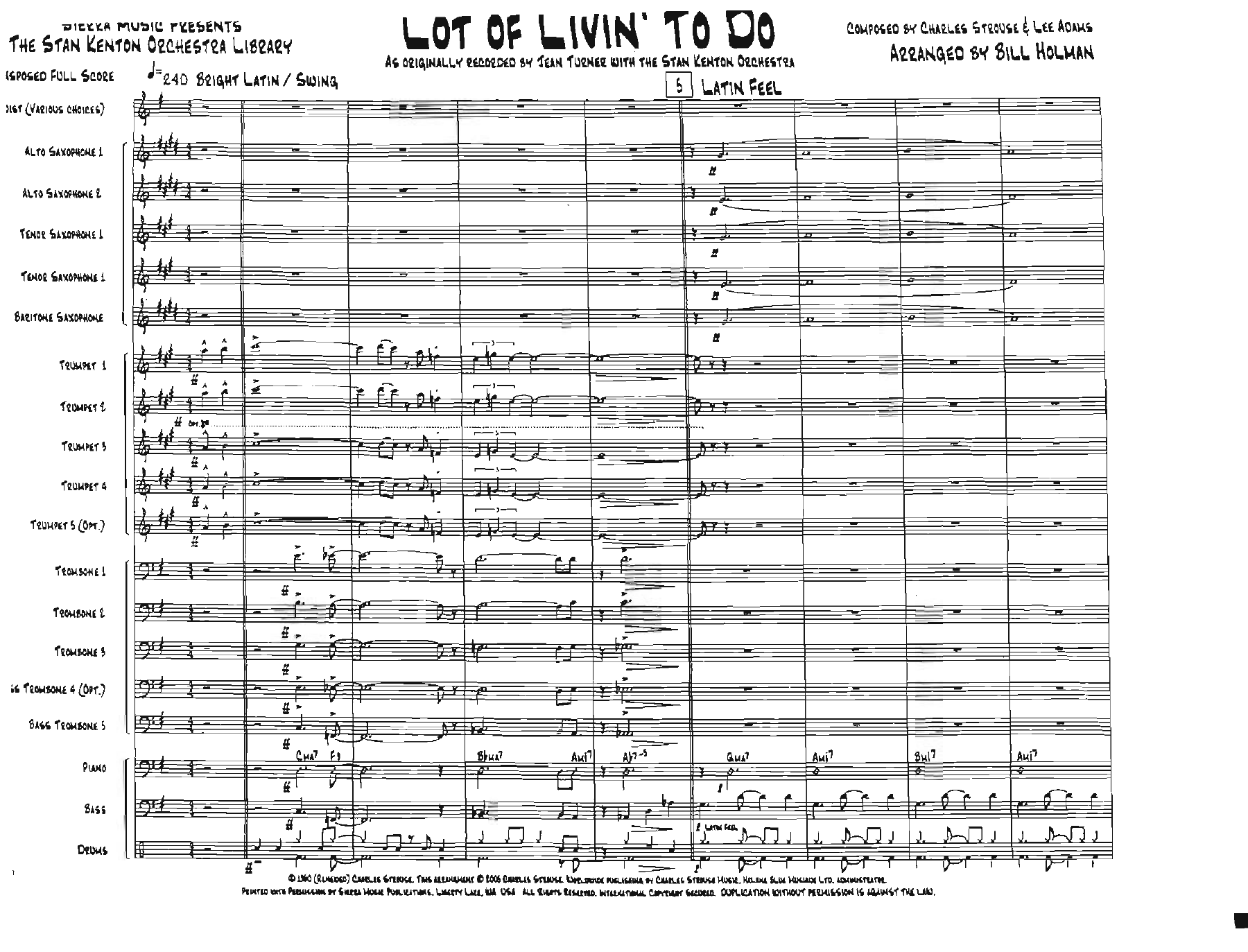
A Lot Of Livin' To Do (B.Holman) Vocal
Composed by Charles Strouse
Arranged by Latin
- Ensemble: Big Band
- Style: Jazz Standard
- Pages: 81
- Instruments (20): Soloist (Vocal), Alto Saxophone 1, Alto Saxophone 2, Tenor Saxophone 1, Tenor Saxophone 2, Baritone Saxophone, Trumpet 1, Trumpet 2, Trumpet 3, Trumpet 4, Trumpet 5, Trombone 1, Trombone 2, Trombone 3, Bass Trombone 4, Bass Trombone 5, Piano, Guitar, Bass, Drums
- Difficulty: advanced
- Content: Individual Parts
- Format: PDF Download (Instant)
- Price: $24.99
Penned by the prolific Charles Strouse for the iconic 1960 Broadway musical *Bye Bye Birdie*, "A Lot Of Livin' To Do" quickly transcended its theatrical origins to become a vibrant jazz standard. The original production, a satirical look at rock and roll and teenage fandom, captured the youthful exuberance and burgeoning energy of the early 1960s. While not an immediate jazz chart-topper, its infectious melody and optimistic message resonated with jazz musicians, who found its harmonic structure and melodic contour ripe for improvisation and sophisticated big band treatments. The song embodies the era's optimistic post-war spirit, a call to embrace life's adventures, making it a timeless piece that continues to inspire. Latin's arrangement of "A Lot Of Livin' To Do" for vocal soloist and big band is a spirited, up-tempo swing chart, firmly rooted in a bright 4/4 feel. The overall mood is exhilarating and celebratory, maintaining the original's youthful zest while elevating it with sophisticated big band voicings. The arrangement is primarily in C major, radiating a bright, confident energy. Latin masterfully employs tight, harmonically rich brass and sax voicings, characteristic of the West Coast cool jazz sound, yet infused with a driving swing that propels the piece forward. The arrangement balances ensemble precision with opportunities for individual expression, capturing the essence of a classic big band performance. Latin's distinctive approach is evident from the outset, with a punchy, brass-driven introduction that immediately sets the energetic tempo. The vocal melody is initially presented with a clean, supportive ensemble backing, allowing the soloist's interpretation to shine. Throughout the arrangement, Latin employs intricate counter-melodies in the saxophone section, often weaving around the vocal line or providing dynamic soli passages that build excitement. A notable feature is the carefully constructed shout chorus, which showcases the full power and precision of the ensemble, building to a thrilling climax before a return to the vocal. The harmonic language is rich but accessible, featuring extended chords and tasteful alterations that add depth without sacrificing the song's inherent catchiness. The arrangement is a masterclass in dynamic shaping, with strategic builds and releases that keep both performers and audience engaged. Performance of this chart requires a cohesive ensemble with strong rhythmic integrity and precise articulation. The vocal soloist carries the primary melodic responsibility, requiring excellent intonation, rhythmic accuracy, and the ability to convey the song's optimistic narrative. Featured solo opportunities are provided for Tenor Saxophone and Trumpet, offering space for improvisation over the standard changes. Technical challenges include the rapid-fire ensemble figures in the brass and sax sections, demanding clean attacks and releases, and the dynamic control required to execute Latin's nuanced phrasing. The rewarding aspect lies in the collective energy generated, the intricate interplay between sections, and the sheer joy of performing a well-crafted, swinging arrangement of a beloved standard. This chart is ideally suited for college, community, and semi-professional big bands looking to add a vibrant, high-energy vocal feature to their repertoire. This arrangement demands a bright, driving swing feel at approximately quarter note = 180-190 BPM. Focus on a light, lifted eighth-note interpretation rather than a heavy, pushed feel. Key technical challenges include precise articulation in the brass section's rapid figures and the saxophones' tightly voiced soli passages; ensure all attacks are clean and uniform. The rhythm section must lay down a solid, unwavering foundation, emphasizing a strong two-feel in the bass and a crisp ride cymbal pattern. Encourage the vocal soloist to project the song's inherent optimism with clear diction and dynamic shaping. Rehearsal tips include isolating the brass and sax soli sections for intonation and rhythmic accuracy, and carefully balancing the ensemble during the shout chorus to ensure all parts cut through. No special techniques like mutes or falls are explicitly notated, allowing for a clean, classic big band sound. Q: What instruments and parts are included in this arrangement? A: This arrangement is scored for a standard big band with 17 instruments, including five saxophones (Alto 1, Alto 2, Tenor 1, Tenor 2, Baritone), four trumpets, four trombones, piano, bass, drums, and a dedicated vocal soloist part. Q: What is the difficulty level of "A Lot Of Livin' To Do (B.Holman) Vocal"? A: This arrangement is rated as medium-advanced. It requires a proficient big band with strong section leaders, precise ensemble playing, and capable improvisers for the featured Tenor Saxophone and Trumpet solos. Q: What is the musical style and historical context of this piece? A: This is an up-tempo jazz standard arrangement of a song from the 1960 Broadway musical *Bye Bye Birdie*. It embodies a bright, energetic swing feel characteristic of the early 1960s big band sound, with sophisticated harmonies and driving rhythms. Q: What makes Latin's arrangement of "A Lot Of Livin' To Do" unique? A: Latin's treatment features intricate, tight voicings for both brass and sax sections, dynamic soli passages, and a powerful shout chorus that builds excitement. It balances the original song's youthful energy with sophisticated big band orchestration, providing a vibrant and engaging vocal feature. Q: What is the approximate performance duration and recommended tempo for this arrangement? A: The approximate performance duration is 3-4 minutes, depending on the length of the improvised solos. The recommended tempo is a bright, up-tempo swing at approximately quarter note = 180-190 BPM.
Questions and answers
- What is included in the A Lot Of Livin' To Do (B.Holman) Vocal PDF?
- The verified current file contains a conductor score and individual parts across 81 pages.
- How many instruments or parts are listed for A Lot Of Livin' To Do (B.Holman) Vocal?
- The verified instrumentation list contains 20 entries for this Big Band arrangement.
- Who is credited for A Lot Of Livin' To Do (B.Holman) Vocal?
- Composer: Charles Strouse. Arranger: Latin.
- What difficulty is listed for A Lot Of Livin' To Do (B.Holman) Vocal?
- The verified difficulty level is advanced.
- What style is listed for A Lot Of Livin' To Do (B.Holman) Vocal?
- The catalog lists the style as Jazz Standard.
- Can I preview A Lot Of Livin' To Do (B.Holman) Vocal before buying?
- Yes. The product page provides a preview generated from the current PDF file.
- How is A Lot Of Livin' To Do (B.Holman) Vocal delivered?
- After successful payment, the digital PDF is made available for download. The displayed price is $24.99.
Musicians Also Search For
A Lot Of Livin' To Do Latin PDF • A Lot Of Livin' To Do Latin sheet music • A Lot Of Livin' To Do arranged by Latin • Latin big band charts • Latin jazz arrangements PDF • A Lot Of Livin' To Do Charles Strouse sheet music • A Lot Of Livin' To Do Charles Strouse big band arrangements • Charles Strouse big band charts • A Lot Of Livin' To Do big band arrangements • A Lot Of Livin' To Do big band PDF download • A Lot Of Livin' To Do jazz sheet music • big band sheet music download • A Lot Of Livin' To Do conductor score PDF • A Lot Of Livin' To Do individual parts download • A Lot Of Livin' To Do sheet music PDF • A Lot Of Livin' To Do Jazz Standard charts • Jazz Standard big band arrangements • buy A Lot Of Livin' To Do sheet music • download A Lot Of Livin' To Do PDF • A Lot Of Livin' To Do jazz charts • best Latin big band arrangements • Charles Strouse arranged by Latin • A Lot Of Livin' To Do printable sheet music • big band repertoire PDF