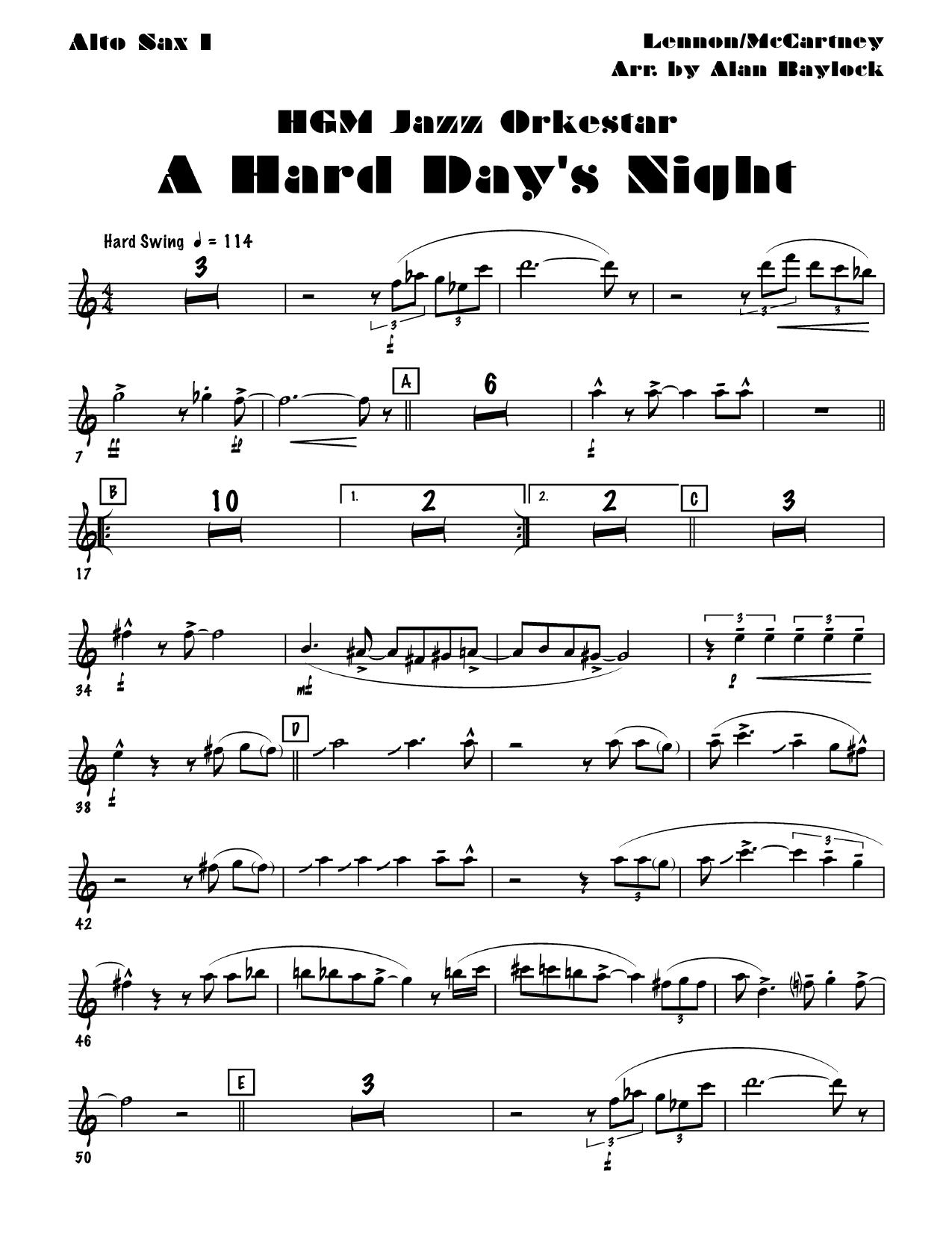
A Hard Day's Night (A.Baylock)
Composed by Lennon-McCartney
Arranged by A.Baylock
- Ensemble: Big Band
- Style: Jazz Standard
- Pages: 50
- Instruments (18): Alto Sax 1, Alto Sax 2, Tenor Sax 1, Tenor Sax 2, Baritone Sax, Trumpet 1, Trumpet 2, Trumpet 3, Trumpet 4, Trumpet 5, Trombone 1, Trombone 2, Trombone 3, Bass Trombone, Guitar, Piano, Bass, Drums
- Difficulty: advanced
- Content: Individual Parts
- Format: PDF Download (Instant)
- Price: $24.99
The iconic title track from The Beatles' 1964 film and album, "A Hard Day's Night," emerged at the zenith of Beatlemania, capturing the infectious energy and melodic brilliance that defined the British Invasion. Originally a vibrant, guitar-driven pop-rock anthem in the key of G major, its innovative opening chord and driving rhythm quickly cemented its status as a cultural touchstone. While not traditionally a jazz standard, its enduring popularity, sophisticated harmonic underpinnings, and memorable melody have made it a compelling canvas for jazz interpreters, inviting fresh perspectives that bridge pop accessibility with jazz improvisation and arrangement. This particular rendition by A.Baylock masterfully re-imagines the classic, transforming its rock-and-roll essence into a sophisticated, medium-up swing big band chart that resonates with both historical reverence and contemporary jazz sensibilities. A.Baylock’s arrangement of "A Hard Day's Night" unfolds with a bright, medium-up swing feel in 4/4, primarily set in the key of F major, offering a comfortable yet energetic foundation. The mood is one of sophisticated exuberance, balancing the original's youthful vigor with the harmonic richness and improvisational depth characteristic of modern big band jazz. The chart opens with a clever reharmonization of the famous intro, initially hinting at the original's jangling guitar chord before smoothly transitioning into a swinging, brass-led statement of the main theme. Throughout the piece, Baylock employs lush, often dense voicings, particularly in the saxophone and brass sections, creating a full and resonant sound that is both powerful and nuanced. Expect intricate counterpoint, well-crafted soli sections for the saxophones that showcase the ensemble's precision, and dynamic brass punctuations that drive the arrangement forward. A.Baylock's distinctive arranging style shines through in the thoughtful development of the melodic material. Rather than simply stating the theme, the melody is passed between sections, often reharmonized with extended chords and altered dominant voicings, giving it a fresh, jazz-infused character. The arrangement features a prominent solo section for Tenor Saxophone 1, providing ample space for improvisation over the familiar chord changes, now infused with a modern jazz vocabulary. Following a dynamic build, a powerful shout chorus emerges, showcasing the full ensemble's might with layered brass figures and soaring saxophone lines, culminating in a climactic restatement of the main theme. The technical demands are moderate to advanced, requiring strong section playing, precise articulation, and a solid understanding of swing rhythm. This arrangement is ideally suited for ambitious college and community big bands, as well as professional ensembles seeking a challenging yet incredibly rewarding piece that will captivate audiences with its blend of familiarity and sophisticated jazz artistry. This arrangement demands a crisp, medium-up swing feel throughout, with a suggested tempo range of quarter note = 132-144 BPM. Emphasize a light, buoyant articulation in the rhythm section, ensuring the ride cymbal drives the pulse without becoming overbearing. Key technical challenges include the intricate saxophone soli passages, which require precise intonation and unified phrasing, and the brass sections' dynamic control, particularly in the powerful shout chorus where blend and balance are paramount. Conductors should pay close attention to Baylock's detailed dynamic markings and articulations, as they are crucial to conveying the intended mood and energy. Rehearsal time should be dedicated to isolating the sax soli for intonation and rhythmic accuracy, and to balancing the brass voicings, ensuring the lead trumpet is supported without overpowering the section. The Tenor Saxophone 1 solo should encourage creative improvisation over the reharmonized changes, providing a clear harmonic roadmap. No special techniques like mutes or falls are explicitly notated beyond standard jazz articulations, allowing the focus to remain on ensemble precision and musicality. Q: What instruments and parts are included in this arrangement? A: This big band arrangement is scored for 17 instruments: Alto Saxophone 1, Alto Saxophone 2, Tenor Saxophone 1, Tenor Saxophone 2, Baritone Saxophone, Trumpet 1, Trumpet 2, Trumpet 3, Trumpet 4, Trombone 1, Trombone 2, Trombone 3, Bass Trombone, Guitar, Piano, Bass, and Drums. Q: What is the difficulty level of "A Hard Day's Night (A.Baylock)"? A: This arrangement is considered advanced intermediate to advanced, suitable for college, community, and professional big bands. It requires strong section playing, precise articulation, and capable improvisers. Q: What is the musical style and historical context of this arrangement? A: This is a contemporary jazz big band arrangement of "A Hard Day's Night," originally a pop-rock hit by The Beatles in 1964. A.Baylock transforms the original into a sophisticated, medium-up swing jazz standard. Q: What makes A.Baylock's arrangement of "A Hard Day's Night" unique? A: Baylock's distinctive approach includes sophisticated reharmonization, intricate saxophone soli sections, dynamic brass writing, and a powerful shout chorus, all while maintaining the original's melodic integrity within a modern jazz idiom. Q: What is the approximate performance duration and recommended tempo for this piece? A: The approximate performance duration is 4-5 minutes, depending on the length of the improvised solo. The recommended tempo is a medium-up swing, typically between quarter note = 132-144 BPM.
Questions and answers
- What is included in the A Hard Day's Night (A.Baylock) PDF?
- The verified current file contains individual parts across 50 pages.
- How many instruments or parts are listed for A Hard Day's Night (A.Baylock)?
- The verified instrumentation list contains 18 entries for this Big Band arrangement.
- Who is credited for A Hard Day's Night (A.Baylock)?
- Composer: Lennon-McCartney. Arranger: A.Baylock.
- What difficulty is listed for A Hard Day's Night (A.Baylock)?
- The verified difficulty level is advanced.
- What style is listed for A Hard Day's Night (A.Baylock)?
- The catalog lists the style as Jazz Standard.
- Can I preview A Hard Day's Night (A.Baylock) before buying?
- Yes. The product page provides a preview generated from the current PDF file.
- How is A Hard Day's Night (A.Baylock) delivered?
- After successful payment, the digital PDF is made available for download. The displayed price is $24.99.
Musicians Also Search For
A Hard Day's Night A.Baylock PDF • A Hard Day's Night A.Baylock sheet music • A Hard Day's Night arranged by A.Baylock • A.Baylock big band charts • A.Baylock jazz arrangements PDF • A Hard Day's Night Lennon-McCartney sheet music • A Hard Day's Night Lennon-McCartney big band arrangements • Lennon-McCartney big band charts • A Hard Day's Night big band arrangements • A Hard Day's Night big band PDF download • A Hard Day's Night jazz sheet music • big band sheet music download • A Hard Day's Night individual parts download • A Hard Day's Night sheet music PDF • A Hard Day's Night Jazz Standard charts • Jazz Standard big band arrangements • buy A Hard Day's Night sheet music • download A Hard Day's Night PDF • A Hard Day's Night jazz charts • best A.Baylock big band arrangements • Lennon-McCartney arranged by A.Baylock • A Hard Day's Night printable sheet music • big band repertoire PDF