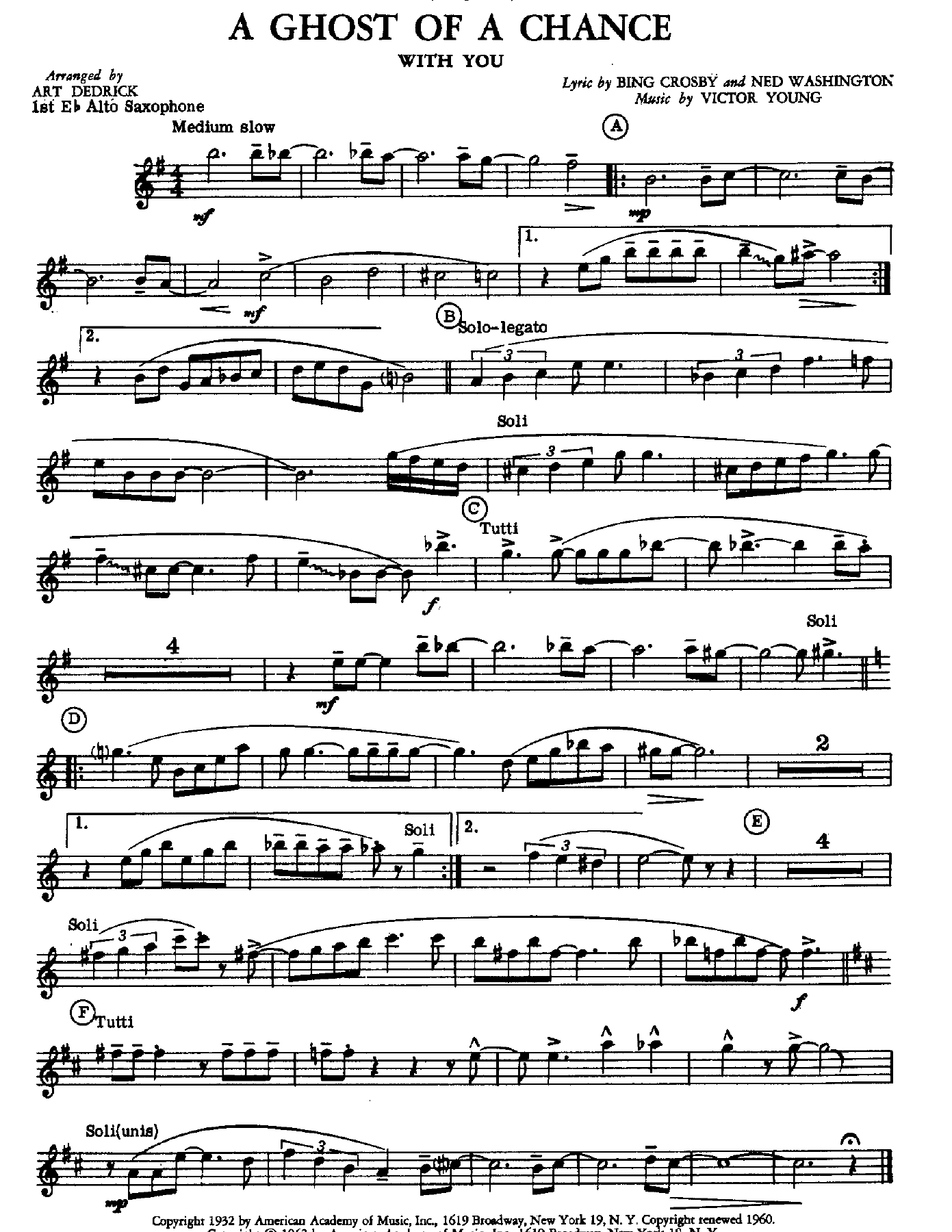
A Ghost Of A Chance (A.Dedrick)
Composed by Victor Young
Arranged by Art Dedrick
- Ensemble: Big Band
- Style: Jazz Standard
- Pages: 18
- Instruments (17): 1st Eb Alto Saxophone, 3rd Eb Alto Saxophone, 2nd Bb Tenor Saxophone, 4th Bb Tenor Saxophone, 5th Eb Baritone Saxophone, 1st Bb Trumpet, 2nd Bb Trumpet, 3rd Bb Trumpet, 4th Bb Trumpet, 1st Trombone, 2nd Trombone, 3rd Trombone, 4th Trombone, Piano, String Bass, Drums, Guitar
- Difficulty: easy
- Content: Individual Parts
- Format: PDF Download (Instant)
- Price: $24.99
Victor Young's timeless ballad, "A Ghost Of A Chance," emerged in 1932, a poignant reflection of the Great Depression era's melancholic romanticism. Originally introduced in the film *One Night in Paradise*, it quickly transcended its cinematic origins to become a cornerstone of the jazz standard repertoire. Its enduring appeal lies in its sophisticated harmonic progression and deeply emotive melody, which has been famously interpreted by a pantheon of jazz and popular vocalists, most notably Frank Sinatra, Billie Holiday, and Sarah Vaughan. The song's structure, often featuring an AABA form, provides a rich canvas for improvisation and nuanced interpretation, cementing its status as a beloved classic that evokes feelings of longing, lost love, and lingering hope. Art Dedrick's big band arrangement of "A Ghost Of A Chance" reimagines this classic as a medium-slow swing ballad, set in the key of F major, maintaining the original's tender, reflective mood while infusing it with the lushness and power of a full jazz orchestra. Dedrick, known for his accessible yet musically rewarding charts, crafts an arrangement that is both evocative and eminently playable. His signature approach often involves clear melodic statements, harmonically rich voicings, and well-placed ensemble sections that build dynamic interest without sacrificing the song's inherent intimacy. The arrangement opens with a delicate, almost ethereal introduction, setting a thoughtful tone before the melody is introduced. The primary melodic statements are initially carried by the lead alto saxophone, often doubled or harmonized by the trumpet section, creating a warm, inviting timbre. Dedrick masterfully employs tightly voiced brass and sax soli sections, particularly in the B section, adding depth and harmonic color that are characteristic of classic big band writing. While specific solo sections are not explicitly marked in all Dedrick charts, the harmonic structure provides ample opportunity for a featured soloist, typically the lead alto or tenor saxophone, to improvise over the form, allowing for individual expression within the ensemble context. The arrangement features subtle dynamic shifts and a carefully constructed build to a gentle, yet impactful, ensemble climax before returning to a more subdued closing statement. The technical challenges are primarily focused on achieving a cohesive ensemble blend, precise articulation in the swing feel, and sensitive dynamic control, rather than demanding extreme instrumental ranges or rapid technical passages. This arrangement is ideally suited for high school, community, and developing college jazz ensembles. Its moderate technical demands allow musicians to focus on musicality, phrasing, and ensemble interaction, making it an excellent teaching tool for developing ballad performance skills. The rewarding aspect lies in the band's ability to collectively convey the song's emotional depth and lyrical beauty, fostering a sense of shared musical expression. The clarity of Dedrick's scoring ensures that even less experienced sections can contribute effectively to the overall lush sound, culminating in a performance that is both polished and profoundly moving. This arrangement of "A Ghost Of A Chance" thrives on a medium-slow swing feel, approximately quarter note = 88-96 bpm. Emphasize a relaxed, floating eighth-note interpretation, avoiding a rushed or stiff pulse. The primary technical challenge lies in achieving a unified ensemble blend and precise intonation, particularly within the sustained chords and close voicings. Encourage woodwinds and brass to listen across sections for harmonic balance. Dynamic control is paramount; practice the subtle swells and diminuendos, especially in the opening and closing phrases, to convey the ballad's inherent tenderness. Articulation should be legato and expressive, with soft tonguing. No special techniques like plunger mutes or falls are explicitly notated, allowing the focus to remain on lyrical phrasing and harmonic beauty. Rehearsal should prioritize listening, breath support for long tones, and shaping melodic lines as a single entity. Q: What instruments and parts are included in this arrangement? A: This big band arrangement includes parts for 17 instruments: Alto Saxophone 1, Alto Saxophone 2, Tenor Saxophone 1, Tenor Saxophone 2, Baritone Saxophone, Trumpet 1, Trumpet 2, Trumpet 3, Trumpet 4, Trombone 1, Trombone 2, Trombone 3, Trombone 4, Piano, Bass, Drums, and Guitar. Q: What is the difficulty level of Art Dedrick's "A Ghost Of A Chance" arrangement? A: This arrangement is considered suitable for high school, community, and developing college jazz ensembles. It focuses on musicality and ensemble blend rather than extreme technical demands, making it an excellent choice for intermediate-level bands. Q: What is the musical style and historical context of "A Ghost Of A Chance"? A: "A Ghost Of A Chance" is a classic jazz standard composed by Victor Young in 1932. This arrangement presents it as a medium-slow swing ballad, evoking the melancholic yet beautiful romanticism of the big band era. Q: What makes Art Dedrick's arrangement of this standard unique? A: Dedrick's approach maintains the original's emotional depth while providing accessible yet rich big band voicings. His signature clarity in scoring and well-balanced soli sections allow the ensemble to achieve a lush, cohesive sound, making it rewarding for performers and listeners alike. Q: What is the typical performance duration and tempo for this arrangement? A: As a medium-slow swing ballad, a typical performance of this arrangement would last approximately 3-4 minutes, depending on any improvised solos. The recommended tempo is around quarter note = 88-96 bpm.
Questions and answers
- What is included in the A Ghost Of A Chance (A.Dedrick) PDF?
- The verified current file contains individual parts across 18 pages.
- How many instruments or parts are listed for A Ghost Of A Chance (A.Dedrick)?
- The verified instrumentation list contains 17 entries for this Big Band arrangement.
- Who is credited for A Ghost Of A Chance (A.Dedrick)?
- Composer: Victor Young. Arranger: Art Dedrick.
- What difficulty is listed for A Ghost Of A Chance (A.Dedrick)?
- The verified difficulty level is easy.
- What style is listed for A Ghost Of A Chance (A.Dedrick)?
- The catalog lists the style as Jazz Standard.
- Can I preview A Ghost Of A Chance (A.Dedrick) before buying?
- Yes. The product page provides a preview generated from the current PDF file.
- How is A Ghost Of A Chance (A.Dedrick) delivered?
- After successful payment, the digital PDF is made available for download. The displayed price is $24.99.
Musicians Also Search For
A Ghost Of A Chance Art Dedrick PDF • A Ghost Of A Chance Art Dedrick sheet music • A Ghost Of A Chance arranged by Art Dedrick • Art Dedrick big band charts • Art Dedrick jazz arrangements PDF • A Ghost Of A Chance Victor Young sheet music • A Ghost Of A Chance Victor Young big band arrangements • Victor Young big band charts • A Ghost Of A Chance big band arrangements • A Ghost Of A Chance big band PDF download • A Ghost Of A Chance jazz sheet music • big band sheet music download • A Ghost Of A Chance individual parts download • A Ghost Of A Chance sheet music PDF • A Ghost Of A Chance Jazz Standard charts • Jazz Standard big band arrangements • buy A Ghost Of A Chance sheet music • download A Ghost Of A Chance PDF • A Ghost Of A Chance jazz charts • best Art Dedrick big band arrangements • Victor Young arranged by Art Dedrick • A Ghost Of A Chance printable sheet music • big band repertoire PDF