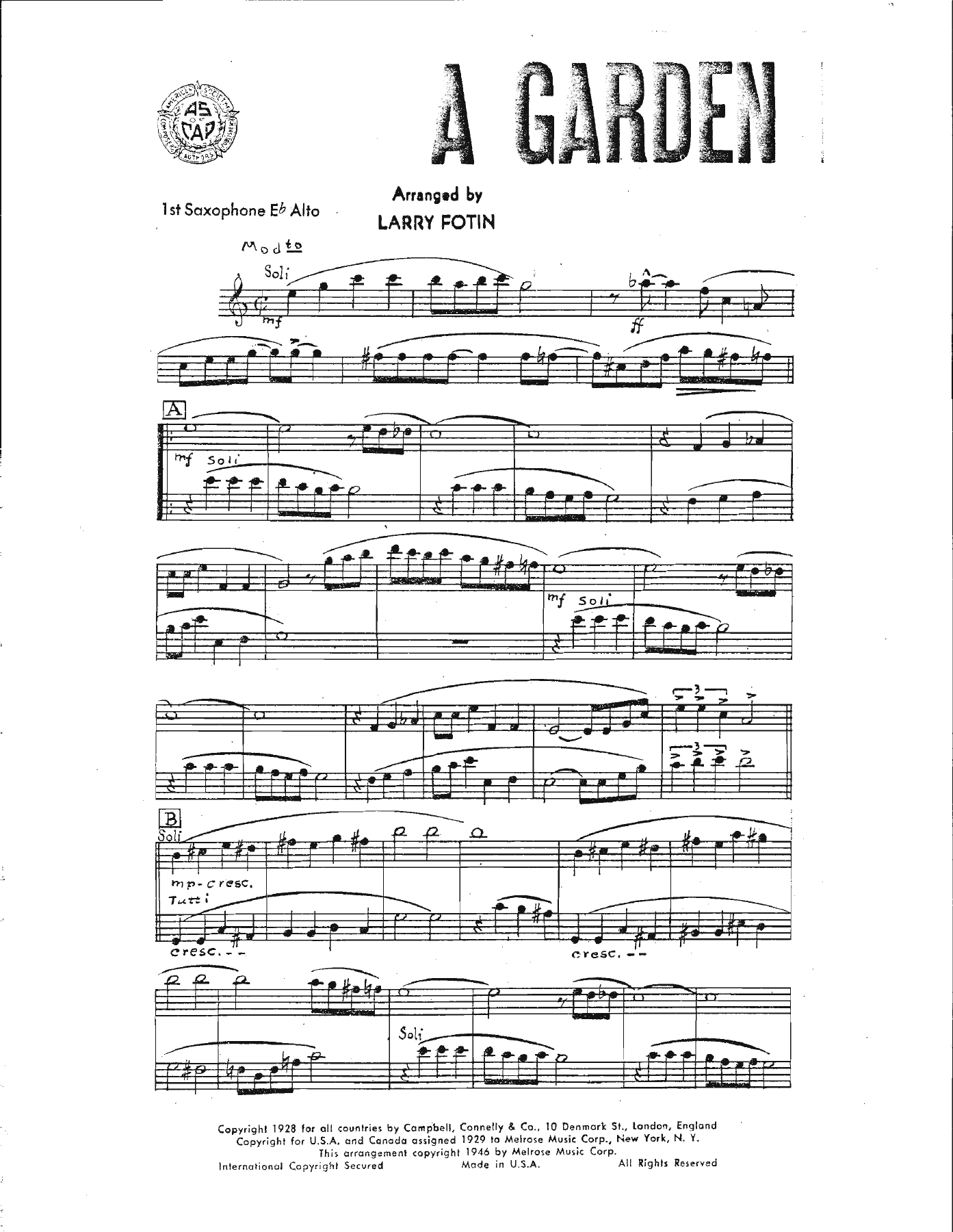
A Garden In The Rain Carrol Gibbons (L.Fotin)
Composed by James Dyrenforth
Arranged by L.Fotin
- Ensemble: Big Band Vocal
- Style: Jazz Standard
- Pages: 30
- Instruments (14): 1st Saxophone Eb Alto, 2nd Saxophone Bb Tenor, 3rd Saxophone Eb Alto, 4th Saxophone Bb Tenor, 5th Saxophone Eb Baritone, 1st Trumpet in Bb, 2nd Trumpet in Bb, 3rd Trumpet in Bb, 1st Trombone, 2nd Trombone, 3rd Trombone, Piano, Bass, Drums
- Difficulty: medium
- Content: Individual Parts
- Format: PDF Download (Instant)
- Price: $24.99
"A Garden In The Rain," penned by composer Carroll Gibbons and lyricist James Dyrenforth, emerged in 1928, quickly establishing itself as a poignant jazz standard of the pre-swing era. First recorded by Gibbons himself with the Savoy Hotel Orpheans, it became his signature tune and enjoyed widespread popularity throughout 1929, with notable versions by Gene Austin, John McCormack, and George Olsen's orchestra. Its enduring melodic charm led to a resurgence in 1952, featuring a hit recording by The Four Aces, and later interpretations by vocal giants like Frank Sinatra and Sarah Vaughan. The piece embodies the lyrical romanticism characteristic of the Great American Songbook, evoking a gentle, reflective mood through its tender melody and evocative lyrics that paint a picture of solace found amidst a summer shower. Its 32-bar song form is a testament to classic songwriting, allowing for both straightforward delivery and nuanced interpretation. L.Fotin's big band vocal arrangement of "A Garden In The Rain" transforms this intimate standard into a lush, expressive vehicle for a vocalist, while maintaining its inherent delicate beauty. The arrangement is conceived as a slow, expressive ballad, likely set in a key that complements a broad vocal range, allowing the vocalist to imbue each phrase with profound emotion. Fotin's distinctive approach often involves rich, extended harmonies and sophisticated voicings within the brass and saxophone sections, creating a warm, supportive bed for the soloist without overpowering the lyrical content. Expect carefully crafted soli sections that feature the ensemble's melodic capabilities, providing counter-melodies and harmonic interest that build throughout the arrangement, culminating in a gentle, yet impactful, shout chorus that highlights the full power of the big band in a controlled, expressive manner. The performance unfolds with the vocalist carrying the primary melody, often introduced by a sensitive piano or saxophone choir accompaniment. Featured solos, typically for tenor saxophone or trumpet, provide instrumental interludes that expand on the melodic and harmonic themes, offering opportunities for expressive improvisation within the ballad style. Technical challenges lie in maintaining a cohesive, sustained sound at a slow tempo, ensuring precise intonation within the extended harmonies, and achieving a seamless blend across the sections. The rewarding aspect of performing this arrangement comes from its emotional depth; the subtle dynamic shifts, the interplay between the vocalist and the ensemble, and the rich harmonic tapestry combine to create a truly moving musical experience for both performers and audience. This arrangement is ideally suited for college, community, and professional big bands that possess a strong vocal soloist and an ensemble capable of executing nuanced dynamics and sophisticated harmonic language. High school bands with advanced players and a dedicated vocal program could also find this a challenging yet highly rewarding piece to tackle, offering valuable experience in ballad interpretation and ensemble sensitivity. The 30 pages of score and parts indicate a comprehensive and well-developed arrangement, providing ample material for a polished performance. Approaching L.Fotin's "A Garden In The Rain" requires meticulous attention to blend, balance, and expressive phrasing. The primary technical challenge lies in sustaining a slow, deliberate tempo while maintaining impeccable intonation, particularly within the rich, extended harmonies. Conductors should emphasize long, singing lines from all sections, encouraging musicians to listen across the ensemble for vertical and horizontal alignment. The tempo should be a slow ballad, approximately quarter note = 60-72 BPM, allowing ample space for the melody and harmonies to breathe. Special techniques are minimal, focusing more on musicality: brass players should employ warm, sustained tones, avoiding harsh attacks, and saxophones should strive for a smooth, vocal-like quality. Rehearsal tips include isolating challenging harmonic passages slowly, using a drone to tune chords, and practicing dynamic swells and diminuendos to enhance the emotional arc. Encourage the rhythm section to provide a gentle, supportive foundation, emphasizing a light, flowing feel rather than a heavy pulse, ensuring the vocalist remains at the forefront of the musical narrative. **Q: What instruments and parts are included in this arrangement?** A: This big band vocal arrangement includes a full set of parts for standard big band instrumentation (saxes, trumpets, trombones, rhythm section) plus a dedicated vocal chart, spanning 30 pages in total. **Q: What is the difficulty level of this arrangement?** A: This arrangement is suitable for college, community, and professional big bands due to its sophisticated harmonic language, nuanced dynamics, and the need for a strong, expressive vocalist and ensemble. Advanced high school bands may also find it appropriate. **Q: What is the musical style and historical context of "A Garden In The Rain"?** A: "A Garden In The Rain" is a classic jazz standard composed in 1928, embodying the romantic ballad style of the pre-swing era and the Great American Songbook, made famous by artists like Carroll Gibbons, Gene Austin, and later Frank Sinatra. **Q: What makes L.Fotin's arrangement of "A Garden In The Rain" unique?** A: L.Fotin's arrangement distinguishes itself through its rich, extended harmonies, sophisticated voicings, and carefully crafted soli sections that provide a lush, supportive backdrop for the vocalist, culminating in an expressive shout chorus, all while maintaining the original piece's delicate mood. **Q: What is the approximate performance duration and recommended tempo for this piece?** A: The performance duration will vary slightly based on interpretation and solo length, but as a slow, expressive ballad, it typically ranges from 4 to 6 minutes. A recommended tempo is approximately quarter note = 60-72 BPM.
Questions and answers
- What is included in the A Garden In The Rain Carrol Gibbons (L.Fotin) PDF?
- The verified current file contains individual parts across 30 pages.
- How many instruments or parts are listed for A Garden In The Rain Carrol Gibbons (L.Fotin)?
- The verified instrumentation list contains 14 entries for this Big Band Vocal arrangement.
- Who is credited for A Garden In The Rain Carrol Gibbons (L.Fotin)?
- Composer: James Dyrenforth. Arranger: L.Fotin.
- What difficulty is listed for A Garden In The Rain Carrol Gibbons (L.Fotin)?
- The verified difficulty level is medium.
- What style is listed for A Garden In The Rain Carrol Gibbons (L.Fotin)?
- The catalog lists the style as Jazz Standard.
- Can I preview A Garden In The Rain Carrol Gibbons (L.Fotin) before buying?
- Yes. The product page provides a preview generated from the current PDF file.
- How is A Garden In The Rain Carrol Gibbons (L.Fotin) delivered?
- After successful payment, the digital PDF is made available for download. The displayed price is $24.99.
Musicians Also Search For
A Garden In The Rain Carrol Gibbons L.Fotin PDF • A Garden In The Rain Carrol Gibbons L.Fotin sheet music • A Garden In The Rain Carrol Gibbons arranged by L.Fotin • L.Fotin big band vocal charts • L.Fotin jazz arrangements PDF • A Garden In The Rain Carrol Gibbons James Dyrenforth sheet music • A Garden In The Rain Carrol Gibbons James Dyrenforth big band vocal arrangements • James Dyrenforth big band vocal charts • A Garden In The Rain Carrol Gibbons big band vocal arrangements • A Garden In The Rain Carrol Gibbons big band vocal PDF download • A Garden In The Rain Carrol Gibbons jazz sheet music • big band vocal sheet music download • A Garden In The Rain Carrol Gibbons individual parts download • A Garden In The Rain Carrol Gibbons sheet music PDF • A Garden In The Rain Carrol Gibbons Jazz Standard charts • Jazz Standard big band vocal arrangements • buy A Garden In The Rain Carrol Gibbons sheet music • download A Garden In The Rain Carrol Gibbons PDF • A Garden In The Rain Carrol Gibbons jazz charts • best L.Fotin big band vocal arrangements • James Dyrenforth arranged by L.Fotin • A Garden In The Rain Carrol Gibbons printable sheet music • big band vocal repertoire PDF