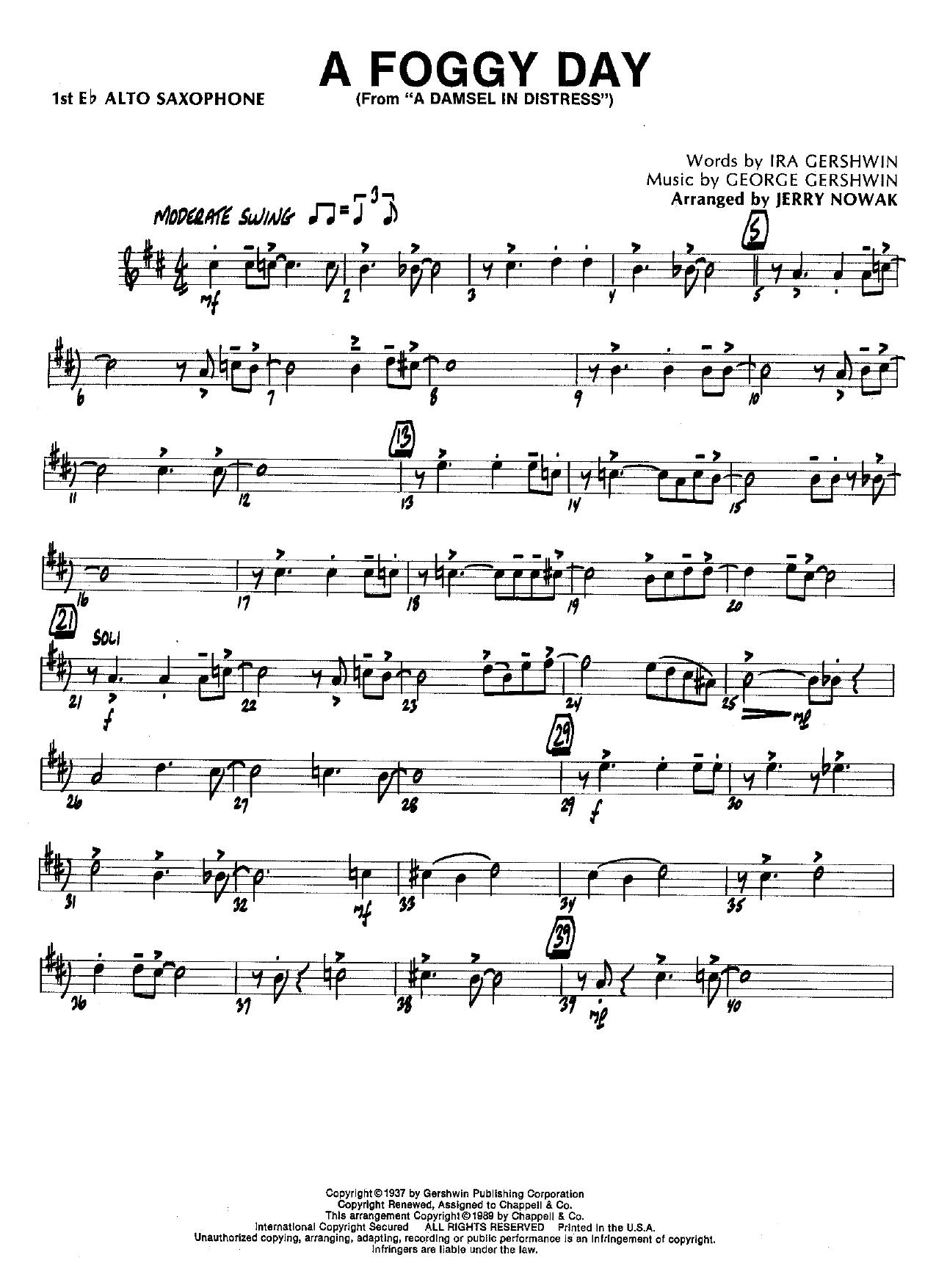
A Foggy Day (J.Nowak)
Composed by George Gershwin
Arranged by Jerry Nowak
- Ensemble: Big Band
- Pages: 40
- Instruments (15): 1st Eb Alto Saxophone, 2nd Eb Alto Saxophone, 1st Bb Tenor Saxophone, 2nd Bb Tenor Saxophone, Eb Baritone Saxophone, 1st Bb Trumpet, 2nd Bb Trumpet, 3rd Bb Trumpet, 1st Trombone, 2nd Trombone, 3rd Trombone, Piano, Guitar, Bass, Drums
- Difficulty: medium
- Content: Individual Parts
- Format: PDF Download (Instant)
- Price: $24.99
George Gershwin and Ira Gershwin introduced "A Foggy Day (in London Town)" in the 1937 musical film *A Damsel in Distress*, starring Fred Astaire. Written during the height of the Golden Age of American songwriting, the tune quickly transitioned from Hollywood silver screen to the core of the jazz canon, cemented by definitive interpretations from artists like Louis Armstrong and Ella Fitzgerald, Frank Sinatra, and the modal explorations of jazz icons such as George Benson and Wynton Kelly. Its sophisticated harmonic structure—navigating deceptively smooth changes with clever chromatic descents and minor key tonalities—makes it a quintessential vehicle for jazz interpretation, balancing melancholy introspection with an underlying urbane swing. Jerry Nowak’s masterful big band adaptation captures the timeless elegance of the Great American Songbook while injecting a vibrant, swinging momentum tailored for modern scholastic and community ensembles. Operating at a comfortable, swinging medium tempo (around 120–124 BPM), the arrangement establishes an inviting groove from the outset. The mood is sophisticated and relaxed yet propulsive, evoking the misty, bustling atmosphere of mid-century London through lush, harmonically rich ensemble voicings. Nowak utilizes classic section-writing techniques, balancing warm, block-chord saxophones with crisp brass interjections that frame the melody without overcrowding it. The structural architecture of the chart highlights clever distribution of material across the ensemble. The traditional AABA form is meticulously honored, with the initial melody introduced cleanly by the trumpet and saxophone sections before opening up into expansive ensemble solis. A highlight of Nowak’s treatment is the seamless transition into an open solo section—backed by idiomatic shout-style comping figures—allowing featured soloists on tenor saxophone or trumpet space to stretch out over standard changes. The subsequent shout chorus builds organically in dynamic intensity and rhythmic complexity, driven by accented swing eighth notes and classic big band punch figures, before winding down to a clever, understated dynamic tag that resolves satisfyingly on a rich extended chord. Advanced middle school, high school, and community big bands will find this arrangement exceptionally rewarding. The technical demands are accessible enough to be mastered within a few rehearsals, yet sophisticated enough to teach vital stylistic lessons in swing articulation, section blend, and dynamic control. Because the brass ranges are kept within moderate, comfortable limits (trumpet ceiling sitting around written G5), players can focus entirely on achieving a unified, authentic jazz feel. This chart serves as an ideal vehicle for teaching stylistic phrasing and offers a guaranteed crowd-pleasing standard for any festival or concert program. Achieving an authentic jazz interpretation of Jerry Nowak’s chart requires strict attention to traditional swing articulation. All eighth notes must be performed with a natural, triplet-based swing feel, ensuring that offbeat eighths are appropriately accented and unstressed notes are lightly tongued. The rhythm section is the engine of this arrangement; the drummer should maintain a steady, light ride cymbal pattern with crisp hi-hat chicks on beats 2 and 4, avoiding heavy rock-style backbeats. The bass player should walk a quarter-note line that anchors the harmonic movement, locking tightly with the pianist’s sparse, tasteful comping. Conductors should pay close attention to dynamic balance during the sax soli and the middle shout chorus. Ensure the brass instruments don't overpower the saxophones when they carry the primary melodic line. Standard big band effects like short falls and controlled crescendos are utilized sparingly to enhance the phrasing; instruct the section players to execute these cleanly without distorting the intonation. Rehearsals should initially focus on locking in the syncopated background figures behind the soloists before addressing the dynamic peaks of the arrangement. Q: What instruments and parts are included in this big band arrangement? A: The instrumentation features a standard 15-instrument big band setup including 2 Alto Saxophones, 2 Tenor Saxophones, Baritone Saxophone, 4 Trumpets, 4 Trombones, Piano, Bass, and Drums, complete with a full conductor score and 40 total pages of parts. Q: What is the difficulty level of this chart? A: This arrangement is graded as medium-easy to medium, making it ideally suited for high school, advanced middle school, and community jazz ensembles looking to develop authentic swing style without extreme technical or range demands. Q: What is the historical style and background of the composition? A: Composed by George Gershwin in 1937 for Fred Astaire's film *A Damsel in Distress*, this piece is a cornerstone jazz standard rooted in the swing era and popularized by countless legendary vocalists and instrumentalists. Q: What makes Jerry Nowak’s arrangement unique? A: Nowak expertly balances rich, traditional Gershwin harmonies with accessible big band scoring, featuring clever section interplay, an open solo section with idiomatic background figures, and a tasteful shout chorus. Q: What is the performance duration and tempo of this arrangement? A: The piece is designed to be played at a comfortable, swinging medium tempo of approximately 120 to 124 BPM, yielding a performance duration of roughly 3 to 4 minutes depending on solo extensions.
Questions and answers
- What is included in the A Foggy Day (J.Nowak) PDF?
- The verified current file contains a conductor score and individual parts across 40 pages.
- How many instruments or parts are listed for A Foggy Day (J.Nowak)?
- The verified instrumentation list contains 15 entries for this Big Band arrangement.
- Who is credited for A Foggy Day (J.Nowak)?
- Composer: George Gershwin. Arranger: Jerry Nowak.
- What difficulty is listed for A Foggy Day (J.Nowak)?
- The verified difficulty level is medium.
- Can I preview A Foggy Day (J.Nowak) before buying?
- Yes. The product page provides a preview generated from the current PDF file.
- How is A Foggy Day (J.Nowak) delivered?
- After successful payment, the digital PDF is made available for download. The displayed price is $24.99.
Musicians Also Search For
A Foggy Day Jerry Nowak PDF • A Foggy Day Jerry Nowak sheet music • A Foggy Day arranged by Jerry Nowak • Jerry Nowak big band charts • Jerry Nowak jazz arrangements PDF • A Foggy Day George Gershwin sheet music • A Foggy Day George Gershwin big band arrangements • George Gershwin big band charts • A Foggy Day big band arrangements • A Foggy Day big band PDF download • A Foggy Day jazz sheet music • big band sheet music download • A Foggy Day conductor score PDF • A Foggy Day individual parts download • A Foggy Day sheet music PDF • buy A Foggy Day sheet music • download A Foggy Day PDF • A Foggy Day jazz charts • best Jerry Nowak big band arrangements • George Gershwin arranged by Jerry Nowak • A Foggy Day printable sheet music • big band repertoire PDF