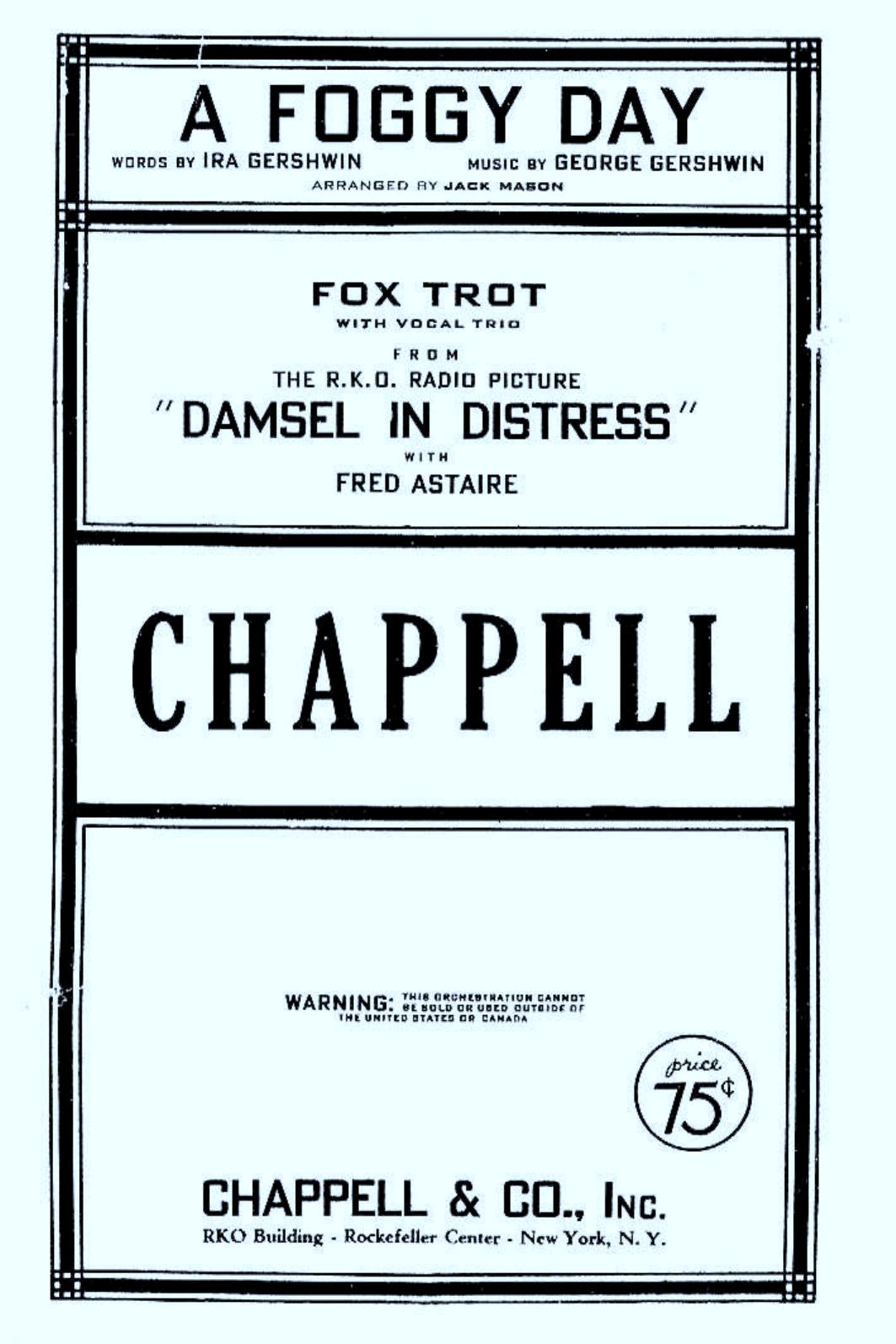
A Foggy Day (J.Mason) sheet music preview

A Foggy Day (J.Mason)

Composed by George Gershwin

Arranged by Jack Mason

  • Ensemble: Big Band
  • Pages: 35
  • Instruments (17): 1st Sax. Eb Alto (doubles Clarinet), 2nd Sax. Bb Tenor, 3rd Sax. Eb Alto (doubles Clarinet), 4th Sax. Eb Baritone, 1st Trumpet in Bb, 2nd Trumpet in Bb, 3rd Trumpet in Bb, 1st Trombone, 2nd Trombone, Piano, Guitar, Bass, Drums (includes Vibraphone), 1st Violins A-B, 1st Violin C, Cello, Vocal Trio (1st Tenor, 2nd Tenor (Lead), Baritone)
  • Difficulty: medium
  • Content: Individual Parts
  • Format: PDF Download (Instant)
  • Price: $24.99

George Gershwin and Ira Gershwin originally penned "A Foggy Day (in London Town)" for Fred Astaire to introduce in the 1937 musical film *A Damsel in Distress*. Emerging from the Golden Age of American popular song, this masterwork quickly transcended its cinematic origins to become an indispensable pillar of the Great American Songbook. Immortalized by jazz icons ranging from Louis Armstrong and Ella Fitzgerald to Dave Brubeck and George Benson, the composition's sophisticated harmonic framework and melancholic yet optimistic melodic contour have made it a quintessential vehicle for jazz interpretation across generations. Jack Mason’s sophisticated big band adaptation breathes fresh vitality into the standard, anchoring the performance in an infectious, buoyant medium-swing groove. Set in a breezy, luminous key that flatters vocalists, the arrangement balances urban sophistication with relaxed warmth. The mood evokes a misty afternoon stroll through the heart of London, shifting fluidly between intimate, narrative-driven vocal passages and explosive, brass-driven interludes. Mason avoids cliché by treating the harmonic progression with subtle modern colorations, introducing clever chromatic voice-leading in the inner reeds while maintaining the timeless accessibility of the original Gershwin melody. The formal architecture of the chart brilliantly showcases the ensemble’s textures, opening with a lush, atmospheric introduction before handing the spotlight to a featured vocal trio. Rather than treating the accompanying big band as static background wallpaper, Mason weaves intricate counterlines in the saxophone and trombone sections that converse directly with the vocalists. A standout feature of the arrangement is a dynamic, tightly wound shout chorus that builds from a simmering whisper into a roaring full-ensemble climax, driven by syncopated rhythmic figures and soaring trumpet leads. Interspersed sectional solis highlight the interplay between the woodwinds and the rhythm section, demanding crisp articulation and a unified conception of swing eighth notes. Advanced high school ensembles, collegiate jazz orchestras, and professional community big bands will find this chart an ideal centerpiece for a concert program. While the rhythm section must maintain a rock-solid, driving pulse with nuanced hi-hat work, the horn parts prioritize stylistic cohesion and blend over blistering technical virtuosity. The inclusion of parts for an 18-instrument roster—featuring a distinct vocal trio alongside expanded woodwinds including clarinet and multiple saxophones—offers rich textural variety. Performers will relish the sophisticated balance between vocal storytelling and classic big band muscle, ensuring an unforgettable experience for both the stage and the audience. Achieving success with this chart hinges on establishing an authentic, relaxed medium-swing feel right from the downbeat. The conductor should ensure the rhythm section anchors the tempo without rushing, keeping the backbeat crisp on beats two and four. Articulation is paramount: quarter notes in the brass should be comfortably detached, while eighth-note lines require a smooth, flowing jazz articulation with accents placed naturally on off-beats. The vocal trio must project a cohesive blend, balancing their phrasing closely with the underlying horn counterlines so text delivery remains clear. During the shout chorus, dynamic contrast is essential; do not allow the ensemble to overblow early. Let the natural crescendo built into Mason’s arrangement do the heavy lifting, ensuring the lead trumpet stays resonant without forcing tone quality. Section leaders should run the sax solis independently to unify intonation and phrasing before full ensemble rehearsals. Q: What instruments and parts are included in this arrangement? A: The chart is scored for an 18-instrument big band ensemble, featuring parts for a Vocal Trio, Alto Saxophone 1, Clarinet, Tenor Saxophone 2, Alto Saxophone 3, standard brass instrumentation, and a full rhythm section across 35 total pages of music. Q: What is the difficulty level of this Jack Mason arrangement? A: This arrangement is graded as medium-advanced, making it exceptionally well-suited for proficient high school bands, collegiate jazz orchestras, and professional community big bands looking for rewarding, polished repertoire. Q: What is the historical background and musical style of "A Foggy Day"? A: Originally composed by George and Ira Gershwin for Fred Astaire in 1937, this arrangement honors that Golden Age heritage while translating the tune into a vibrant, swinging jazz big band idiom. Q: What makes this specific arrangement by Jack Mason unique? A: Mason’s treatment stands out through its sophisticated writing for a vocal trio complemented by interwoven woodwind counterlines, a distinctive clarinet voice, and a dynamically escalating shout chorus that reinterprets standard harmonic voicings. Q: What is the recommended performance tempo and duration for this piece? A: The chart is set in a comfortable medium-swing tempo (typically around 116–124 BPM) and runs for approximately 3.5 to 4 minutes, providing an ideal length for festival programs or concert sets.

Questions and answers

What is included in the A Foggy Day (J.Mason) PDF?
The verified current file contains individual parts across 35 pages.
How many instruments or parts are listed for A Foggy Day (J.Mason)?
The verified instrumentation list contains 17 entries for this Big Band arrangement.
Who is credited for A Foggy Day (J.Mason)?
Composer: George Gershwin. Arranger: Jack Mason.
What difficulty is listed for A Foggy Day (J.Mason)?
The verified difficulty level is medium.
Can I preview A Foggy Day (J.Mason) before buying?
Yes. The product page provides a preview generated from the current PDF file.
How is A Foggy Day (J.Mason) delivered?
After successful payment, the digital PDF is made available for download. The displayed price is $24.99.

Musicians Also Search For

A Foggy Day Jack Mason PDFA Foggy Day Jack Mason sheet musicA Foggy Day arranged by Jack MasonJack Mason big band chartsJack Mason jazz arrangements PDFA Foggy Day George Gershwin sheet musicA Foggy Day George Gershwin big band arrangementsGeorge Gershwin big band chartsA Foggy Day big band arrangementsA Foggy Day big band PDF downloadA Foggy Day jazz sheet musicbig band sheet music downloadA Foggy Day individual parts downloadA Foggy Day sheet music PDFbuy A Foggy Day sheet musicdownload A Foggy Day PDFA Foggy Day jazz chartsbest Jack Mason big band arrangementsGeorge Gershwin arranged by Jack MasonA Foggy Day printable sheet musicbig band repertoire PDF

All arrangements by Jack Mason All George Gershwin sheet music