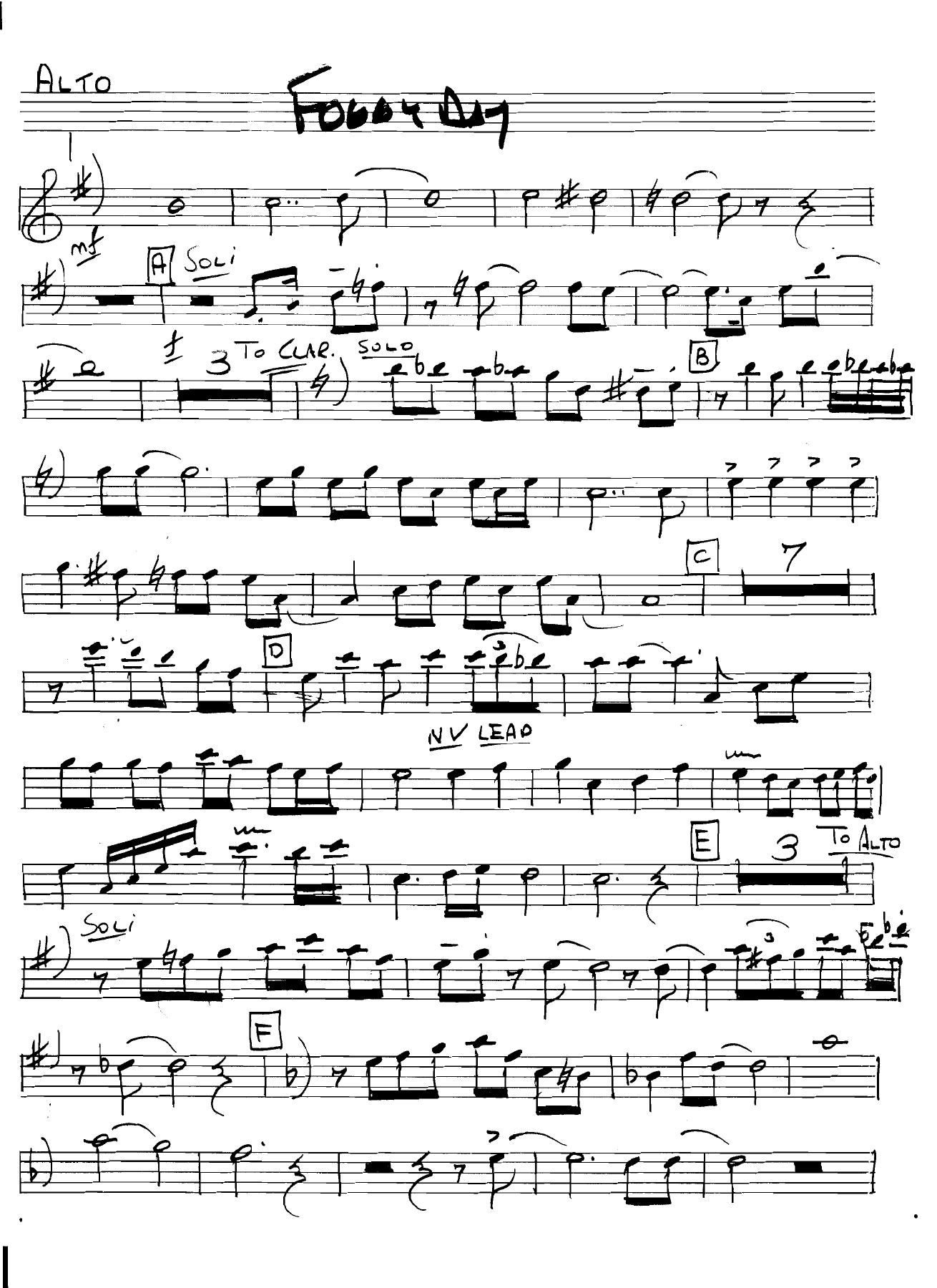
A Foggy Day (A.Shaw)
Composed by George Gershwin
Arranged by Artie Shaw
- Ensemble: Big Band
- Style: Jazz Standard
- Pages: 29
- Instruments (17): Alto Saxophone 1, Alto Saxophone 2, Tenor Saxophone 1, Tenor Saxophone 2, Baritone Saxophone, Trumpet 1, Trumpet 2, Trumpet 3, Trumpet 4, Trombone 1, Trombone 2, Trombone 3, Bass Trombone, Guitar, Piano, Bass, Drums
- Difficulty: medium
- Content: Individual Parts
- Format: PDF Download (Instant)
- Price: $24.99
George Gershwin's timeless composition, "A Foggy Day (In London Town)," first introduced in the 1937 film *A Damsel in Distress*, quickly ascended to the pantheon of jazz standards. Its elegant, melancholic melody and sophisticated harmonic progression perfectly encapsulate the romanticism and urban sophistication of the American Songbook era. Originally sung by Fred Astaire, the tune's enduring appeal lies in its evocative narrative of finding love amidst the gloom, a theme that has resonated with countless listeners and inspired generations of improvisers. The piece's AABA form, characteristic of the era, provides a clear structure for both interpretation and improvisation, making it a cornerstone of the jazz repertoire. This particular arrangement, penned by the legendary clarinetist and bandleader Artie Shaw, offers a definitive big band treatment that captures the essence of the swing era while showcasing Shaw's distinctive musical voice. Artie Shaw's take on "A Foggy Day" is a masterclass in swing-era orchestration, presenting a medium-swing feel in the key of F major that is both sophisticated and irresistibly danceable. The arrangement opens with a lush, harmonically rich introduction, immediately setting a mood of understated elegance. Shaw's signature approach to big band writing is evident in the seamless blend of instrumental sections, particularly his innovative saxophone voicings which often feature close-knit harmonies that create a warm, enveloping sound. The piece maintains a consistent 4/4 medium swing groove throughout, allowing the melody to unfold naturally without feeling rushed. The emotional arc progresses from a contemplative opening to a more energetic, yet always refined, swing feel, culminating in a satisfying resolution. Performance of this Artie Shaw arrangement demands a high level of ensemble precision and stylistic authenticity. The melody is predominantly carried by the saxophone section, often in unison or harmonized lines, with brass interjections providing rhythmic punctuation and harmonic support. There are carefully crafted soli sections for the saxophones that require tight articulation and blend, showcasing Shaw's brilliance as an arranger. While specific improvised solo sections are not explicitly marked in the traditional sense, the arrangement provides ample space within the framework for a featured soloist (typically tenor saxophone or clarinet, reflecting Shaw's own instrumentation preferences) to interpret the melody or improvise over the changes, allowing for individual expression within the ensemble context. The technical challenges lie in achieving the characteristic swing articulation, precise ensemble attacks and releases, and maintaining a consistent, buoyant groove. This arrangement is ideally suited for advanced high school, college, community, and professional big bands looking to perform authentic swing-era repertoire with historical accuracy and musical depth. Its intricate voicings and demanding ensemble passages provide an excellent educational opportunity for developing musicians to understand the nuances of swing performance practice, while offering seasoned ensembles a rewarding and polished addition to their concert programs. The clarity of Shaw's writing, combined with the timeless appeal of Gershwin's melody, ensures that this arrangement remains a captivating and engaging experience for both performers and audiences alike. Conductors should emphasize a relaxed, yet precise, medium swing feel throughout "A Foggy Day," ensuring the rhythm section lays down a solid, unhurried foundation. The tempo should hover around quarter note = 120-128 BPM to allow the rich harmonies and melodic lines to breathe. A key technical challenge lies in achieving the characteristic Artie Shaw saxophone section sound: seamless legato phrasing combined with crisp, unified articulation on accented notes. Brass players should focus on a warm, controlled tone, avoiding excessive brilliance, particularly in background figures. Rehearsal time should be dedicated to balancing the intricate saxophone soli sections, ensuring inner voices are heard without overpowering the lead. Pay close attention to dynamics, as Shaw's writing often uses subtle shifts to build tension and release. No special mutes or extended techniques are explicitly required, but a clear understanding of swing-era articulation and phrasing is paramount for an authentic performance. Q: What instruments are included in this arrangement? A: This big band arrangement is scored for 17 instruments: Alto Saxophone 1, Alto Saxophone 2, Tenor Saxophone 1, Tenor Saxophone 2, Baritone Saxophone, Trumpet 1, Trumpet 2, Trumpet 3, Trumpet 4, Trombone 1, Trombone 2, Trombone 3, Trombone 4, Piano, Bass, Drums, and Guitar. Q: What is the difficulty level of this arrangement? A: This arrangement is considered advanced, suitable for experienced high school, college, community, and professional big bands. It requires strong ensemble precision, stylistic understanding, and the ability to navigate intricate swing-era voicings. Q: What is the musical style and historical context of this arrangement? A: This is an authentic big band arrangement of the jazz standard "A Foggy Day," composed by George Gershwin in 1937. Arranged by Artie Shaw, it embodies the sophisticated medium-swing style characteristic of the late 1930s and early 1940s big band era. Q: What makes this Artie Shaw arrangement unique? A: Artie Shaw's distinctive approach is evident in the lush, close-voiced saxophone soli sections, sophisticated harmonic treatments, and the overall elegant, yet swinging, character. It showcases his signature orchestration style, which blends melodic clarity with rich ensemble textures. Q: What is the typical performance duration and tempo for this piece? A: The typical performance duration for this arrangement is approximately 3-4 minutes, depending on any improvised solos. It is performed at a consistent medium swing tempo, generally around quarter note = 120-128 BPM.
Musicians Also Search For
A Foggy Day Artie Shaw PDF • A Foggy Day Artie Shaw sheet music • A Foggy Day arranged by Artie Shaw • Artie Shaw big band charts • Artie Shaw jazz arrangements PDF • A Foggy Day George Gershwin sheet music • A Foggy Day George Gershwin big band arrangement • George Gershwin big band charts • A Foggy Day big band arrangement • A Foggy Day big band PDF download • A Foggy Day jazz ensemble sheet music • big band sheet music instant download • A Foggy Day individual parts download • A Foggy Day sheet music with parts • A Foggy Day Jazz Standard chart • Jazz Standard big band arrangements • buy A Foggy Day sheet music online • download A Foggy Day PDF • A Foggy Day jazz chart • best Artie Shaw big band arrangements • George Gershwin songs arranged by Artie Shaw • A Foggy Day printable sheet music • big band repertoire PDF