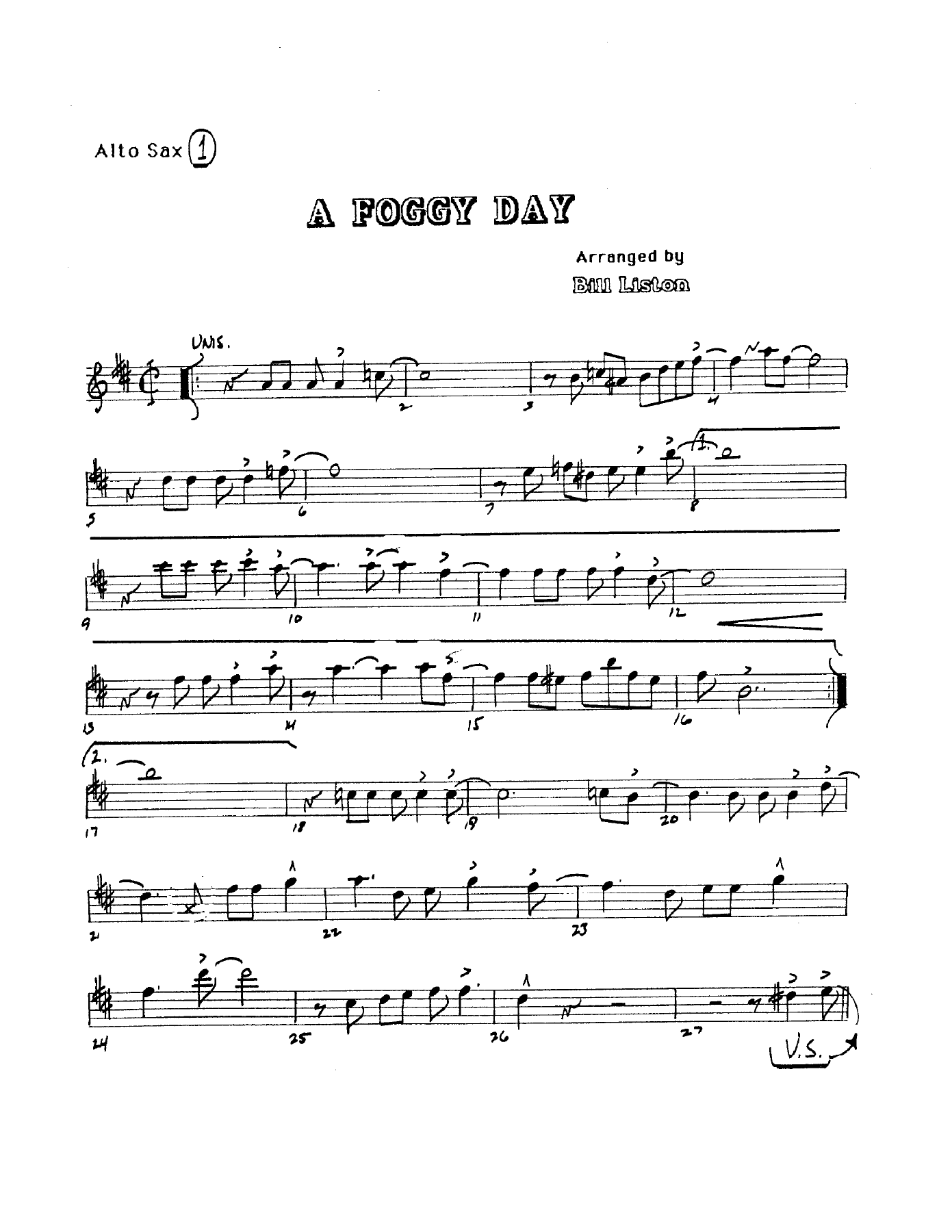
A Foggy Day (B.Liston) sheet music preview

A Foggy Day (B.Liston)

Composed by George Gershwin

Arranged by B.Liston

  • Ensemble: Big Band
  • Style: Jazz Standard
  • Pages: 53
  • Instruments (16): Alto Sax 1, Alto Sax 2, Tenor Sax 1, Tenor Sax 2, Bari Sax, Trumpet 1, Trumpet 2, Trumpet 3, Trumpet 4, Trombone 1, Trombone 2, Trombone 3, Trombone 4, Piano, Bass, Drums
  • Difficulty: advanced
  • Content: Individual Parts
  • Format: PDF Download (Instant)
  • Price: $24.99

"A Foggy Day," originally introduced by Fred Astaire in the 1937 film *A Damsel in Distress*, stands as a cornerstone of the Great American Songbook and an enduring jazz standard. Composed by George Gershwin with lyrics by his brother Ira, the piece quickly gained popularity, with Astaire's recording reaching number three on the pop charts that same year. Its timeless appeal lies in its evocative melody and sophisticated harmonic structure, which beautifully capture the romantic melancholy of a foggy London day giving way to the joy of newfound love. Over the decades, "A Foggy Day" has been embraced by countless jazz luminaries, including Ella Fitzgerald, Louis Armstrong, Frank Sinatra, and Red Garland, each contributing to its rich legacy as a versatile and beloved vehicle for improvisation and interpretation. The song's 34-bar ABAC form, a slight departure from the more common 32-bar structure, offers a unique contour that challenges and inspires musicians. This big band arrangement by B.Liston reimagines this classic with a medium swing feel, set primarily in a bright, yet nuanced, F major. B.Liston's approach is characterized by a masterful blend of traditional big band voicings and contemporary harmonic textures, creating an arrangement that is both familiar and fresh. The mood is initially reflective, mirroring the song's lyrical narrative, before building to an uplifting and energetic conclusion. Expect lush saxophone soli sections that showcase intricate counterpoint, punctuated by brass interjections that add drive and excitement. B.Liston, known for their meticulous scoring and deep understanding of ensemble dynamics, typically infuses arrangements with a sense of forward momentum and carefully crafted harmonic extensions that provide a rich sonic palette without sacrificing accessibility. The arrangement features the iconic melody passed through various sections, beginning with a lyrical statement by the alto saxophone, then transitioning to the full saxophone section, and later featuring the brass. There are ample opportunities for featured solos, typically allocated to trumpet and tenor saxophone, allowing for expressive improvisation over the Gershwin brothers' distinctive chord changes. Technical challenges include precise articulation in the fast-moving soli passages, dynamic control across the full ensemble, and maintaining a consistent, driving swing feel. The rewarding aspect of performing this arrangement lies in its dynamic contrasts, the interplay between sections, and the opportunity to convey the song's emotional arc through a powerful big band setting. Specific musical moments, such as the tightly voiced shout chorus leading into the final ensemble statement, are particularly impactful. This arrangement is ideally suited for college and community jazz ensembles, as well as semi-professional bands seeking a sophisticated yet playable chart. The comprehensive scoring for 16 instruments provides a full, rich sound, making it an excellent choice for groups looking to perform a well-known standard with a fresh and engaging interpretation. Its balance of challenging sections and rewarding ensemble moments makes it an invaluable addition to any big band's repertoire, offering both educational value and audience appeal. Conductors should emphasize a consistent, driving medium swing feel throughout, ensuring the rhythm section lays down a solid, yet flexible, foundation. The initial melody statements require careful attention to phrasing and blend, particularly within the saxophone section, to convey the song's inherent lyricism. Brass players should focus on precise articulation and dynamic shaping, especially in the punchy interjections and the powerful shout chorus. Lead trumpet range extends to a written high C, requiring a strong lead player. Rehearsal time should be dedicated to balancing the intricate soli passages, ensuring all lines are heard clearly without one section overpowering another. Encourage soloists to explore the harmonic richness of the Gershwin changes, drawing inspiration from classic interpretations while infusing their own voice. Dynamic contrasts are crucial for this piece; practice extreme softs and powerful fortes to maximize impact. Q: What instruments are included in this big band arrangement? A: This arrangement is scored for a standard 16-instrument big band lineup, including Alto Saxophone 1, Alto Saxophone 2, Tenor Saxophone 1, Tenor Saxophone 2, Baritone Saxophone, Trumpet 1, Trumpet 2, Trumpet 3, Trumpet 4, Trombone 1, Trombone 2, Trombone 3, Bass Trombone, Piano, Bass, and Drums. Q: What is the difficulty level of this arrangement? A: This arrangement is considered suitable for college, community, and semi-professional jazz ensembles. It presents moderate technical challenges, particularly in articulation and dynamic control, making it a rewarding experience for developing and experienced bands alike. Q: What is the musical style and historical context of "A Foggy Day"? A: "A Foggy Day" is a jazz standard from the Great American Songbook, composed by George Gershwin in 1937 for the film *A Damsel in Distress*. It embodies the sophisticated melodic and harmonic language of the pre-bebop jazz era, making it a timeless piece for big band performance. Q: What makes B.Liston's arrangement of "A Foggy Day" unique? A: B.Liston's arrangement distinguishes itself through a medium swing feel, sophisticated voicings, and dynamic contrasts that build from a lyrical opening to a powerful shout chorus. It offers fresh harmonic textures while remaining true to the original's classic jazz standard character. Q: What is the approximate performance duration and tempo for this piece? A: The arrangement is designed for a medium swing tempo, typically around 140-160 beats per minute. The approximate performance duration, including solos, is between 4 and 5 minutes, depending on the length of improvised sections.

Questions and answers

What is included in the A Foggy Day (B.Liston) PDF?
The verified current file contains individual parts across 53 pages.
How many instruments or parts are listed for A Foggy Day (B.Liston)?
The verified instrumentation list contains 16 entries for this Big Band arrangement.
Who is credited for A Foggy Day (B.Liston)?
Composer: George Gershwin. Arranger: B.Liston.
What difficulty is listed for A Foggy Day (B.Liston)?
The verified difficulty level is advanced.
What style is listed for A Foggy Day (B.Liston)?
The catalog lists the style as Jazz Standard.
Can I preview A Foggy Day (B.Liston) before buying?
Yes. The product page provides a preview generated from the current PDF file.
How is A Foggy Day (B.Liston) delivered?
After successful payment, the digital PDF is made available for download. The displayed price is $24.99.

Musicians Also Search For

A Foggy Day B.Liston PDFA Foggy Day B.Liston sheet musicA Foggy Day arranged by B.ListonB.Liston big band chartsB.Liston jazz arrangements PDFA Foggy Day George Gershwin sheet musicA Foggy Day George Gershwin big band arrangementsGeorge Gershwin big band chartsA Foggy Day big band arrangementsA Foggy Day big band PDF downloadA Foggy Day jazz sheet musicbig band sheet music downloadA Foggy Day individual parts downloadA Foggy Day sheet music PDFA Foggy Day Jazz Standard chartsJazz Standard big band arrangementsbuy A Foggy Day sheet musicdownload A Foggy Day PDFA Foggy Day jazz chartsbest B.Liston big band arrangementsGeorge Gershwin arranged by B.ListonA Foggy Day printable sheet musicbig band repertoire PDF

All arrangements by B.Liston All George Gershwin sheet music