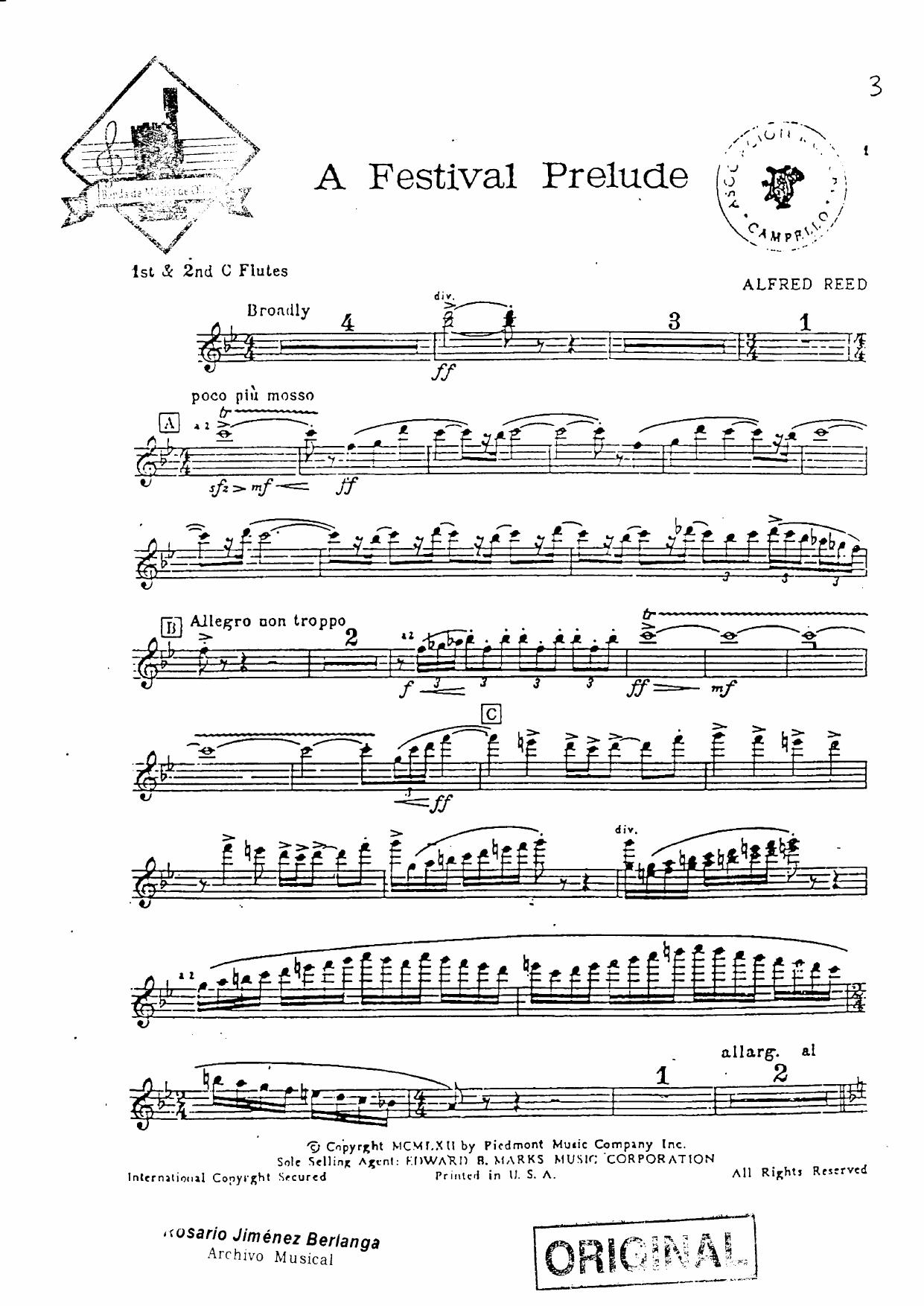
A festival Prelude - A. Reed (M.X) sheet music preview

A festival Prelude - A. Reed (M.X)

Composed by Alfred Reed

Arranged by James Curnow

  • Ensemble: Concert Band
  • Style: Jazz Standard
  • Pages: 58
  • Instruments (25): 1st & 2nd C Flutes, 1st & 2nd Oboes, 1st & 2nd Bassoons, Eb Clarinet, 1st Bb Clarinet, 2nd Bb Clarinet, 3rd Bb Clarinet, 1st Eb Alto Saxophone, 2nd Eb Alto Saxophone, Bb Tenor Saxophone, Eb Baritone Saxophone, 1st & 2nd Bb Cornets, 1st Bb Trumpet, 2nd Bb Trumpet, 3rd Bb Trumpet, 1st & 2nd Horns in F, 3rd & 4th Horns in F, 1st Trombone, 2nd Trombone, 3rd Trombone, Baritone (Bass Clef), Basses (Tubas), Drums (Snare Drum, Bass Drum), Percussion (Pair of Cymbals, Triangle), Timpani
  • Difficulty: advanced
  • Content: Individual Parts
  • Format: PDF Download (Instant)
  • Price: $22.99

Alfred Reed's "A Festival Prelude," originally composed in 1956, stands as a cornerstone of the modern concert band repertoire, renowned for its brilliant and powerful orchestration. This work emerged from the mid-20th century, a period marked by significant growth and innovation in wind band literature, and was dedicated to the Phillips University Band, which premiered the piece under Reed's baton at the 25th anniversary of the Tri-State Music Festival. While not a jazz standard in its original form, Reed's masterful command of wind orchestration and his ability to craft memorable, sweeping themes have made "A Festival Prelude" a piece frequently revisited and reinterpreted, showcasing its inherent musicality and adaptability. Its enduring popularity and status as a classic in the concert band world stem from its intricate structure and the emotional depth Reed imbued within its festive framework. Mr. X's jazz arrangement of "A Festival Prelude" reimagines this iconic work with a medium swing feel, transforming its ceremonial grandeur into a vibrant, sophisticated jazz standard. The arrangement maintains the original's core thematic material, built from a main theme and two fanfare-like figures, but reharmonizes them with extended jazz harmonies, including 9ths, 11ths, and 13ths, and incorporates bebop scales and modal shifts. The musical character shifts from the original's bright and brilliant mood to a spirited yet nuanced jazz interpretation, evoking a sense of celebratory swing. Mr. X's distinctive approach is evident in the strategic use of rich brass voicings, intricate woodwind soli sections that weave Reed's melodic lines through a new harmonic landscape, and dynamic shout choruses that build to exhilarating climaxes. Modulations are handled with a keen jazz sensibility, creating fresh harmonic interest while respecting the original's structural integrity. This arrangement offers a rewarding challenge for college and advanced community concert bands, as well as professional ensembles seeking to explore the intersection of classical and jazz idioms. While the original work already demands technical proficiency, Mr. X's treatment introduces new layers of rhythmic complexity and improvisational flavor. Featured solos are integrated seamlessly, providing opportunities for individual expression within the ensemble's framework, particularly for trumpet, alto saxophone, and trombone. The main theme, initially presented in sweeping unison by woodwinds and brass, is now re-envisioned with a swinging articulation, while the fanfare figures retain their crisp precision but gain a new rhythmic drive. The arrangement culminates in a powerful, thundering conclusion, echoing Reed's original intent but infused with the unmistakable energy of a jazz big band. Conductors approaching this arrangement should emphasize a consistent medium swing feel throughout, ensuring rhythmic precision in the brass fanfares while allowing for expressive melodic phrasing in the woodwind soli sections. Key technical challenges include navigating the extended jazz harmonies, particularly in the brass voicings, which require careful balance and intonation. Rehearsal should focus on precise articulation, especially in the triplet fanfares, which must be crisp and marcato without becoming sluggish. Soloists should be encouraged to improvise over the provided chord changes, drawing inspiration from the original melodic contours. Special attention should be given to dynamic contrasts, moving from the quiet, legato variations of the main theme to the powerful, full-ensemble climaxes. The arrangement calls for standard concert band instrumentation, with particular emphasis on a strong, balanced clarinet choir and distinct brass sections to achieve the intended tone colors. **Q: What instruments and parts are included in this arrangement?** A: This arrangement includes a complete set of parts for a standard concert band instrumentation, encompassing full woodwind sections (including clarinets, saxophones, flutes, oboes, bassoons), comprehensive brass sections (trumpets, cornets, horns, trombones, baritones, tubas), percussion, and string bass. It also includes a 58-page conductor score. **Q: What is the difficulty level of this jazz arrangement?** A: This arrangement is suitable for college, advanced community, and professional concert bands. It is considered a Grade 4-5 level, demanding strong technical proficiency, advanced rhythmic understanding, and familiarity with jazz stylistic elements. **Q: What is the musical style and historical context of this piece?** A: This is a jazz standard arrangement of Alfred Reed's "A Festival Prelude," originally composed in 1956 for concert band. While Reed's original is a classical wind band masterpiece, this arrangement reinterprets it with a medium swing jazz feel, incorporating modern jazz harmonies and improvisation. **Q: What makes Mr. X's arrangement unique compared to the original?** A: Mr. X's arrangement transforms the original's classical fanfare and thematic development into a vibrant jazz piece through reharmonization with extended chords, the integration of swing rhythms, and the inclusion of improvised solo sections. It features distinct jazz voicings, soli passages, and dynamic shout choruses, offering a fresh perspective on a beloved work. **Q: What is the approximate performance duration and tempo of this arrangement?** A: The approximate performance duration for this arrangement is around 4:30 to 5:00 minutes, consistent with the original's concise structure. The tempo is a medium swing, allowing for both rhythmic drive and expressive melodic interpretation.

Questions and answers

What is included in the A festival Prelude - A. Reed (M.X) PDF?
The verified current file contains individual parts across 58 pages.
How many instruments or parts are listed for A festival Prelude - A. Reed (M.X)?
The verified instrumentation list contains 25 entries for this Concert Band arrangement.
Who is credited for A festival Prelude - A. Reed (M.X)?
Composer: Alfred Reed. Arranger: James Curnow.
What difficulty is listed for A festival Prelude - A. Reed (M.X)?
The verified difficulty level is advanced.
What style is listed for A festival Prelude - A. Reed (M.X)?
The catalog lists the style as Jazz Standard.
Can I preview A festival Prelude - A. Reed (M.X) before buying?
Yes. The product page provides a preview generated from the current PDF file.
How is A festival Prelude - A. Reed (M.X) delivered?
After successful payment, the digital PDF is made available for download. The displayed price is $22.99.

Musicians Also Search For

A festival Prelude - A. Reed James Curnow PDFA festival Prelude - A. Reed James Curnow sheet musicA festival Prelude - A. Reed arranged by James CurnowJames Curnow concert band chartsJames Curnow jazz arrangements PDFA festival Prelude - A. Reed Alfred Reed sheet musicA festival Prelude - A. Reed Alfred Reed concert band arrangementsAlfred Reed concert band chartsA festival Prelude - A. Reed concert band arrangementsA festival Prelude - A. Reed concert band PDF downloadA festival Prelude - A. Reed jazz sheet musicconcert band sheet music downloadA festival Prelude - A. Reed individual parts downloadA festival Prelude - A. Reed sheet music PDFA festival Prelude - A. Reed Jazz Standard chartsJazz Standard concert band arrangementsbuy A festival Prelude - A. Reed sheet musicdownload A festival Prelude - A. Reed PDFA festival Prelude - A. Reed jazz chartsbest James Curnow concert band arrangementsAlfred Reed arranged by James CurnowA festival Prelude - A. Reed printable sheet musicconcert band repertoire PDF

All arrangements by James Curnow All Alfred Reed sheet music