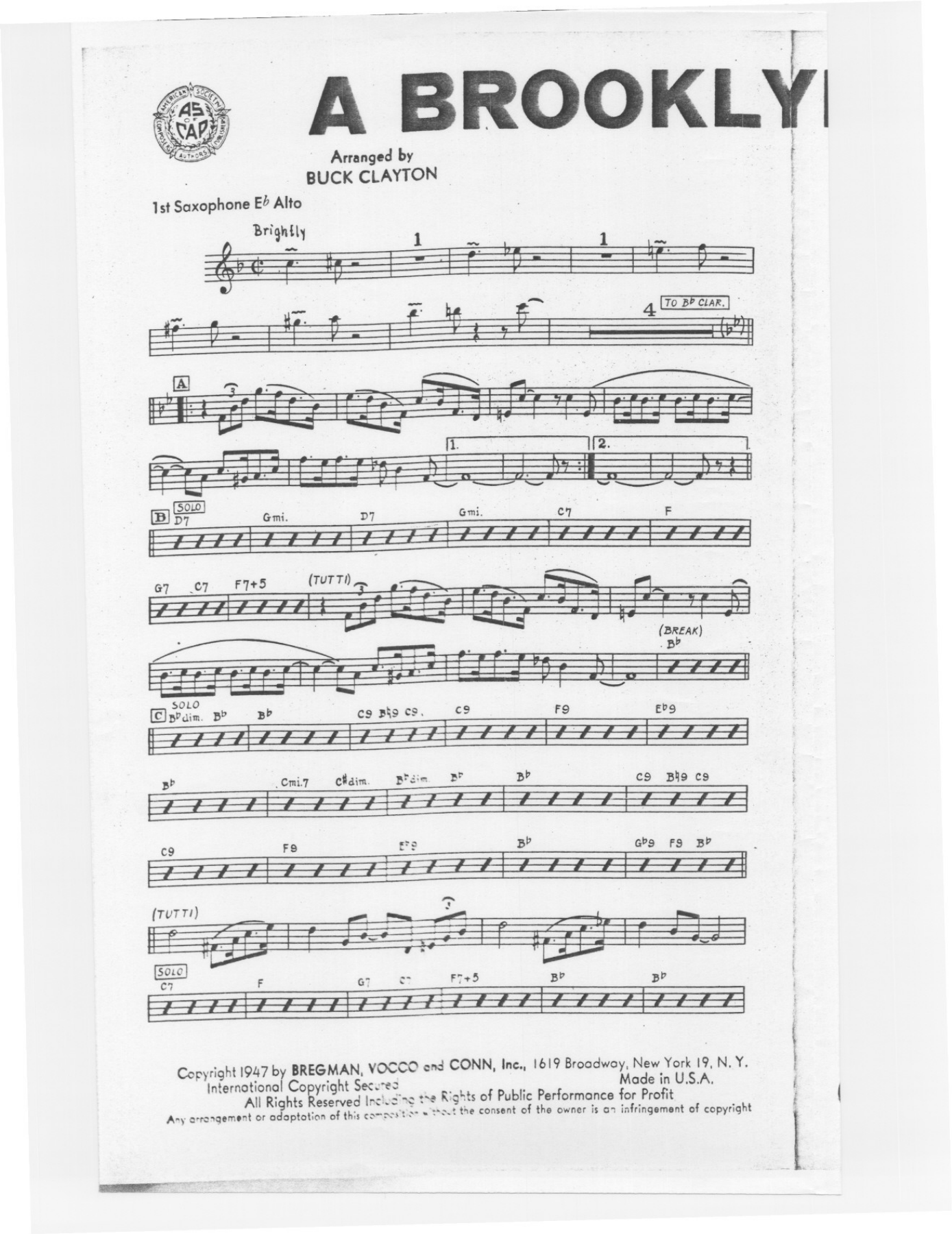
A Brooklyn Breeze (B.Clayton)
Composed by Buck Clayton
Arranged by Benny Goodman
- Ensemble: Big Band
- Style: Jazz Standard
- Pages: 38
- Instruments (16): 1st Saxophone Eb Alto, 2nd Saxophone Bb Tenor, 3rd Saxophone Eb Alto, 4th Saxophone Bb Tenor, 5th Saxophone Eb Baritone, 1st Trumpet in Bb, 2nd Trumpet in Bb, 3rd Trumpet in Bb, 1st Trombone, 2nd Trombone, 3rd Trombone, Piano, Bass, Drums, Guitar, 1st Violins Conductor
- Difficulty: medium
- Content: conductor score and individual parts
- Format: PDF Download (Instant)
- Price: $24.99
Buck Clayton's "A Brooklyn Breeze" emerges from the vibrant post-swing, pre-bebop era, a period when big bands were still the dominant force in jazz but evolving with new harmonic and rhythmic sophistication. Composed by the legendary Count Basie Orchestra trumpeter and arranger, the original piece captures the essence of a relaxed, yet rhythmically engaging jazz standard, often characterized by its elegant melodic lines and understated swing. While not as universally recognized as some other standards, "A Brooklyn Breeze" stands out for its sophisticated harmonic progression and its capacity to evoke a sense of cool urbanity, making it a favorite among discerning musicians and listeners who appreciate its subtle charm and melodic integrity. It represents a bridge between the classic Basie sound and the more modern inclinations that would soon define the genre. This particular arrangement, crafted by the iconic "King of Swing" Benny Goodman, reinterprets Clayton's composition through the lens of Goodman's distinctive big band sound. Goodman's approach here is a masterclass in elegant, medium-swing orchestration, maintaining the original's laid-back feel while infusing it with his ensemble's characteristic precision and drive. The arrangement is set in a comfortable medium swing tempo, likely around 120-130 BPM, and is typically presented in a bright, accessible key such as F or Bb major, allowing for rich brass and reed voicings. The mood is one of sophisticated relaxation, evoking a pleasant, unhurried stroll through a familiar cityscape, with moments of gentle introspection balanced by collective exhilaration. Goodman's signature arranging techniques are evident throughout this 17-instrument chart. Expect meticulously crafted sectional voicings, particularly within the saxophone soli passages, which are often characterized by close harmony and smooth, interlocking lines that showcase the section's blend. The brass sections, while powerful, are used with restraint and precision, often providing crisp rhythmic punctuation or soaring melodic counterpoints rather than overwhelming the ensemble. The melody is initially carried by the lead alto saxophone, often doubled or harmonized by the other reeds, before transitioning to full ensemble statements. There are typically featured solo opportunities, most often for tenor saxophone or trumpet, allowing for improvisational expression over the standard's engaging chord changes. The arrangement builds to a satisfying shout chorus, where the full band unites in a powerful, yet controlled, statement before a return to a more subdued, swinging outro. Performing "A Brooklyn Breeze" under Goodman's arrangement is a rewarding experience for college-level and advanced community big bands. The technical challenges lie not in extreme ranges or blistering tempos, but in achieving the precise articulation, impeccable blend, and nuanced dynamic control that define Goodman's sound. The ensemble must master the art of collective swing, ensuring that the rhythm section provides a solid, unwavering foundation while the horns execute their intricate lines with clarity and unified intent. The balance between individual solo expression and cohesive ensemble playing is paramount, making this a valuable piece for developing musical maturity and stylistic authenticity within a big band setting. Conductors should emphasize a consistent, relaxed medium swing feel from the outset, ensuring the rhythm section lays down a solid, unhurried groove with a clear, walking bass line and a ride cymbal pattern that propels without rushing. Articulation is key: brass attacks should be precise and unified, while saxophone lines require a smooth, legato approach, particularly in the soli sections. Pay close attention to dynamic contrasts, moving from subtle piano sections to robust forte shout choruses with control, avoiding harshness. There are no specific mute requirements beyond standard cup and straight mutes for brass, which should be applied and removed cleanly. Rehearsal time should be dedicated to balancing the intricate saxophone voicings and ensuring precise cut-offs and releases, especially at the end of phrases. Encourage soloists to embrace the melodic and harmonic sophistication of the piece, favoring tasteful improvisation over technical flash. **Q: What instruments are included in this arrangement of "A Brooklyn Breeze (B.Clayton)"?** A: This big band arrangement includes parts for 17 instruments: Alto Saxophone 1, Alto Saxophone 2, Tenor Saxophone 1, Tenor Saxophone 2, Baritone Saxophone, Trumpet 1, Trumpet 2, Trumpet 3, Trumpet 4, Trombone 1, Trombone 2, Trombone 3, Trombone 4, Piano, Bass, Drums, and Guitar. **Q: What is the difficulty level of this arrangement?** A: This arrangement is suitable for college-level or advanced community big bands. It requires strong ensemble blend, precise articulation, and nuanced dynamic control, making it challenging but highly rewarding for proficient musicians. **Q: What musical style and historical context does "A Brooklyn Breeze" represent?** A: "A Brooklyn Breeze" is a jazz standard composed by Buck Clayton, originating from the post-swing era. This Benny Goodman arrangement presents it as a sophisticated, medium-swing big band piece, reflecting the elegant and polished sound characteristic of Goodman's ensembles. **Q: What makes Benny Goodman's arrangement of "A Brooklyn Breeze" unique?** A: Goodman's arrangement is distinguished by its meticulous sectional voicings, particularly in the saxophone soli, and its balanced use of brass for rhythmic punctuation and melodic counterpoint. It maintains the original's relaxed feel while infusing it with Goodman's signature precision and drive. **Q: What is the typical performance duration and tempo for this piece?** A: The performance duration typically ranges from 4 to 6 minutes, depending on the length of improvised solos. The arrangement is designed for a comfortable medium swing tempo, generally around 120-130 beats per minute.
Questions and answers
- What is included in the A Brooklyn Breeze (B.Clayton) PDF?
- The verified current file contains a conductor score and individual parts across 38 pages.
- How many instruments or parts are listed for A Brooklyn Breeze (B.Clayton)?
- The verified instrumentation list contains 16 entries for this Big Band arrangement.
- Who is credited for A Brooklyn Breeze (B.Clayton)?
- Composer: Buck Clayton. Arranger: Benny Goodman.
- What difficulty is listed for A Brooklyn Breeze (B.Clayton)?
- The verified difficulty level is medium.
- What style is listed for A Brooklyn Breeze (B.Clayton)?
- The catalog lists the style as Jazz Standard.
- Can I preview A Brooklyn Breeze (B.Clayton) before buying?
- Yes. The product page provides a preview generated from the current PDF file.
- How is A Brooklyn Breeze (B.Clayton) delivered?
- After successful payment, the digital PDF is made available for download. The displayed price is $24.99.
Musicians Also Search For
A Brooklyn Breeze Benny Goodman PDF • A Brooklyn Breeze Benny Goodman sheet music • A Brooklyn Breeze arranged by Benny Goodman • Benny Goodman big band charts • Benny Goodman jazz arrangements PDF • A Brooklyn Breeze Buck Clayton sheet music • A Brooklyn Breeze Buck Clayton big band arrangements • Buck Clayton big band charts • A Brooklyn Breeze big band arrangements • A Brooklyn Breeze big band PDF download • A Brooklyn Breeze jazz sheet music • big band sheet music download • A Brooklyn Breeze conductor score PDF • A Brooklyn Breeze individual parts download • A Brooklyn Breeze sheet music PDF • A Brooklyn Breeze Jazz Standard charts • Jazz Standard big band arrangements • buy A Brooklyn Breeze sheet music • download A Brooklyn Breeze PDF • A Brooklyn Breeze jazz charts • best Benny Goodman big band arrangements • Buck Clayton arranged by Benny Goodman • A Brooklyn Breeze printable sheet music • big band repertoire PDF